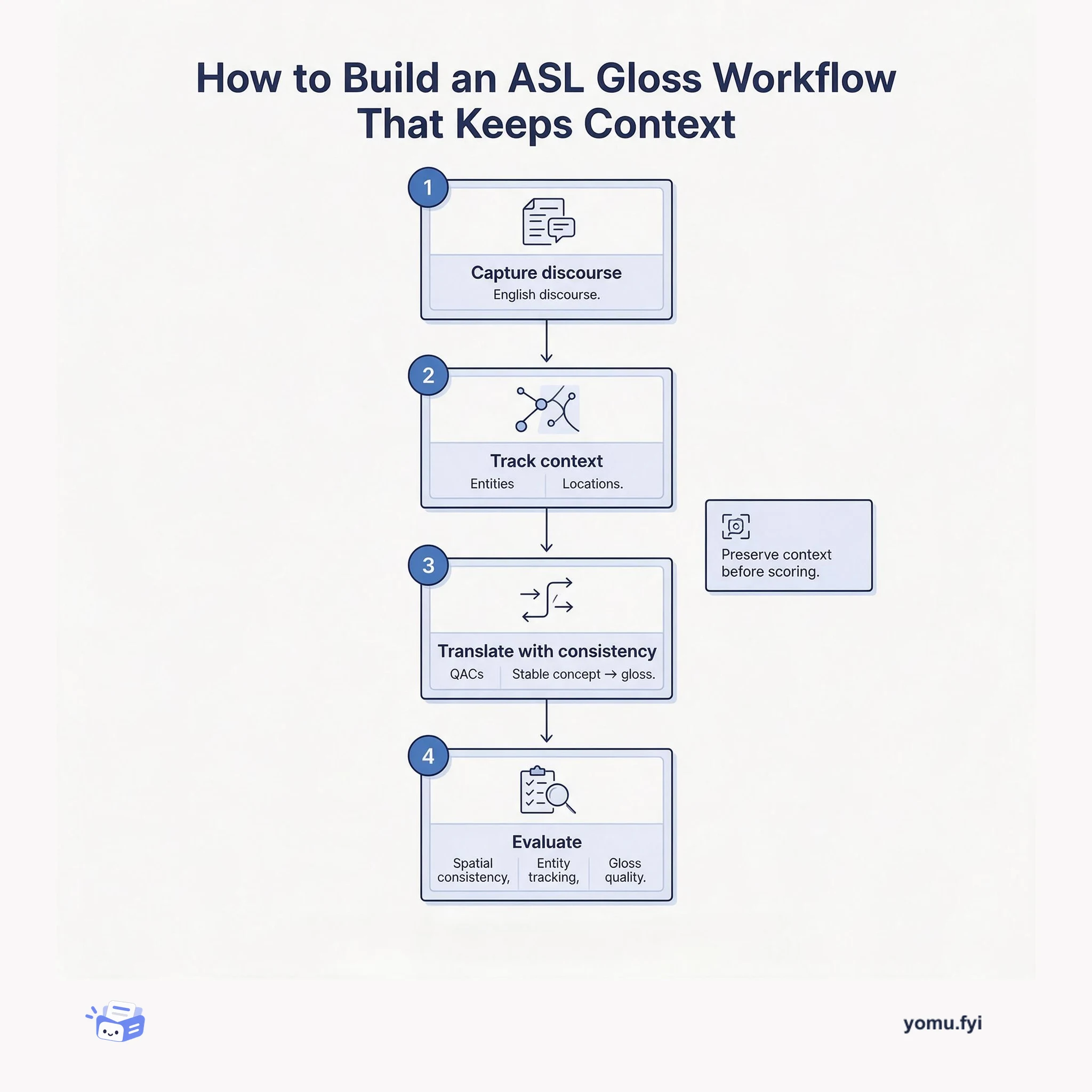
How to Build an ASL Gloss Workflow That Keeps Context
Learn a practical workflow for translating English discourse into ASL gloss while preserving spatial references, question-answer structure, and consistent concept-to-gloss mappings.
Loading…
Topic
1 post about ASL. Every summary links to the original.
See the idea
Learn a practical workflow for translating English discourse into ASL gloss while preserving spatial references, question-answer structure, and consistent concept-to-gloss mappings.
The Good Stuff
Paid picks we use ourselves. Links carry a referral code — a subscription through one earns us a commission at no extra cost to you.
Newest first
DiscoSign addresses a limitation in sign language processing: systems have traditionally translated at the sentence level, overlooking discourse phenomena important to sign language comprehension. It presents a modular Large Language Model (LLM)-based framework for text-to-sign language gloss translation that handles spatial coreference resolution, Question-Answer Clauses (QACs), and concept-gloss consistency, preserving entity locations and stable English-to-ASL sign mappings across discourse. Because traditional translation metrics do not measure discourse-level quality, the authors introduce metrics for each coherence dimension targeted by the framework. Experiments on sentence-level and discourse-level datasets report improved spatial consistency and entity tracking over sentence-only translation, while maintaining competitive single-sentence gloss quality; the work describes this as the first systematic framework with a corresponding evaluation methodology.
The best engineering reads, once a week.

