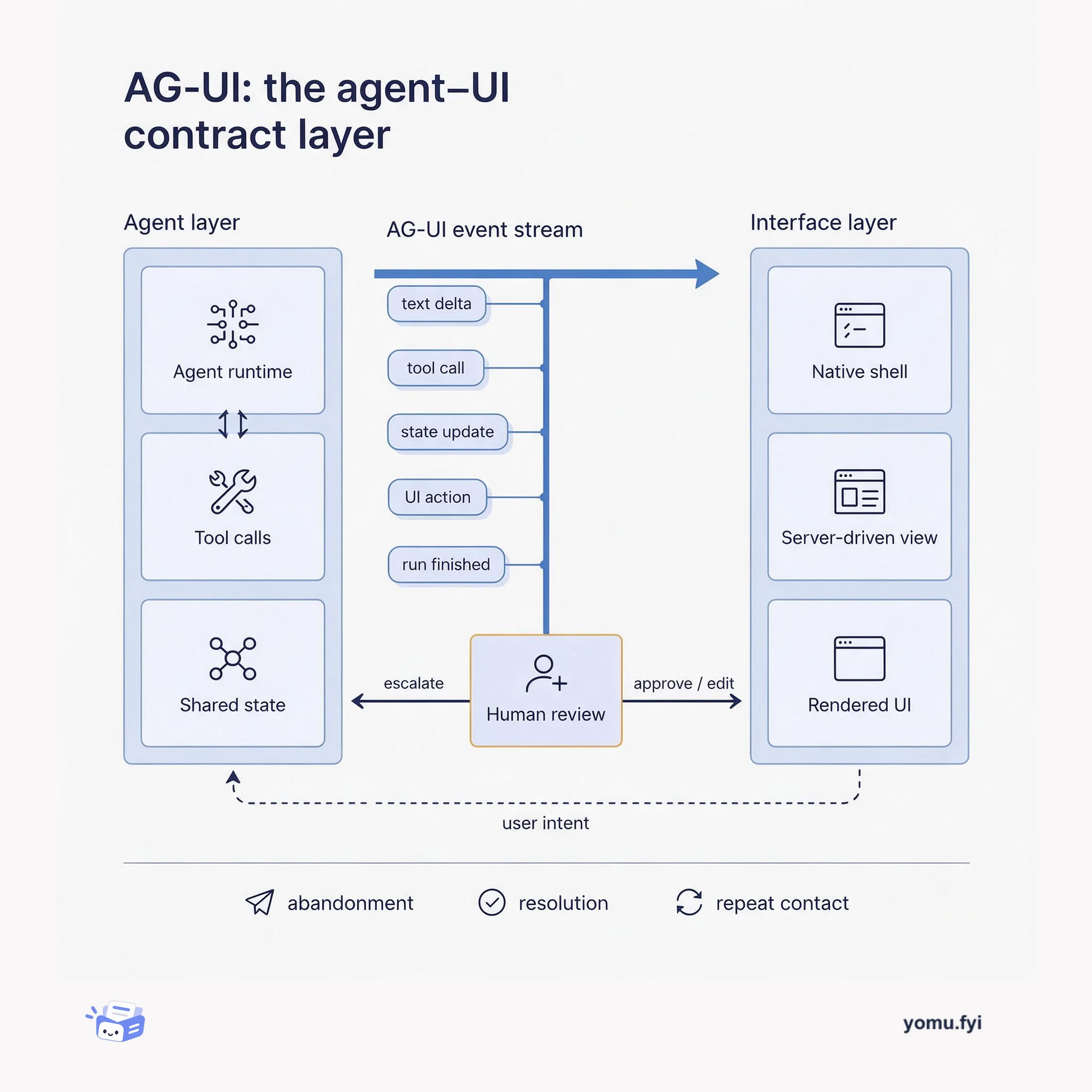
AG-UI as the Agent–UI Contract Layer
AG-UI is a typed event contract between an agent backend and a frontend, turning streamed agent state into UI. This diagram maps the layers and shows where human review plugs in.
 SalesforceScott NybergProblem & solution
Salesforce Marketing Cloud’s AI Delivery Lead Sohini Arya and team built Agent Designer, a system that automates the creation and testing of multi-agent AI teams. The orchestrator cannot write agent files itself; instead, seven specialist agents analyze architecture, failure modes, and compliance before the orchestrator synthesizes findings for human review. The system transforms an engineer’s request into a tested multi-agent team in 15-30 minutes, down from 2-4 hours manually, and helped approximately 200 engineers adopt the manager-of-agents model. Governance challenges included enforcing write-scope boundaries via prompts, reconciling independently produced design conflicts, and applying topology-specific budget formulas that account for flat, swarm, or team structures. Verifier agents return structured PASS/WARN/FAIL blocks, and self-healing is limited to two fix attempts and a $3 ceiling to prevent runaway repairs, with the orchestrator’s 500-turn budget divided across analysis, approval, generation, testing, and retries.
Salesforce Marketing Cloud’s AI Delivery Lead describes how her team built Agent Designer to automate multi-agent AI team design and testing, addressing governance, verification, and self-healing challenges.
Agent Designer uses an orchestrator and seven specialist agents to analyze architecture, failure modes, and compliance; synthesizes findings for human approval; then generates and tests agent files with bounded self-healing. It enforces write-scope via prompts, uses structured verifier output, and applies topology-specific budget formulas.
Agent Designer reduces multi-agent team creation from 2-4 hours to 15-30 minutes by automating file generation, testing, and repair, with the orchestrator prohibited from writing agent files itself.
Governance is enforced through write-scope boundaries in prompts, topology-specific budget formulas (flat, swarm, team), and structured PASS/WARN/FAIL verifier output to prevent false approvals.
Self-healing is limited to two fix attempts and a $3 spending ceiling, with the test doctor classifying failures into categories like violations, tool errors, and soft failures to avoid misdiagnosis.
Since the agent specification lacked a native write-scope field, the team enforced each member's write boundaries within its prompt, creating deterministic boundaries that prevent agents from modifying overlapping artifacts or assuming unassigned authority.
Agent Designer stores budgets, turn limits, and cost ceilings in one config file and applies topology-specific formulas: flat check for single agent, items × cost × steps for swarm, whole-roster ceilings for team. The orchestrator's 500-turn budget is divided across phases.
Verifiers return structured PASS/WARN/FAIL blocks instead of free-form text, with rules like 'warn rather than fail when uncertain'. The orchestrator performs a meta-check across verifier outputs to determine agreement and correctness.
Summaries are generated from the original by a language model. Check the original before relying on it.
See the idea
AG-UI is a typed event contract between an agent backend and a frontend, turning streamed agent state into UI. This diagram maps the layers and shows where human review plugs in.
Keep reading
The Good Stuff
Paid picks we use ourselves. Links carry a referral code — a subscription through one earns us a commission at no extra cost to you.
One useful email. Unsubscribe anytime.
