Celery Beat: Where Should the Schedule Live?
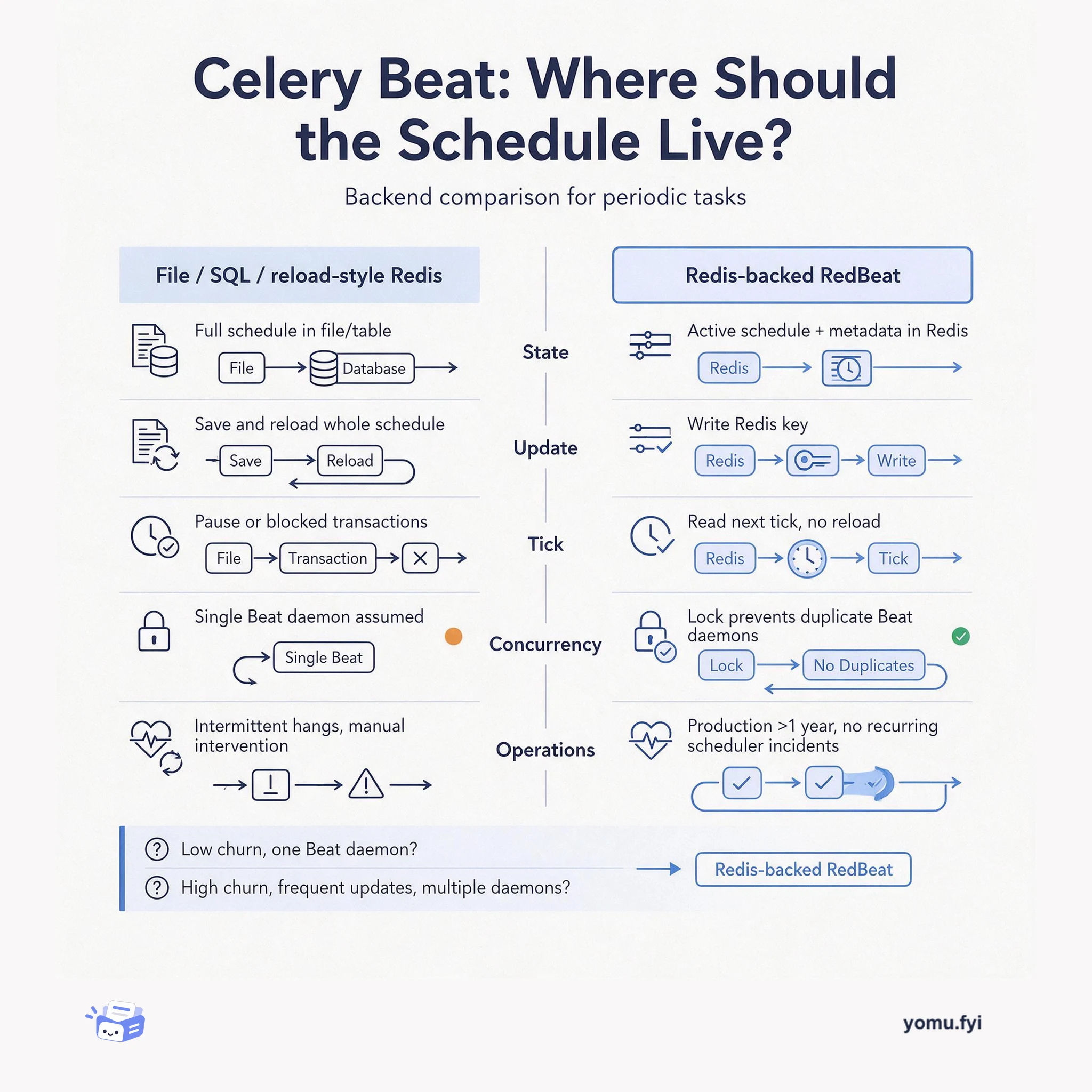
Compare Celery Beat scheduler backends—file, SQL, and Redis/RedBeat—by where the active schedule lives, how updates propagate, and what failure modes each introduces.
 ClickhouseAnnouncement
ClickHouse Managed Postgres launched storage alerts in August, warning at 85% disk usage, and those alerts have already helped customers identify issues like unused replication slots. The service now adds five targeted notifications: inactive replication slots, planned switchovers, unplanned failovers, long-running transactions, and connection-usage warnings. The replication-slot notification triggers when a logical slot retains over 10 GiB of unconfirmed WAL data for two hours, excluding managed CDC slots, and includes slot names. Planned-switchover and unplanned-failover notifications each specify the affected service and completion time, distinguishing scaling events from failure recovery. Long-running transactions open for at least two hours and connection usage at 95% of the limit trigger warnings with transaction age, helping operators check idle sessions, locks, or pool settings before impact, with delivery via console, email, or Slack.
ClickHouse Managed Postgres launched storage alerts in August 2026, warning at 85% disk usage.
Five new notifications address inactive replication slots (over 10 GiB WAL for 2 hours), planned switchovers, unplanned failovers, long-running transactions (2+ hours), and connection usage at 95%.
Planned-switchover and unplanned-failover notifications help operators distinguish scaling events from unplanned outages by identifying the service and promotion time.
Long-running transaction warnings include the transaction age, helping operators detect locks and table bloat before performance degrades.
A logical replication slot that accumulates over 10 GiB of unconfirmed write-ahead log (WAL) data for at least two hours triggers the notification. The alert excludes slots used by the managed CDC service and includes the slot name for investigation.
A planned switchover is part of scaling or storage upscaling, while an unplanned failover occurs when the primary becomes unavailable unexpectedly. Both notifications include the affected service and the time of promotion, so operators can interpret the interruption correctly.
The warning activates at 95% of the connection limit. Start by checking which applications hold connections and whether those sessions are active or idle, then review pool settings and look for connections that the application has not closed or returned to the pool.
Summaries are generated from the original by a language model. Check the original before relying on it.
See the idea
Compare Celery Beat scheduler backends—file, SQL, and Redis/RedBeat—by where the active schedule lives, how updates propagate, and what failure modes each introduces.
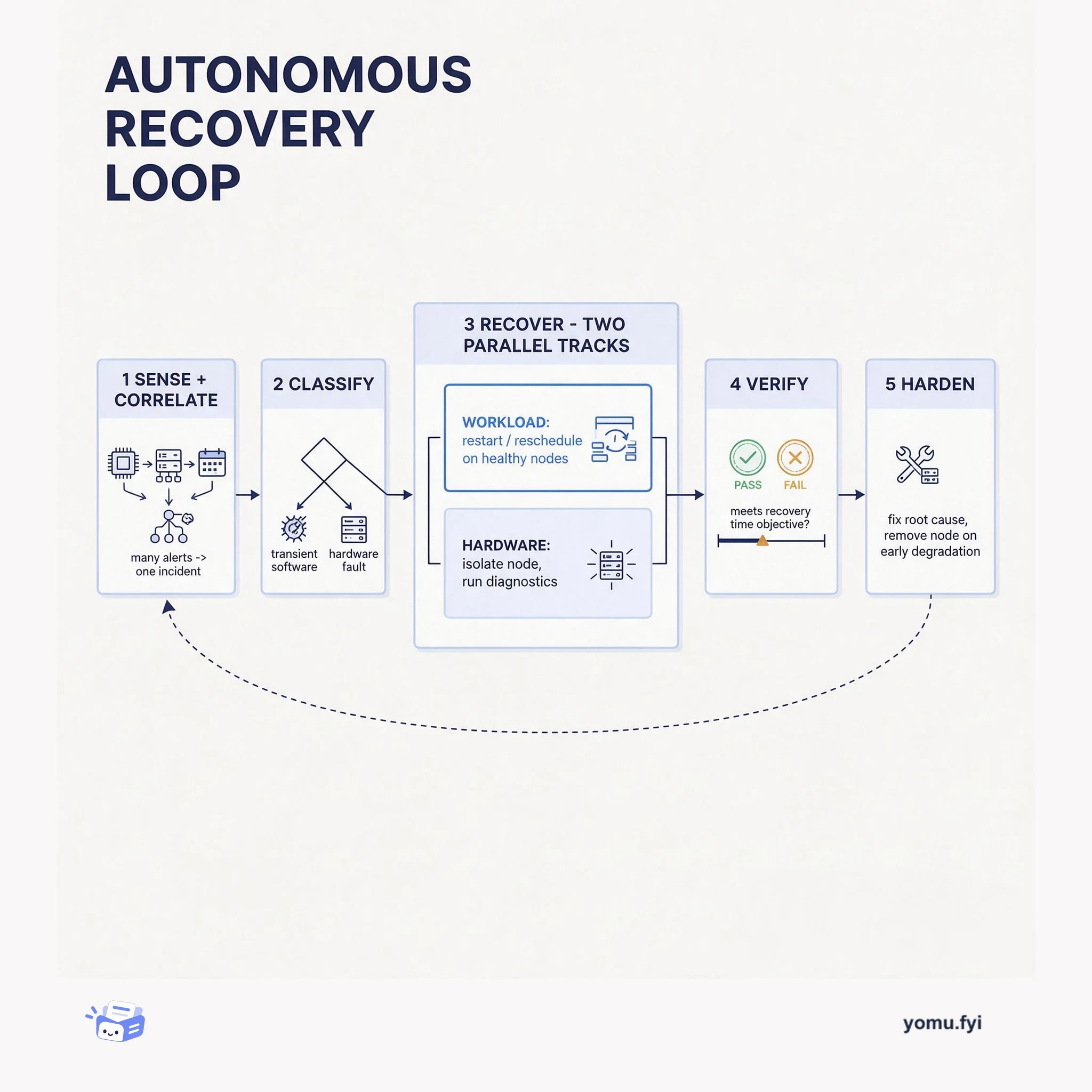
Autonomous Recovery is a closed loop that senses degradation, classifies a fault as transient or hardware, recovers workloads and quarantines hardware in parallel, then verifies against an RTO.
Keep reading
The Good Stuff
Paid picks we use ourselves. Links carry a referral code — a subscription through one earns us a commission at no extra cost to you.
One useful email. Unsubscribe anytime.