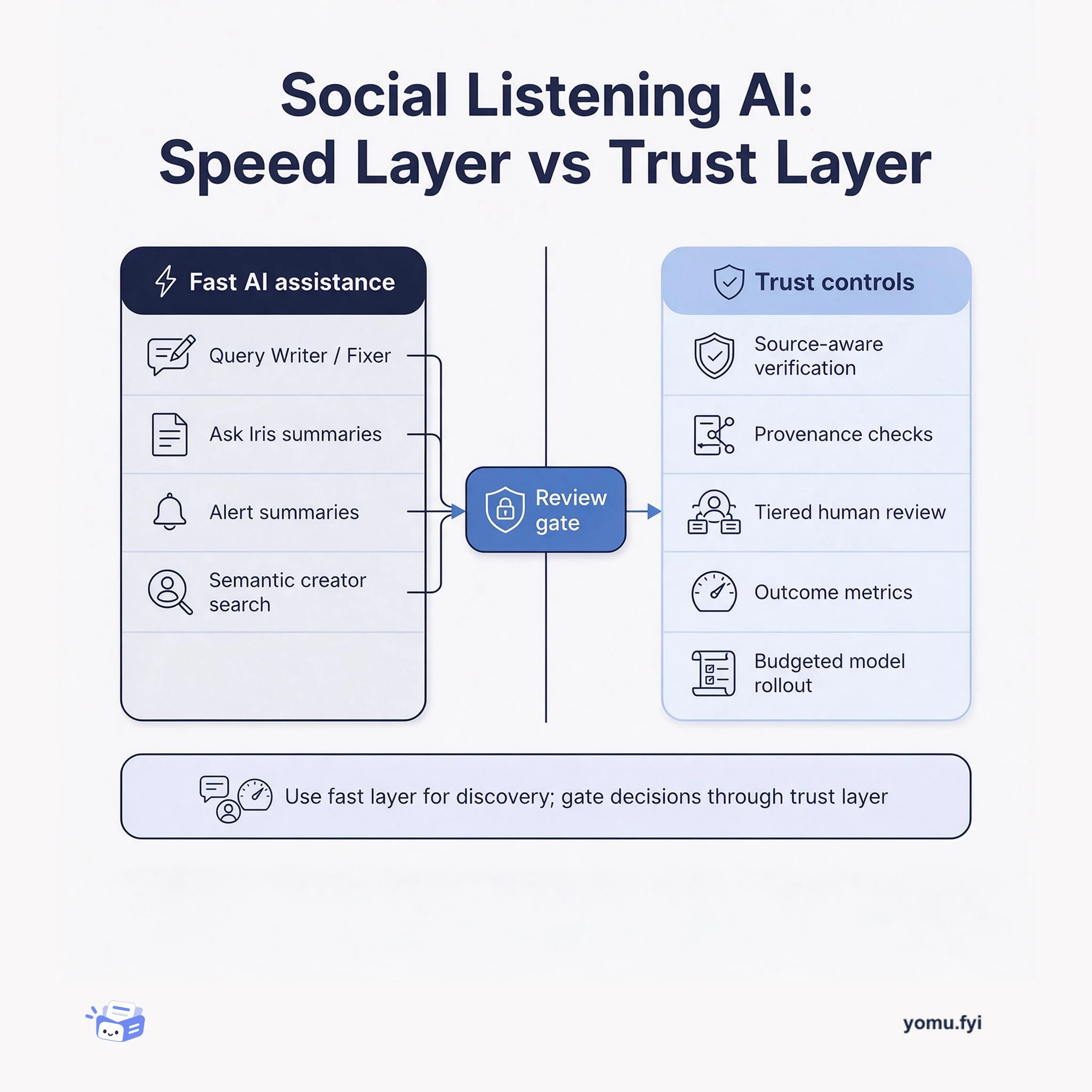
Brandwatch AI: Speed Layer vs Trust Layer
Compare Brandwatch's AI speed features—Ask Iris, Query Writer, and AI summaries—with the governed checks that make social insights trustworthy before teams act.
Loading…
Topic
9 posts about Social Listening. Every summary links to the original.
See the idea
Compare Brandwatch's AI speed features—Ask Iris, Query Writer, and AI summaries—with the governed checks that make social insights trustworthy before teams act.
The Good Stuff
Paid picks we use ourselves. Links carry a referral code — a subscription through one earns us a commission at no extra cost to you.
Newest first
An analysis of footwear conversations around the 2026 World Cup compares how sponsorship, search demand, social attention, and sentiment shaped the competition between Adidas, Nike, Puma, New Balance, and other brands. Consumer Research tracked tournament-related mentions from June 11 to July 19 and paired them with search queries across the US, UK, and Canada. Adidas led tournament-specific footwear conversation with 63% of mentions, while Nike led broader brand discussion with 995k mentions, brand search momentum, and 78% positive sentiment. Nike’s cultural activations, including LISA’s “Rip The Script” campaign and Ronaldo’s Mercurial moments, generated shareable attention, whereas Adidas benefited from official sponsorship, the Trionda match ball, and player storytelling. Pink cleats became a cross-brand liability, attracting more than 5.5k mentions with nearly 70% negative sentiment, showing that visibility did not automatically produce favorable attention.
This analysis examines how five non-sponsor brands used football-related moments to gain attention without buying official tournament partnerships. Consumer Research tracked brand mentions in public social and news content from June 11 to July 8, identifying responses to clean-stadium rules, fan travel, beer shortages, and rising ranch interest. Levi’s covered-logo campaign generated 20.1k mentions, while Heinz’s taped condiment packaging produced 5.1k; Miller Lite and Delta reacted to the Tartan Army with a beer barge and airport welcome. Kraft followed a TSA post with a limited-edition “TSA-Compliant Ranch” kit, recording over 4k mentions and a 3,998% increase over the previous timeframe. The examples support a model based on speed, authenticity, and real-time listening, with social and search signals helping brands act while trends are building.
Consumer Research tracked close to 32.6 million tournament-related mentions from June 10 to June 28 to examine how fans experienced the tournament through food, beverages, celebrations, and public events. International visitors reacted strongly to American staples: ranch dressing reached 70.3k mentions, free refills 45k, free or unlimited bread more than 30k, and barbecue nearly 64k, while Google interest in “ranch dressing” rose 586.4% and “ranch dressing ingredients” 600%. The experience also exposed friction, with stadium beers costing more than $20 and hydration breaks drawing negative sentiment in over 79% of sentiment-categorized mentions. Watch parties generated over 226k mentions, and New York held 22% of host-city watch-party conversation, offering alternatives to stadium prices. Norway’s “Viking Row” reached nearly 229k mentions, showing how organic fan rituals can spread across borders and create fast-moving opportunities for brands.
Western-only social listening strategies can miss consumer conversations and early signals in APAC, where platforms shape culture, purchasing trends, and product discovery. APAC sources matter because RedNote (Xiaohongshu) combines search-led recommendations, reviews, lifestyle content, and social commerce, while WeChat connects messaging, communities, payments, e-commerce, customer service, and purchases across a customer lifecycle. Sina Weibo provides a fast-moving view of public sentiment, entertainment, influencer culture, launches, and controversies, with narratives sometimes spreading to global coverage and international platforms. Together, these sources show how trends form, buying decisions develop, and narratives evolve across regions, rather than only what people say about brands. The stated conclusion is that brands should expand listening beyond Western platforms to identify trends earlier, understand high-intent behavior in real time, and make more globally relevant decisions.
AI tools increasingly answer consumer questions directly, reducing click-throughs while making remaining referrals more likely to convert, according to the Post. Brands therefore need to influence the broader information environment that shapes LLM recommendations, not merely optimize the URLs shown as citations. LLMs draw on owned content, earned media, and social conversations, including crawlable trade publications, industry blogs, Reddit, forums, and podcast transcripts. A telecommunications brand illustrates the owned-content route: after identifying real troubleshooting questions and publishing targeted answers, it reduced call center contact volume by 25% and improved issue resolution. The guidance also stresses concrete claims, authentic participation, and monitoring outdated or inaccurate narratives to build fresher context around a brand.
Brandwatch Consumer Research examined finance-related online conversations and found that negativity is increasing, with negative mentions up 21% between March 1, 2025, and March 1, 2026. The analysis identifies three major sources of frustration: free trials that convert into subscriptions through unclear pricing or cancellation practices, brands removing or replacing previously free benefits, and buy-now-pay-later (BNPL) services associated with overspending, debt, and financial stress. Mentions of free trials rose 45%, denied-refund mentions in those discussions rose 107%, benefit downgrades or removals rose 19%, and BNPL’s negative sentiment increased almost 600%. Drawing on 609 million conversations from social media, forums, review sites, and blogs over 12 months, the report recommends consent, advance notice, customer education, and financial-literacy support.
Ramadan reshapes daily routines, online activity, spending, dining, and hospitality, making it a major consumer and cultural moment across Muslim regions. Drawing on nearly 7 million English- and Arabic-language online conversations from 2025, the analysis tracks shopping, food, home aesthetics, hospitality, and regional posting patterns. Ramadan mentions rose 76% in the three months before the 2026 holiday year over year, while fragrance mentions increased 33%, Iftar-party mentions approached 900,000, recipes rose 144%, and Iftar or Suhoor packages and ticketed events rose 145% in 2025. Joy accounted for 57% of emotion-categorized Ramadan mentions, and conversations centered on togetherness, spirituality, traditions, and generosity. Afternoon activity peaks between 2 pm and 4 pm across the analyzed regions, but brands are advised to use their own regional and platform analytics and meet audiences through authentic participation rather than promotion.
Customer experience (CX) spans every interaction across the journey, from advertising and purchase through support, product use, and advocacy, rather than referring only to customer service, UX, or customer success. The guide argues that AI has raised expectations for fast, personalized responses, while privacy-first marketing increases the importance of consented zero-party and first-party data, voice-of-customer programs, and social listening. Its framework maps awareness, consideration, purchase, post-purchase, and loyalty or advocacy; combines social, survey, support, and review data; prioritizes fixes with an impact-versus-effort matrix; and establishes workflows, response SLAs, and ongoing measurement. It recommends metrics including NPS, CSAT, CES, sentiment, and churn rate, alongside competitive benchmarking and continuous iteration. Examples describe using Brandwatch's Data Upload API and Social Panels to identify product issues, customer questions, and improvement opportunities before broader launches or operational changes.
The analysis examines online conversation around the 2023 FIFA Women’s World Cup using English-language mentions from social media, blogs, forums, and news sources collected between 20 July and 20 August 2023. It reports over 2.2 million social-media mentions, with major peaks during the Round of 16, the semi-finals, and the final, which generated more than 150,000 mentions and ended with Spain winning the title. Among gender-categorized authors on X, 75% were male, while England was the most discussed country, followed by Australia, the United States, New Zealand, and Spain. Mary Earps’s penalty save produced an initial final-minute spike, and Spain’s coronation prompted a peak of 2,100 mentions at 10:03 PM AEST. The analysis concludes that mention volume, sentiment, emotion, and team comparisons can help brands identify which aspects of the sport generate the most interest and where to participate.
The best engineering reads, once a week.

