The article demonstrates extending Red Hat OpenShift Lightspeed by integrating the Red Hat Satellite MCP server and bring your own knowledge (BYOK). The Satellite MCP server exposes live operational data, such as kernel versions, CVEs, and errata, through the Model Context Protocol. BYOK enriches the assistant with private enterprise knowledge, enabling retrieval-augmented generation (RAG) to combine internal documentation with infrastructure data. The integration requires installing the OpenShift Lightspeed operator and deploying the Satellite MCP server in the openshift-lightspeed project. Authentication is handled by storing the header value in a Secret, and the MCP server expects clients to include appropriate Accept headers for the text/event-stream media type.
Context
The article demonstrates combining multiple knowledge sources into a single AI assistant using Red Hat OpenShift Lightspeed as the front-end. It integrates the Red Hat Satellite MCP server to retrieve live operational data and uses BYOK to add private enterprise knowledge. The goal is to answer questions about infrastructure, organizations, hosts, packages, CVEs, errata, and internal policies through one conversational interface.
Approach / What changed
The approach is to extend Red Hat OpenShift Lightspeed by integrating the Red Hat Satellite MCP server and bring your own knowledge (BYOK). First, install the OpenShift Lightspeed operator. Then deploy the Satellite MCP server in the openshift-lightspeed project, which exposes Satellite capabilities through MCP. Authentication is handled by storing the header value in a Secret. Finally, BYOK enriches the assistant with private enterprise knowledge, enabling RAG to combine internal documentation with live infrastructure data.
Takeaways
1
OpenShift Lightspeed can be extended with Red Hat Satellite MCP to retrieve live operational data like kernel versions, CVEs, and errata.
2
BYOK allows the assistant to access private enterprise knowledge, which can be combined with live infrastructure data through RAG.
3
The MCP server requires clients to include appropriate Accept headers for text/event-stream media type, and authentication is stored as a header value in a Secret.
FAQ
Why does a plain curl request get rejected by the MCP server?
The MCP server expects clients to include appropriate Accept headers for text/event-stream media type. A plain curl request without this header is rejected because it doesn't advertise support for the required media type.
How is authentication handled for the Satellite MCP server?
Authentication information is stored in a Secret that holds the header value rather than a generic credential field. This allows the MCP server to authenticate requests using the specific header required by the protocol.
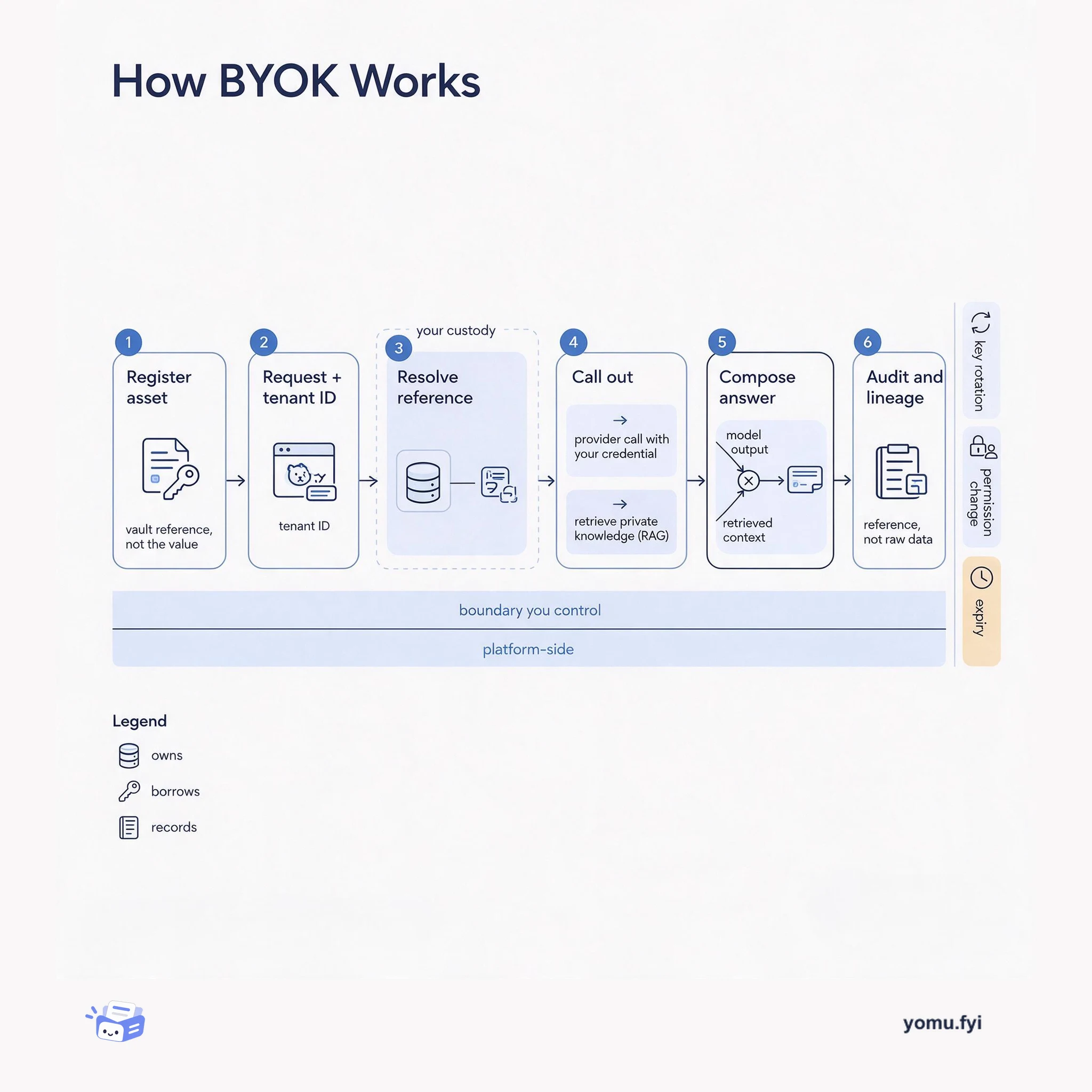
BYOK lets a system run on assets you supply — your model credential or your private knowledge — instead of the vendor's defaults. This walkthrough traces six steps from registration to an audited response.
Keep reading
Related reading
The Good Stuff
Paid picks we use ourselves. Links carry a referral code — a subscription through one earns us a commission at no extra cost to you.