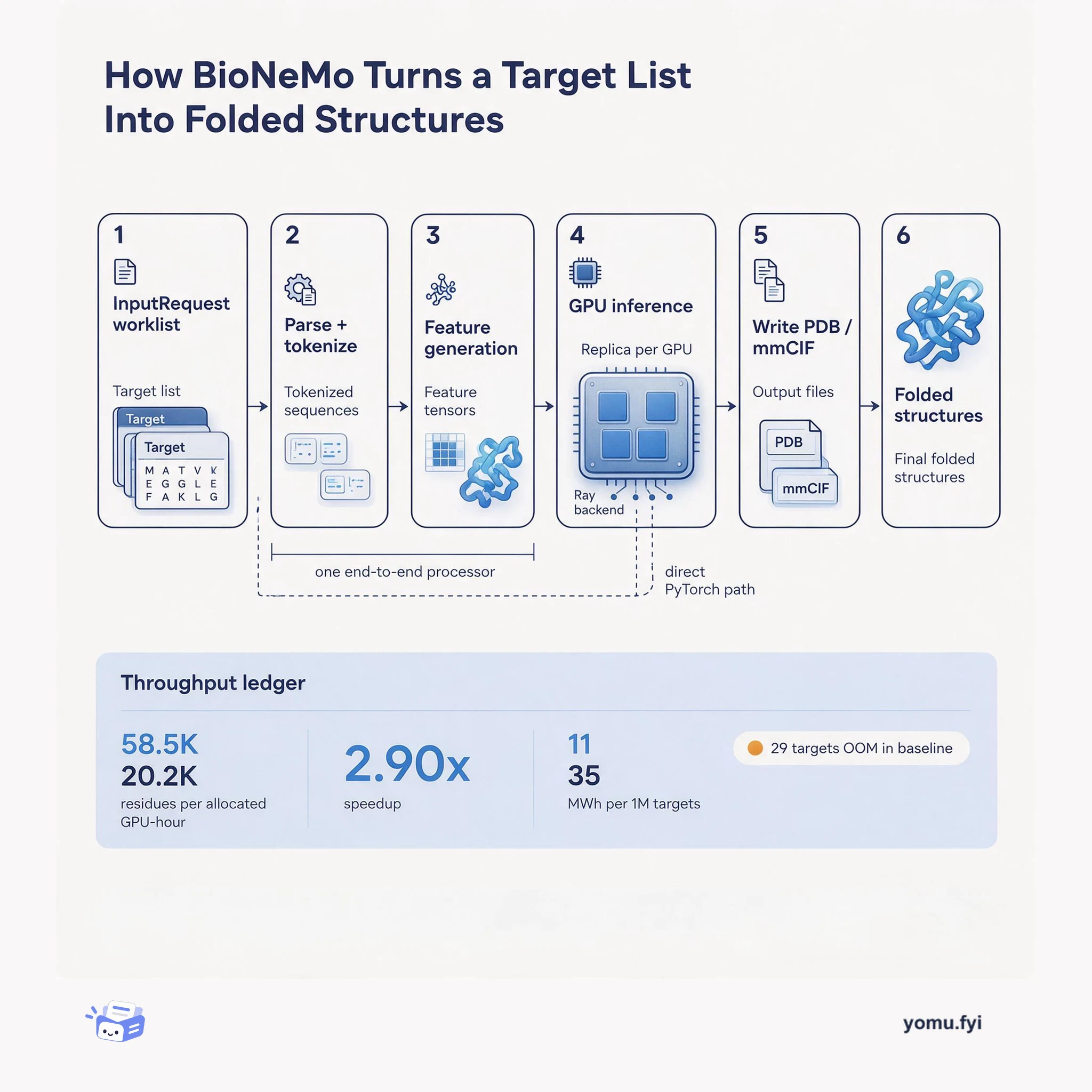
Proteome-scale biomolecular structure prediction requires moving large worklists efficiently, and NVIDIA BioNeMo Inference Runtime (BioIR) accelerates supported models on NVIDIA GPUs while retaining a PyTorch workflow. Its end-to-end processor passes InputRequest objects through parsing, tokenization, feature generation, GPU inference, and PDB or mmCIF writing; a Ray backend places complete model replicas on GPUs for concurrent independent inputs, while direct PyTorch integration supports custom code. In a matched 1,000-target human-dimer benchmark, BioIR completed all targets at 58.5K successfully folded residues per allocated GPU-hour versus 20.2K for the tested public implementation, a 2.90× improvement, which ran out of memory on 29 targets. Rated-power-equivalent estimates for one million comparable targets were 11 versus 35 MWh at 8-GPU TDP and 21 versus 64 MWh at full-node maximum power, excluding data-center overhead and several pipeline costs.
Context
Proteome-scale structure prediction involves processing large worklists of independent inputs efficiently. The described benchmark and deployment guidance address throughput, resource efficiency, and operational considerations for running supported biomolecular structure-prediction models at scale.
Approach / What changed
BioIR provides an end-to-end processor with serial and Ray executor backends, plus direct PyTorch module integration. The Ray workflow uses complete model replicas across visible GPUs and overlaps parser, tokenizer, feature-generation, inference, and writer stages. The tutorial covers input preparation, validation, configuration, measurement, stage balancing, and troubleshooting.
Takeaways
1
Each protein chain requires an A3M MSA; BioIR accepts paired or unpaired MSAs for multiple non-identical protein chains but does not run HHsearch or HMMsearch.
2
The Ray replica capacity rule is engine_stage.compute × engine_stage.num_gpus ≤ visible GPUs; each replica loads the full model and reserves its configured GPU resources.
3
BioIR’s benchmark metrics separate model-forward time from end-to-end pipeline performance, and the energy figures are rated-power-equivalent estimates rather than metered measurements.
BioNeMo Inference Runtime runs one pipeline per target: parse, tokenize, generate features, infer on a GPU replica, and write a structure. This diagram traces those stages and the throughput trade-off.
Keep reading
Related reading
The Good Stuff
Paid picks we use ourselves. Links carry a referral code — a subscription through one earns us a commission at no extra cost to you.