HP is building an AI-ready go-to-market data foundation on Databricks, unifying customer data and third-party signals in a governed Marketing Lakehouse after consolidating hundreds of data repositories. The company estimates that consolidating CDP capabilities with CustomerLake could reduce total cost of ownership by up to 40% compared to its former Composable CDP approach. HP expanded available marketing data with 90% net-new signals across media, brand, intent, and technographic sources. In the first session of using CustomerLake, HP configured data models, published attributes, and became ready to build audiences in two hours, a process that previously could take two to three months. HP is also bringing identity resolution into its Databricks environment to create a governed foundation for measurement, audience activation, and model improvement, and using AI/BI Genie to bridge the gap between technical readiness and business usability.
Context
HP previously used a Composable CDP approach that required duplicating pipelines and data, and lacked business context in the activation layer. The company consolidated hundreds of data repositories into a governed Marketing Lakehouse on Databricks to unify customer data and third-party signals, but still needed to bridge the gap between technical readiness and business usability for marketers.
Approach / What changed
HP adopted Databricks CustomerLake to consolidate CDP capabilities directly on its governed Marketing Lakehouse, using Unity Catalog for governance and Delta Sharing for data sharing. The company also uses AI/BI Genie and agent-based capabilities to provide self-service analytics and activation for marketers, with semantic layers that define business context such as metric views and instructions.
Takeaways
1
HP estimates that consolidating CDP capabilities with CustomerLake could reduce total cost of ownership by up to 40% compared to its former Composable CDP approach.
2
HP expanded available marketing data with 90% net-new signals across media, brand, intent, and technographic sources.
3
In the first session of using CustomerLake, HP became ready to build audiences in two hours, a process that previously could take two to three months.
FAQ
How does CustomerLake reduce CDP TCO?
By consolidating CDP capabilities directly on the governed data foundation, eliminating the need for duplicate pipelines, data movement, and separate platform licensing. HP estimates up to 40% TCO reduction compared to its former Composable CDP approach.
What new data signals did HP add?
HP expanded with 90% net-new signals across media, brand, intent, and technographic sources, including expanding intent-data ingestion from 75 topics to approximately 20,000 topics.
How did HP become audience-ready in two hours?
Because CustomerLake is native to Databricks and Unity Catalog, HP's team worked directly with existing schemas, tables, definitions, and governance instead of recreating context in a separate platform. They configured data models and published attributes quickly.
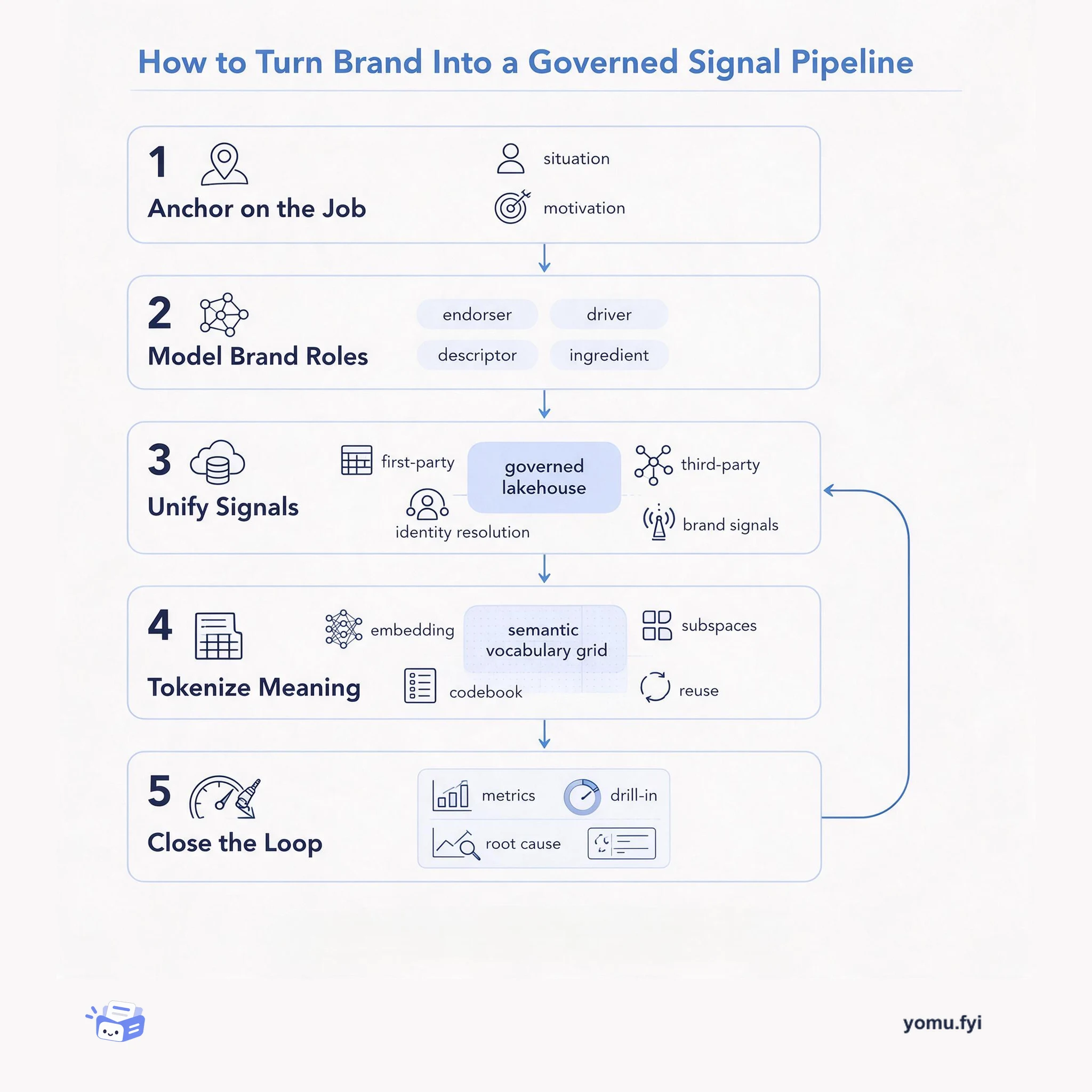
A practical how-to for engineers who need to turn brand from a style guide into a governed signal pipeline: anchor on jobs, model brand roles, unify signals, tokenize meaning, and close the loop with measurement.
Keep reading
Related reading
The Good Stuff
Paid picks we use ourselves. Links carry a referral code — a subscription through one earns us a commission at no extra cost to you.