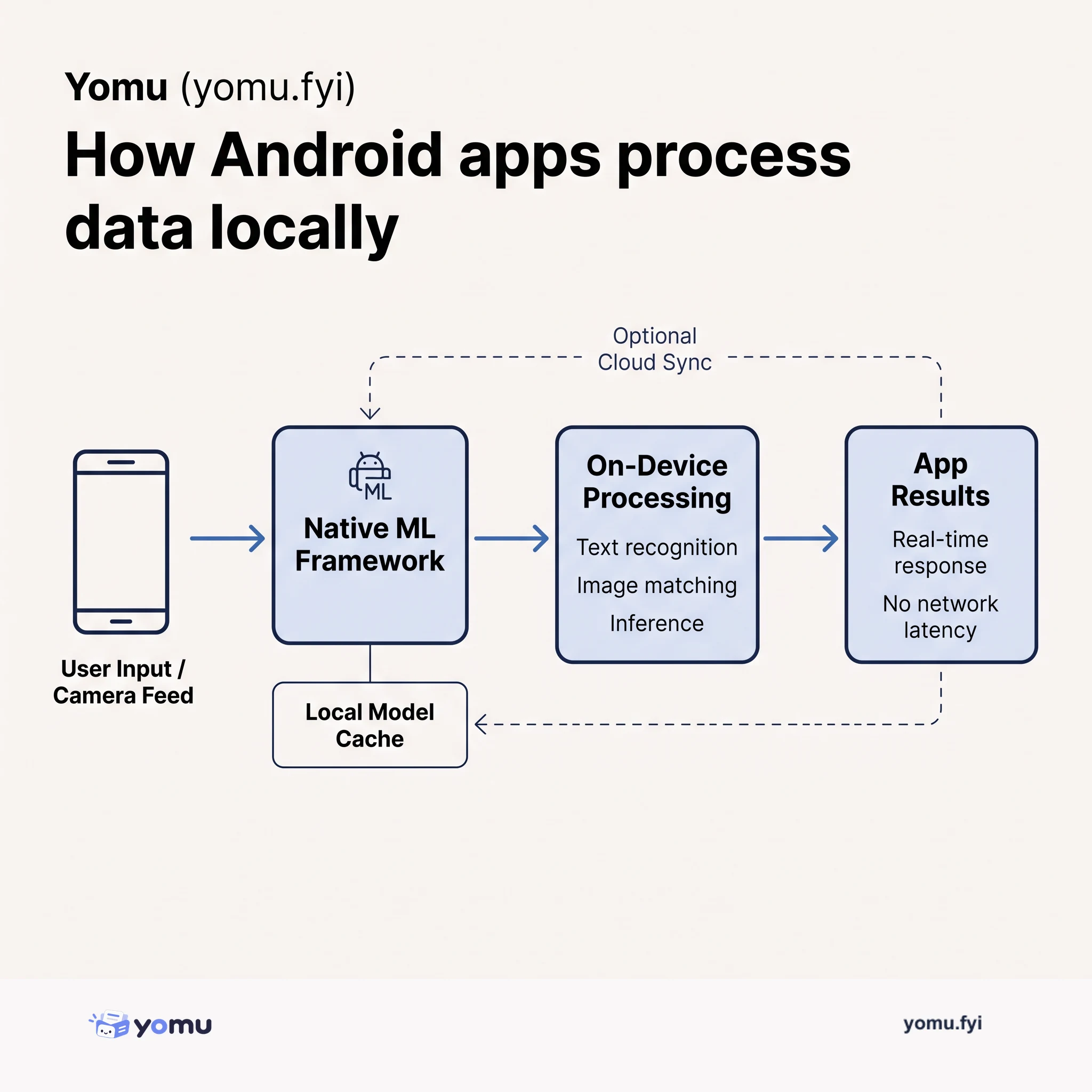
How Android Apps Handle Real-Time Local Processing
Android's on-device machine learning stack lets apps run inference, image recognition, and text processing locally without sending data to servers, reducing latency and protecting privacy.
 ThumbtackZachary WanderProblem & solution
Thumbtack migrated 1,500 Android screenshot tests from Firebase Test Lab to Roborazzi to eliminate slow and error-prone testing on remote emulators. The engineering team ported test suites from androidTest to test in batches of 20, adjusting test rules and annotations for Robolectric. Because Roborazzi runs in a single JVM process with parallel execution, the team had to debug shared font cache pollution and cross-platform shadow rendering inconsistencies between macOS and Debian. They resolved configuration repetition by mapping Robolectric annotations into module-level robolectric.properties files and avoided stale cached images by clearing Roborazzi's cache via a custom Gradle task. The migration significantly decreased CI runtimes while making local test recording and verification easier.
Thumbtack relied on Firebase Test Lab to capture and compare Jetpack Compose layouts for Android apps, but using remote emulators and devices proved slow, tedious, and error-prone.
The team ported 1,500 test suites in batches of 20 from androidTest to test using Roborazzi and Robolectric. They hoisted flags to disable shadows individually, consolidated shared configurations into robolectric.properties files, and hooked a Gradle cache-clearing task into AbstractTestTask.
Roborazzi executes tests in a single JVM process in parallel, removing emulator process isolation and risking cross-suite state leakage like shared font cache pollution.
Cross-platform graphics rendering between macOS workstations and Debian CI environments caused shadow discrepancies, which Thumbtack resolved by hoisting flags to disable shadows across layouts.
Robolectric class annotations can be mapped to camelCase property keys in a robolectric.properties file to standardize configurations such as SDK version, qualifiers, and native graphics mode.
Summaries are generated from the original by a language model. Check the original before relying on it.
See the idea
Android's on-device machine learning stack lets apps run inference, image recognition, and text processing locally without sending data to servers, reducing latency and protecting privacy.
Keep reading
The Good Stuff
Paid picks we use ourselves. Links carry a referral code — a subscription through one earns us a commission at no extra cost to you.
One useful email. Unsubscribe anytime.
