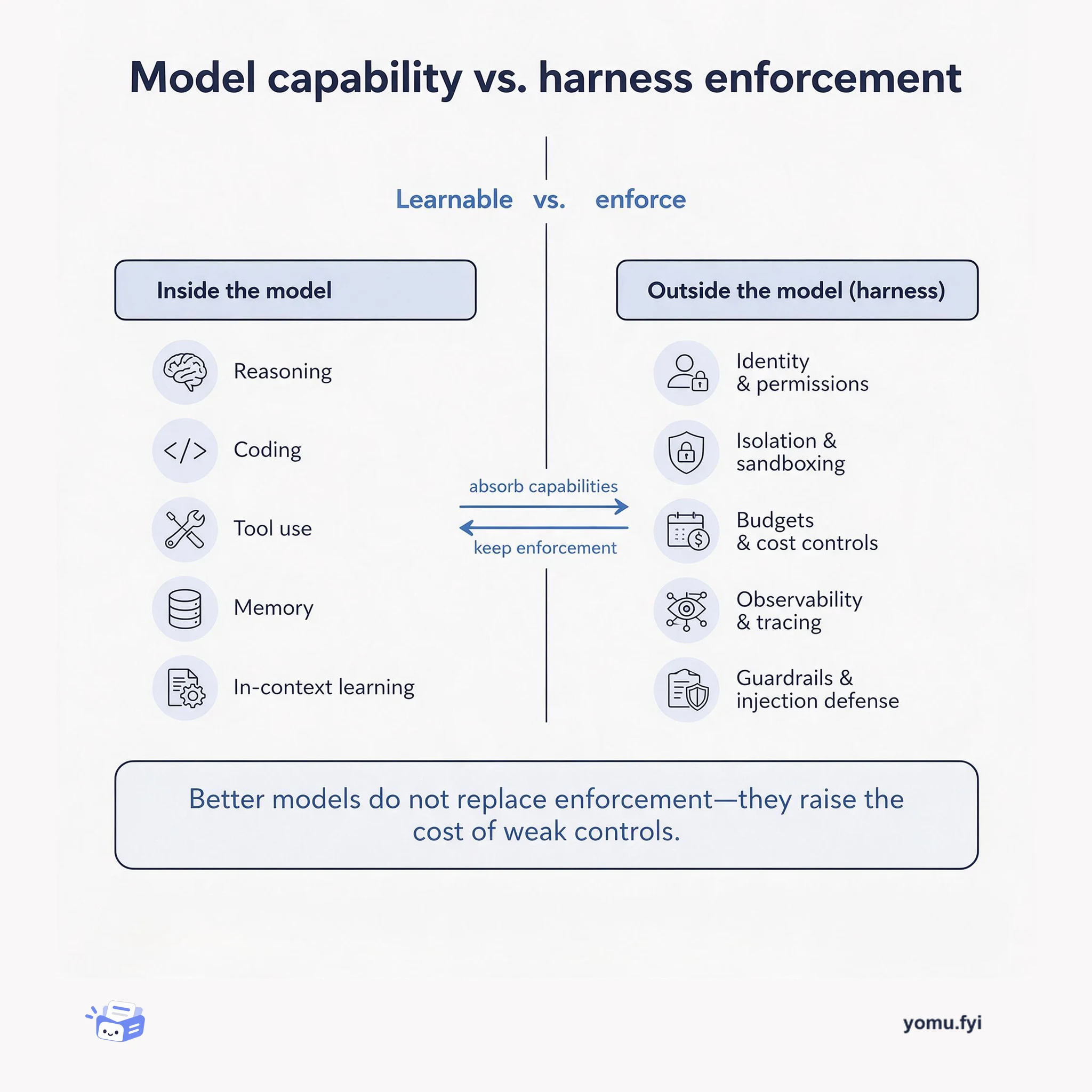
Model vs. Harness: Where AI Agent Controls Belong
A comparison of what AI models should learn versus what agent infrastructure must enforce. See how reasoning, permissions, isolation, budgets, and observability split across the boundary.
 AnthropicAnthropicAnnouncement
Anthropic introduced Claude Opus 4 and Claude Sonnet 4, setting new standards for coding, advanced reasoning, and AI agents. Claude Opus 4 is described as the world’s best coding model, leading on SWE-bench (72.5%) and Terminal-bench (43.2%), with sustained performance on long-running tasks. Claude Sonnet 4 significantly improves on Sonnet 3.7, achieving 72.7% on SWE-bench and excelling in agentic scenarios. Both models are hybrid, offering near-instant responses and extended thinking, which now supports tool use, parallel tool execution, and improved memory via local file access. Claude Code became generally available with VS Code and JetBrains extensions, GitHub Actions background tasks, and an extensible SDK.
Anthropic released Claude Opus 4 and Claude Sonnet 4, hybrid models offering near-instant responses and extended thinking. Extended thinking now supports tool use, parallel tool execution, and improved memory via local file access. Claude Code became generally available with VS Code and JetBrains extensions, GitHub Actions background tasks, and an extensible SDK. New API capabilities include a code execution tool, MCP connector, Files API, and one-hour prompt caching. Both models are available on Claude plans, API, Amazon Bedrock, and Vertex AI.
Claude Opus 4 scored 72.5% on SWE-bench Verified and 43.2% on Terminal-bench, making it the best coding model according to Anthropic.
Claude Sonnet 4 achieved 72.7% on SWE-bench and is being adopted by GitHub Copilot, Manus, iGent, Sourcegraph, and Augment Code.
Both models are 65% less likely to use shortcuts or loopholes than Sonnet 3.7 on agentic tasks susceptible to such behavior.
Claude Opus 4 is priced at $15 per million input tokens and $75 per million output tokens. Claude Sonnet 4 is priced at $3 per million input tokens and $15 per million output tokens.
Claude Opus 4 scored 72.5% on SWE-bench Verified and 43.2% on Terminal-bench. Claude Sonnet 4 scored 72.7% on SWE-bench Verified. With additional test-time compute, Opus 4 reached 79.4% and Sonnet 4 reached 80.2% on SWE-bench.
Both models are 65% less likely to engage in shortcut or loophole behavior than Claude Sonnet 3.7 on agentic tasks that are particularly susceptible to such behavior.
Summaries are generated from the original by a language model. Check the original before relying on it.
See the idea
A comparison of what AI models should learn versus what agent infrastructure must enforce. See how reasoning, permissions, isolation, budgets, and observability split across the boundary.
Keep reading
The Good Stuff
Paid picks we use ourselves. Links carry a referral code — a subscription through one earns us a commission at no extra cost to you.
One useful email. Unsubscribe anytime.
