Cloudflare introduced Clef-omni, a decision model that natively handles audio, video, image, and text inputs in a single pipeline, built on a Qwen3-Omni mixture-of-experts backbone with text-to-speech components removed. Unlike cascading pipelines, it directly embeds media into a unified sequence and uses two-stage attention routing with lexical grammar to compute confidence scores, trained by freezing the backbone and applying LoRA adapters with label-smoothed cross-entropy and Brier score calibration. The company also cut Clef-flash’s price to $0.038 per million input tokens while reducing its context window from 64k to 24k for the hosted version, based on usage data showing only 0.24% of requests exceed that limit. Clef’s hosted version received speed optimizations at the infrastructure layer without new model weights, and Clef-omni is available open-weight on HuggingFace. Benchmarks show Clef-omni scoring 98.2 on BFCL case exact and 92.7 on API-Bank accuracy, with median text-only decision latency around 130 milliseconds.
Context
Following last week’s release of Clef and Clef-flash, Cloudflare’s open-weight decision models, this announcement adds Clef-omni with full multimodality, reduces Clef-flash pricing, and improves Clef latency through infrastructure optimizations.
Approach / What changed
Clef-omni is built on a Qwen3-Omni-30B-A3B-Instruct mixture-of-experts foundation, with the text-to-speech output components removed. The model accepts audio (wav/mp3), video (mp4/webm), images, and text directly. It executes a quick prefill pass across all modalities, scoring valid parameter options simultaneously using two-stage attention routing. Training freezes the Qwen3 backbone and applies low-rank adapters (LoRA) with label-smoothed cross-entropy loss and Brier score calibration. Clef-flash’s price reduction was achieved through optimizations and reducing the hosted context window to 24k tokens based on usage data. Clef’s speed improvements come from serving infrastructure optimizations without new model weights.
Takeaways
1
Clef-omni natively processes audio, video, image, and text in a single API call, eliminating the need for separate transcription or splitting pipelines. It achieves ~130ms median latency for text-only decisions and ~1.5 seconds for a 21-second video clip.
2
Clef-flash’s hosted price dropped from $0.09 to $0.038 per million input tokens, but its context window was reduced from 64k to 24k based on usage data; the open-weight version on Hugging Face supports up to 256k tokens for self-hosting.
3
Clef-omni is built on a Qwen3-Omni MoE backbone with TTS components removed, trained by freezing the backbone and applying LoRA adapters with label-smoothed cross-entropy and Brier score calibration for robust performance across schema variations.
FAQ
How does Clef-omni handle video and audio input?
It accepts wav/mp3 for audio and mp4/webm for video alongside text and images. The model directly embeds media into a unified sequence without needing separate transcription or splitting. It uses two-stage attention routing with lexical grammar to compute confidence scores across all modalities.
Why was the Clef-flash context window reduced and what is the new limit?
The hosted Clef-flash now has a 24k context window instead of 64k to enable cheaper pricing. The open-weight model supports up to 256k. Only 0.24% of requests exceeded 24k tokens, so the trade-off was deemed acceptable.
How does Clef-omni's pricing compare to other Clef models?
Clef-omni is priced at $0.15 per million input tokens. Clef-flash is now $0.038 per million, and Clef remains at $0.24 per million. Clef-omni and Clef-flash are cheaper than Jev.
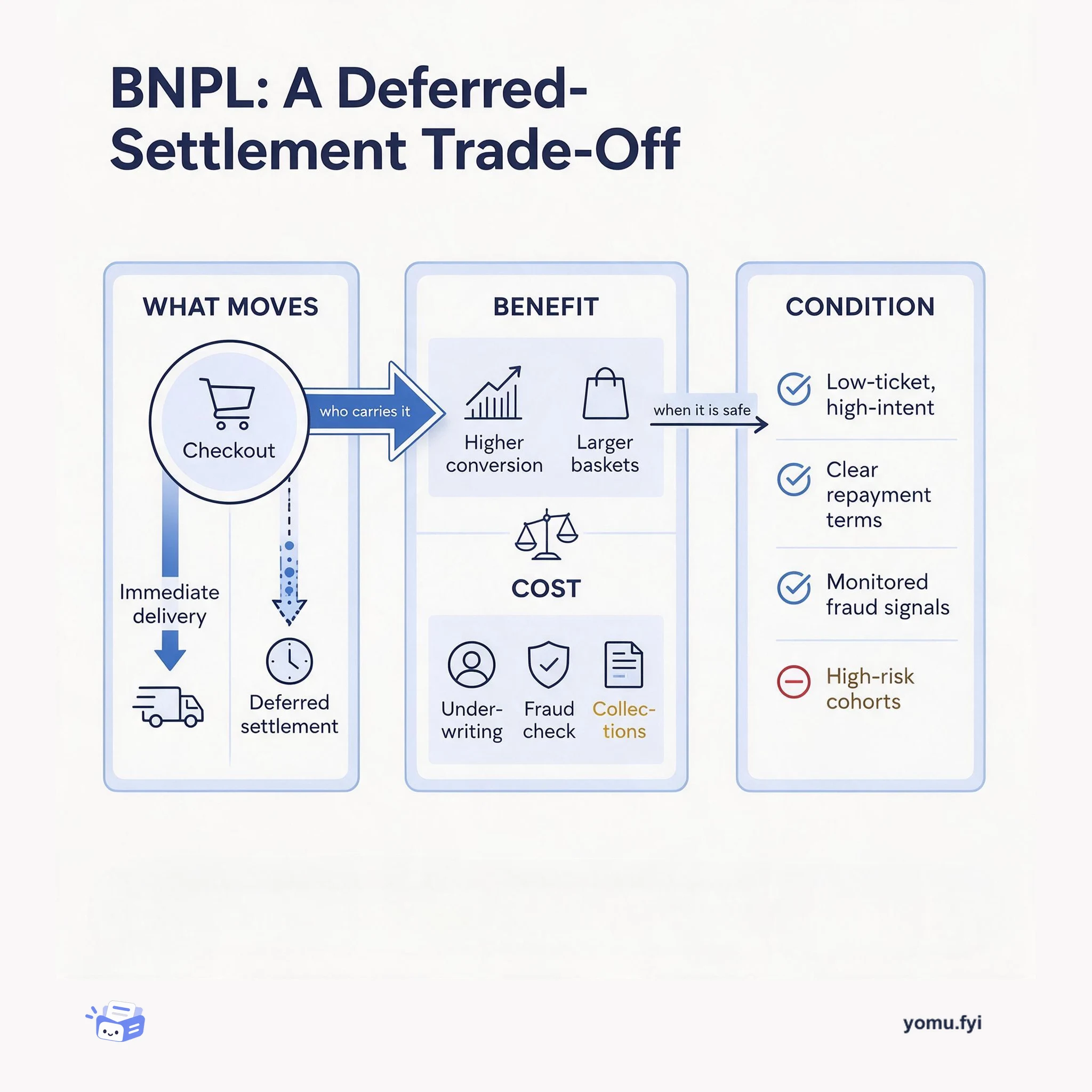
Buy Now, Pay Later is a deferred-settlement trade-off: merchants gain conversion while underwriting, fraud, and collections risk move elsewhere. This diagram maps the benefit, the cost, and the condition that decides.
Keep reading
Related reading
The Good Stuff
Paid picks we use ourselves. Links carry a referral code — a subscription through one earns us a commission at no extra cost to you.