Car Rental: A Search Layer, a Contract, and a Handover
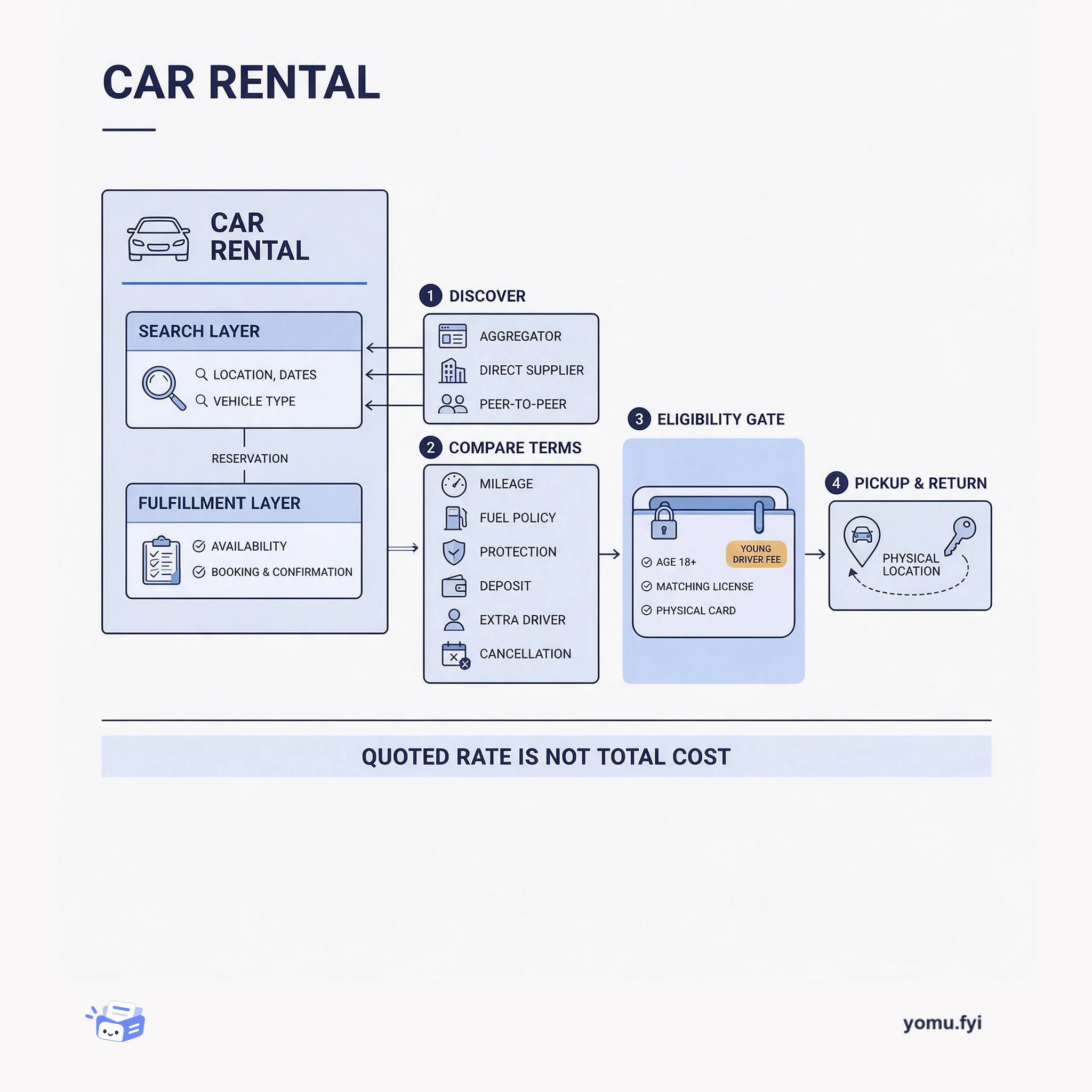
A car rental is a search layer over many fleets plus a contract enforced at the counter. This explainer maps its four parts and why the advertised daily rate never equals the total cost.
Loading…
Topic
4 posts about E-commerce. Every summary links to the original.
See the idea
A car rental is a search layer over many fleets plus a contract enforced at the counter. This explainer maps its four parts and why the advertised daily rate never equals the total cost.
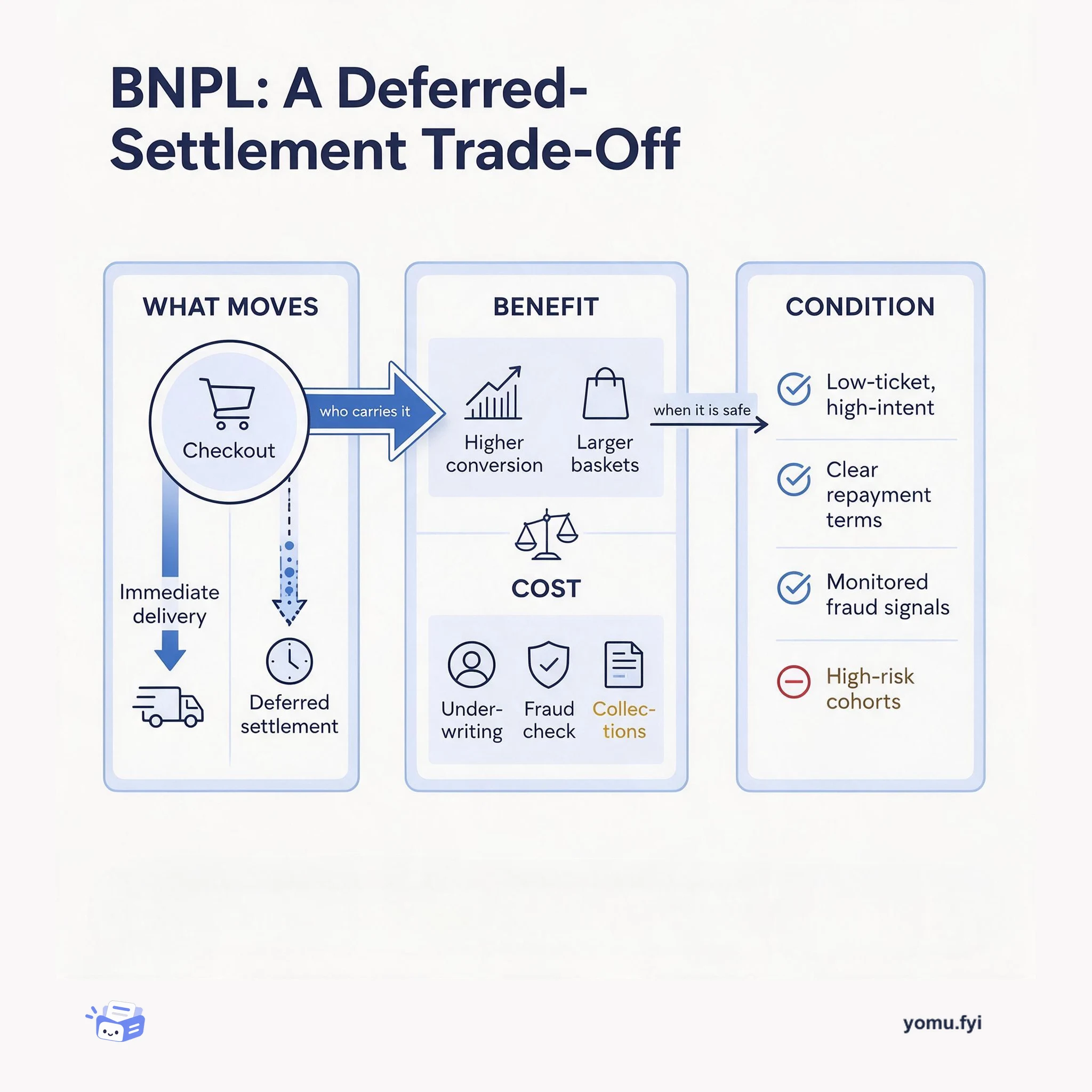
Buy Now, Pay Later is a deferred-settlement trade-off: merchants gain conversion while underwriting, fraud, and collections risk move elsewhere. This diagram maps the benefit, the cost, and the condition that decides.
The Good Stuff
Paid picks we use ourselves. Links carry a referral code — a subscription through one earns us a commission at no extra cost to you.
Newest first
AI agents are transforming retail discovery, requiring product catalogs to be machine-readable and context-rich for systematic retrieval, with McKinsey estimating AI agents could orchestrate $3 trillion to $5 trillion globally by 2030. Retailers need a single enriched catalog that projects consistently to three surfaces: outbound product feeds, agentic commerce endpoints via REST APIs or MCP, and product detail pages with schema.org JSON-LD. MongoDB’s document model supports three tiers of enrichment—identity and transactability, filterable attributes, and agentic context such as use cases and semantic embeddings—to help AI agents reason over products. Change streams and aggregation pipelines keep projections current across surfaces, ensuring consistency that AI agents cross-check. MongoDB Search and Vector Search enable hybrid retrieval for intent-based queries, helping retailers improve discoverability and gain a competitive advantage in the agentic commerce era.
Consumer experience now drives purchasing decisions, as 74% of shoppers base choices on experience alone, and 75% of consumers favor companies that offer rewards. Pandemic-driven online shifts have raised expectations and made loyalty harder to maintain. Improvements include using contextual surveys with rewards such as Rybbon, maintaining consistency across devices via persistent carts and social media response (expected by 65% of users), and personalizing with product tours and data enrichment like Amplitude. Support can be supercharged with Resolution Bot, multilingual articles, and order tracking (desired by 70% of shoppers), while checkout optimization—avoiding forced account creation (a 34% abandonment cause) and redundant data entry, plus integrating Stripe—directly reduces friction. These targeted steps turn customer experience into a powerful competitive edge.
The post presents a reference architecture for building a production-grade e-commerce recommendation system on Databricks, based on a real-world implementation for a leading fashion e-commerce platform in Asia serving over 1 million monthly active users across 100,000+ SKUs. The system ingests approximately 1,000 events per second via Lakeflow Connect’s Zerobus into Unity Catalog Delta tables within a medallion architecture. Serving uses two paths: Path A for pre-computed batch recommendations via key-value lookup from Lakebase online tables, and Path B for real-time session-aware scoring using AI Search and a LightGBM model in a 3-stage funnel. The architecture unifies ingestion, feature management, model training, vector retrieval, and serving on a single governed platform, with cold-start handling for new users and products. Expected outcomes include low 2-digit millisecond responses, daily-fresh recommendations, and unified governance via Unity Catalog.
A 34% year-over-year increase in consumers using generative AI for online shopping, especially among Gen Z and Millennials, is motivating e-commerce teams to adopt AI shopping agents. This tutorial demonstrates building a chat-based shopping assistant on MongoDB Atlas with CrewAI that supports zero-click buying from product discovery to post-purchase follow-up. The agent interprets natural-language queries, retrieves semantically relevant products via MongoDB Vector Search with Voyage AI embeddings using price and inventory pre-filters before similarity ranking, and uses Change Streams for atomic inventory checkout. Atlas Triggers enable proactive order notifications, while Atlas Stream Processing detects delivery patterns by monitoring updates in two-minute tumbling windows, writing confirmed signals to agent_triggers when at least 10 orders per carrier-region are delayed by 45 minutes. MongoDB consolidates operational data, semantic search, and event-driven capabilities into a single platform, reducing latency and complexity.
The best engineering reads, once a week.