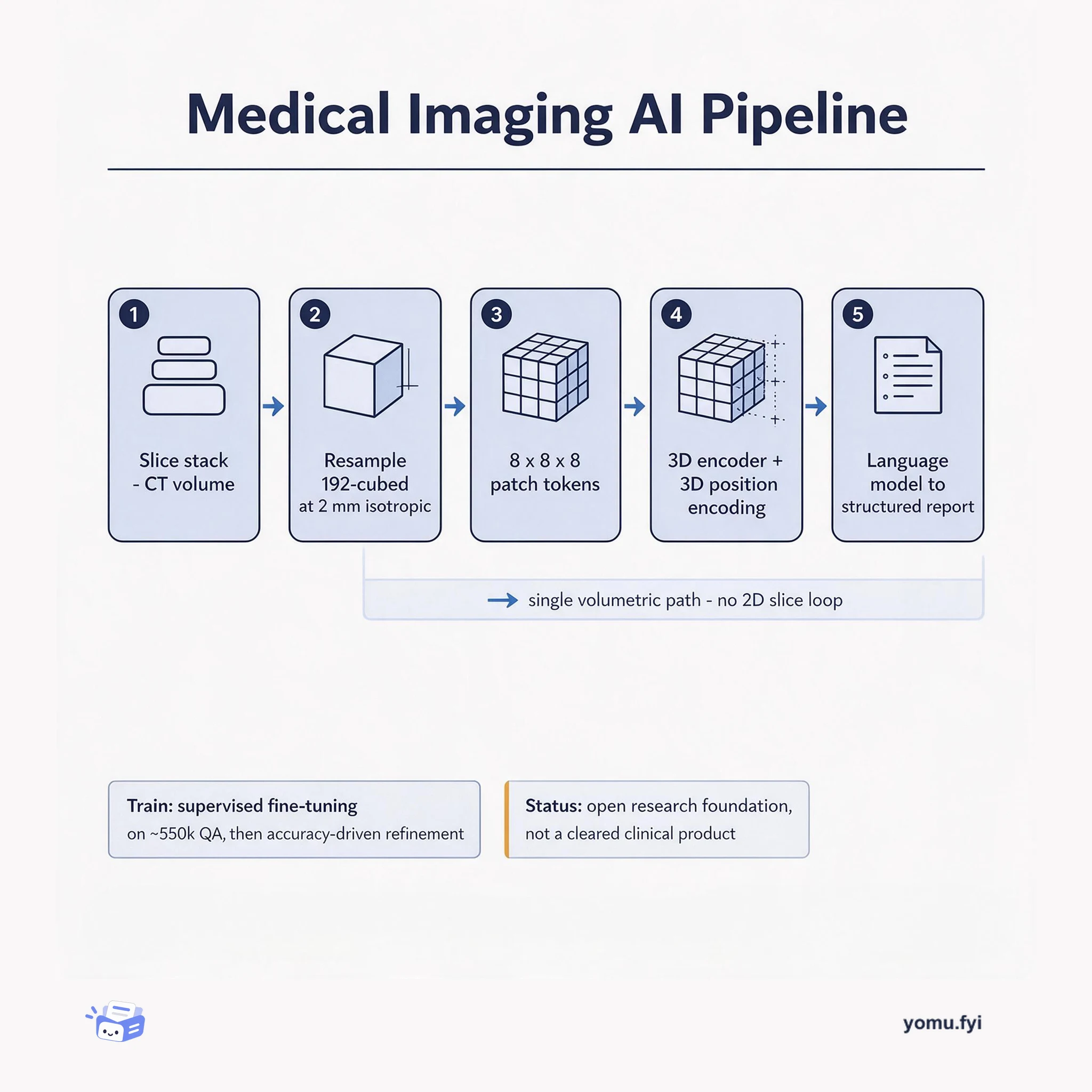
NVIDIA released NV-Reason-CT, a vision language model for 3D CT analysis that processes volumes as true 3D input rather than independent 2D slices. The model generates structured diagnostic reports covering 30 chest and 29 abdominal abnormalities and emulates radiologist chain-of-thought reasoning with systematic anatomical reviews and uncertainty articulation. Its architecture pairs a Qwen3.5-4B language model with a full 3D ViT encoder that processes volumes resampled to 192³ voxels at 2mm isotropic resolution using 8x8x8 patch tokens and 3D MRoPE for spatial token relationships. Training uses supervised fine-tuning on roughly 550,000 QA examples from CT-RATE, NIH CT, and CancerVerse followed by Group Relative Policy Optimization that refines reasoning quality based on diagnostic accuracy. NV-Reason-CT is an open research foundation not a cleared clinical product and sits within NVIDIA’s Medical AI ecosystem alongside NV-Reason-CXR, NV-Segment-CTMR, and NV-Generate-CTMR.
Context
3D CT volumes contain 300–600 axial slices with three-dimensional anatomical context that 2D encoders cannot reconstruct. Standard VLMs treat images as 2D token grids, discarding through-plane spatial relationships. Radiologists require systematic reasoning, uncertainty articulation, and multiturn dialogue. This gap in perception, reasoning, and conversational depth motivated building a dedicated 3D VLM.
Takeaways
1
3D VLMs require native volumetric processing because flattening a CT volume into 2D slices loses the through-plane spatial relationships that define structures like masses and infiltrates.
2
NV-Reason-CT’s architecture uses a full 3D ViT encoder with 8x8x8 patches and 3D MRoPE to preserve volumetric token relationships, unlike models that adapt 2D encoders by treating slices independently.
3
The training pipeline combines supervised fine-tuning on 550,000 QA examples with GRPO reinforcement learning to refine chain-of-thought reasoning quality based on diagnostic accuracy.
FAQ
What CT resolution does NV-Reason-CT process?
The model processes CT volumes resampled to 192³ voxels at 2mm isotropic resolution, using non-overlapping 8x8x8 patch tokens, resulting in 13,824 vision tokens.
Is NV-Reason-CT cleared for clinical use?
No. NV-Reason-CT is an open research and development foundation, not an autonomous diagnostic system or cleared clinical product. It is designed for researchers and developers to post-train for specialized CT analysis applications.
What types of abnormalities does the CT ontology cover?
The CT ontology covers 30 chest and 29 abdominal abnormalities, including lung nodules, pneumothorax, hepatic lesions, and renal cysts, guiding and evaluating the model's structured report generation.
A walkthrough of how a 3D CT model turns a voxel volume into a structured diagnostic report: isotropic resampling, 3D patch tokens, spatial encoding, and language-model reasoning.
Keep reading
Related reading
The Good Stuff
Paid picks we use ourselves. Links carry a referral code — a subscription through one earns us a commission at no extra cost to you.