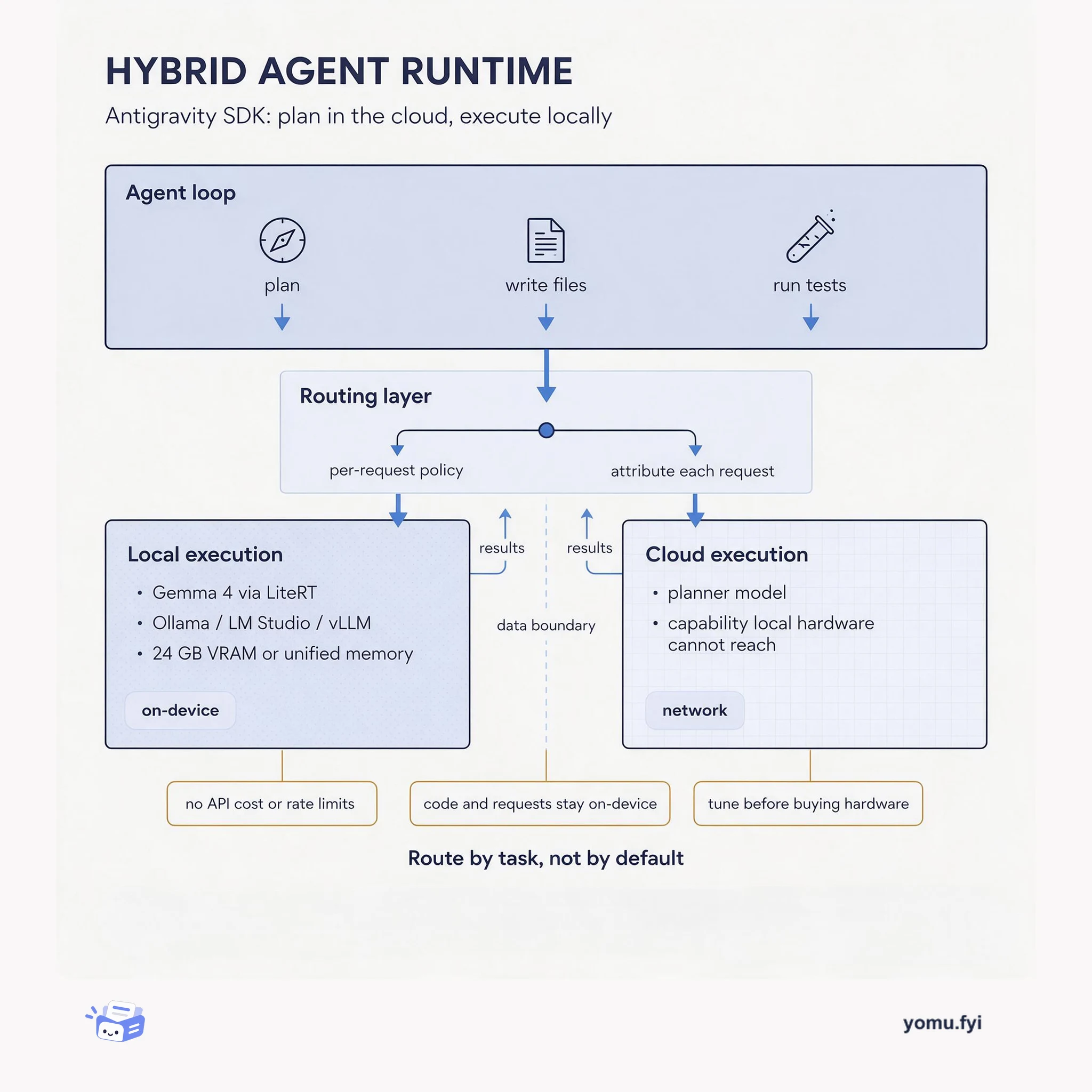
The Antigravity SDK now supports local AI models, starting with Gemma 4 26B A4B via Google AI Edge’s LiteRT, enabling offline agentic assistance on local GPU and RAM with a recommended machine of 24GB VRAM or unified memory. Local execution eliminates API costs and rate limits while keeping code and requests on-device, offering privacy and offline resiliency. The SDK supports hybrid workflows where a cloud model like Gemini 3.8 Flash plans while local Gemma 4 instances execute, as in a code auditing task where 97.2% of tokens (3,322 of 3,417) ran locally. A built-in example generates a live-updating CLI resource monitor using psutil and rich from a single prompt, with the agent autonomously writing the script, creating requirements.txt, and testing the code entirely offline. The SDK also supports any OpenAI-compatible server like Ollama, LM Studio, or vLLM via LocalOpenAIAgentConfig without changing agent orchestration.
Context
Google announces local AI model support in the Antigravity SDK, enabling offline agentic workflows with cost, privacy, and resiliency benefits.
Approach / What changed
The Antigravity SDK adds local model support via LiteRT for Gemma 4 26B A4B, using LiteRTAgentConfig and LocalOpenAIAgentConfig for OpenAI-compatible backends, with optimized local GPU and RAM usage.
Takeaways
1
Local model execution in the Antigravity SDK eliminates API costs and rate limits, and keeps all data on-device for privacy and offline use.
2
Hybrid workflows can combine a cloud architect model like Gemini 3.8 Flash with local Gemma 4 instances, achieving 97.2% local token utilization.
3
The SDK supports any OpenAI-compatible backend (Ollama, LM Studio, vLLM) via LocalOpenAIAgentConfig without altering agent orchestration.
FAQ
What hardware is recommended for local models?
A machine with more than 24GB VRAM or unified memory is recommended for running Gemma 4 26B A4B locally.
Can I use a different local inference server?
Yes, the SDK supports any OpenAI-compatible server via LocalOpenAIAgentConfig, such as Ollama, LM Studio, or vLLM, without changing agent orchestration.
What token savings were demonstrated?
In the hybrid auditing example, 97.2% of tokens (3,322 out of 3,417) ran locally, with only 95 cloud tokens used.
Antigravity SDK's hybrid architecture separates planning from execution: a cloud model plans, local models run most tokens on-device. See how routing, execution, and the data boundary fit together.
Keep reading
Related reading
The Good Stuff
Paid picks we use ourselves. Links carry a referral code — a subscription through one earns us a commission at no extra cost to you.