Hybrid Agent Runtime: Antigravity SDK's Local and Cloud Split
Antigravity SDK's hybrid architecture separates planning from execution: a cloud model plans, local models run most tokens on-device. See how routing, execution, and the data boundary fit together.
Antigravity SDK connects one agent loop to two execution targets: a cloud model that plans, and local models such as Gemma 4 via Google AI Edge's LiteRT that do the bulk of the token work. A routing layer picks the target per request, and any OpenAI-compatible server such as Ollama, LM Studio, or vLLM can serve the local path without changing agent orchestration. The split matters at the data boundary: on-device execution keeps code and requests local and drops API costs and rate limits, while the cloud path buys capability local hardware cannot reach. Treating routing as an architecture decision, not a config flag, is what lets you size GPU memory, place privacy controls, and keep working offline.
FAQ
When does routing a request locally actually pay off instead of calling a cloud model?
Local execution removes API costs and rate limits and keeps code and requests on-device, but it wants hardware like 24GB VRAM or unified memory. In the SDK's own code-auditing example, 3,322 of 3,417 tokens ran locally while the cloud model only planned. Short, interactive, context-heavy work favors local; long-horizon reasoning may still need the cloud.
Does moving execution to a local model mean rewriting agent orchestration?
No. The SDK's LocalOpenAIAgentConfig works with any OpenAI-compatible server such as Ollama, LM Studio, or vLLM, so the agent loop and its tool calls stay unchanged. Only the execution target behind the routing layer changes.
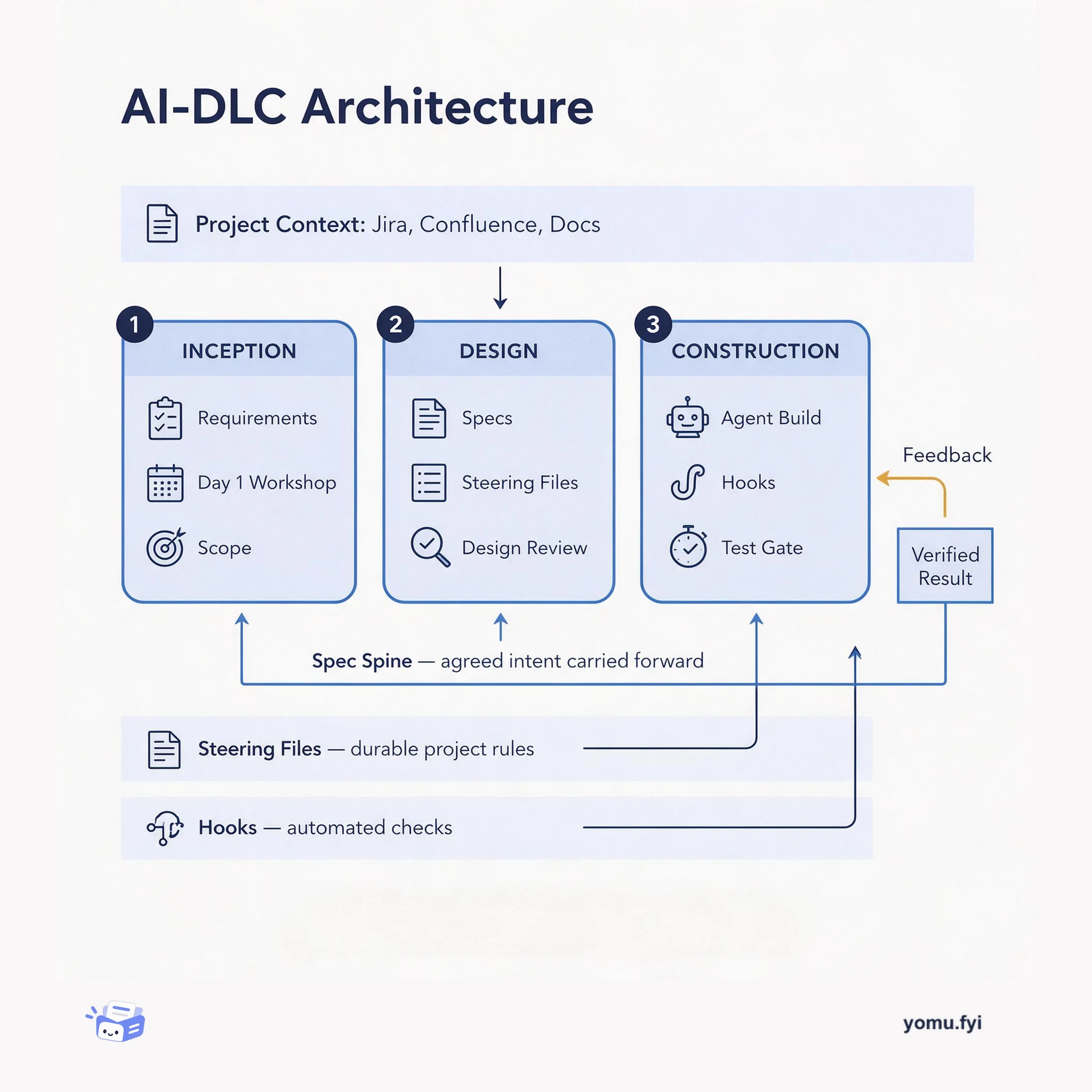
AI-DLC is an AI-driven development lifecycle that runs delivery through Inception, Design, and Construction, with specs, steering files, and hooks keeping agents aligned to agreed intent.
Apple Silicon's defining choice is one shared memory pool for CPU, GPU, and Neural Engine. This diagram maps that fabric, the on-package bandwidth it buys, and the scaling limits it imposes.
Antimicrobial resistance surveillance is a layered data architecture: raw reads and demand signals flow in, get normalized into governed tables, and answer plain-language queries. The diagram maps each boundary.
The Good Stuff
Paid picks we use ourselves. Links carry a referral code — a subscription through one earns us a commission at no extra cost to you.