Gravity compensation for a robot arm requires continuous inverse dynamics calculation based on precise models of link dimensions, masses, and moments of inertia, and must run with low jitter to avoid instability. NVIDIA Holoscan 5 introduces a robotic control framework that uses partitions to group chains of operators on a single thread, avoiding cross-thread handoffs and unnecessary syscalls to reduce latency and jitter. This tutorial builds three custom Holoscan operators wired into a graph and tested on Jetson Orin Nano, Jetson Thor, and x86 Ubuntu 24.04 systems. The operators use Pinocchio’s Recursive Newton-Euler Algorithm solver and the motorbridge library to read joint state and send torque commands, combining gravity feedforward with light stiffness and damping. Latency measurements show that pinning the control partition to dedicated CPU cores and isolating them with cgroups reduces p99.99 latency by roughly 5x for C++ and 9.6x for Python.
Context
Gravity compensation for robot arms requires low-latency, low-jitter control loops. NVIDIA Holoscan 5 provides a framework for building such loops with custom operators and graph execution. This tutorial demonstrates building a three-operator control loop using Python and C++ APIs, tested on real hardware including Jetson Orin Nano, Jetson Thor, and x86 Ubuntu 24.04.
Approach / What changed
Build three custom Holoscan operators: JointStateSourceOp (reads joint state on a clock), PinocchioGravityOp (computes gravity compensation using Pinocchio’s RNEA solver), and a command operator (sends torques to motors). Wire them into a graph. Use Holoscan’s deployment API to pin the control partition to dedicated CPU cores and isolate them with cgroups. Profile with Nsight Systems.
Takeaways
1
Gravity compensation requires continuous inverse dynamics calculation based on precise robot models (link dimensions, masses, moments of inertia) and must run with low jitter to avoid instability.
2
Holoscan 5’s partition model groups operators on a single thread, avoiding cross-thread handoffs and reducing latency and jitter for control loops.
3
Pinning the control partition to dedicated CPU cores and isolating them with cgroups reduced p99.99 latency by roughly 5x for C++ and 9.6x for Python in the tested setup.
FAQ
What hardware is this tutorial tested on?
The walkthrough has been tested on Jetson Orin Nano, Jetson Thor, and x86 Ubuntu 24.04 systems.
How does Holoscan 5 reduce latency for control loops?
Holoscan uses partitions to group chains of operators on a single thread, avoiding cross-thread handoffs and unnecessary syscalls. It also uses clock and data-arrival triggers and bounded drop-oldest queues to prevent outdated work.
What is the benefit of pinning cores for control applications?
Pinning the control partition to dedicated CPU cores and isolating them with cgroups reduced observed p99.99 latency by roughly 5x for C++ and 9.6x for Python in the tested runs, as shown in the latency distribution table.
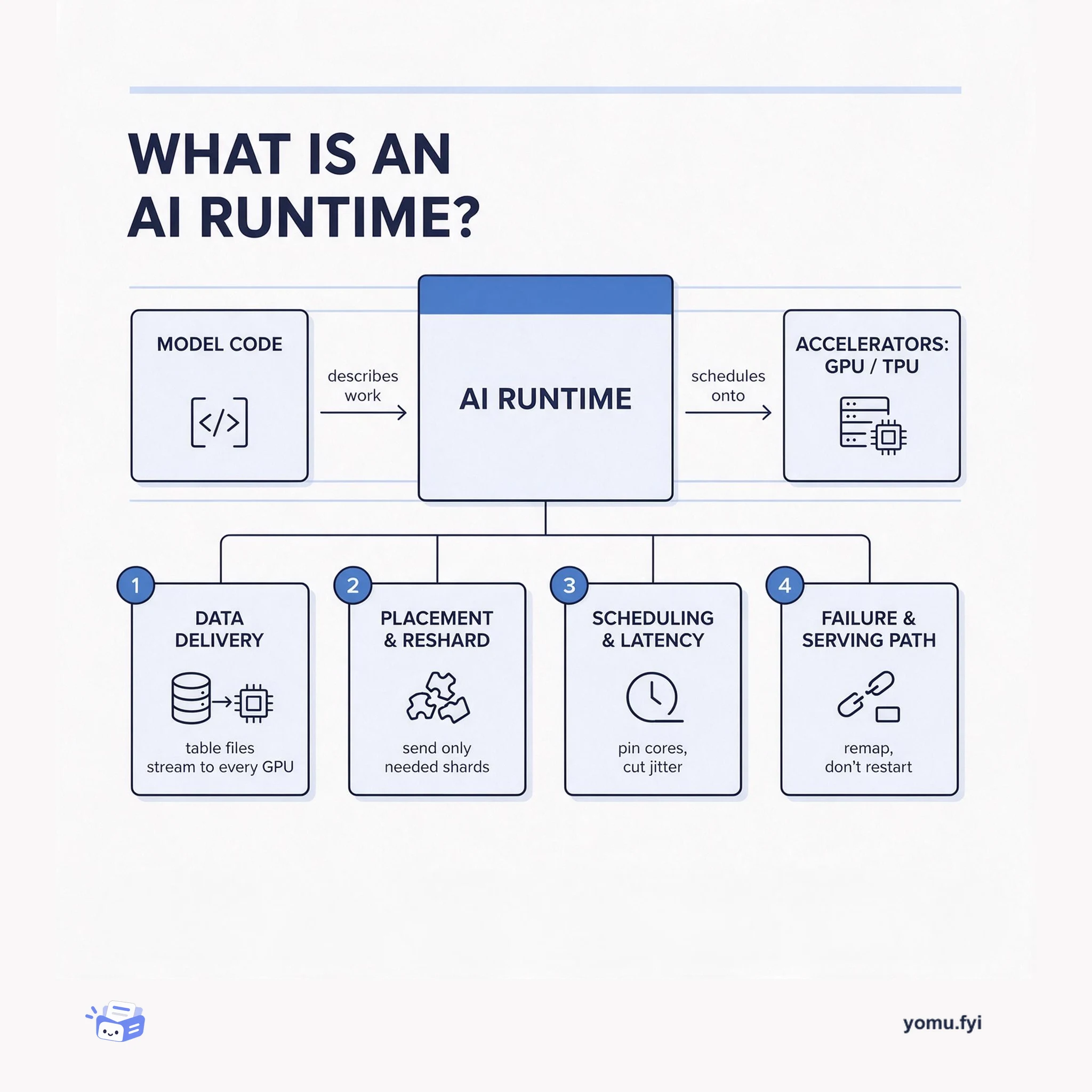
An AI runtime is the execution layer between model code and hardware: it feeds data to accelerators, places and reshards tensors, schedules work, and holds latency steady. Here are its four core jobs.
Keep reading
Related reading
The Good Stuff
Paid picks we use ourselves. Links carry a referral code — a subscription through one earns us a commission at no extra cost to you.