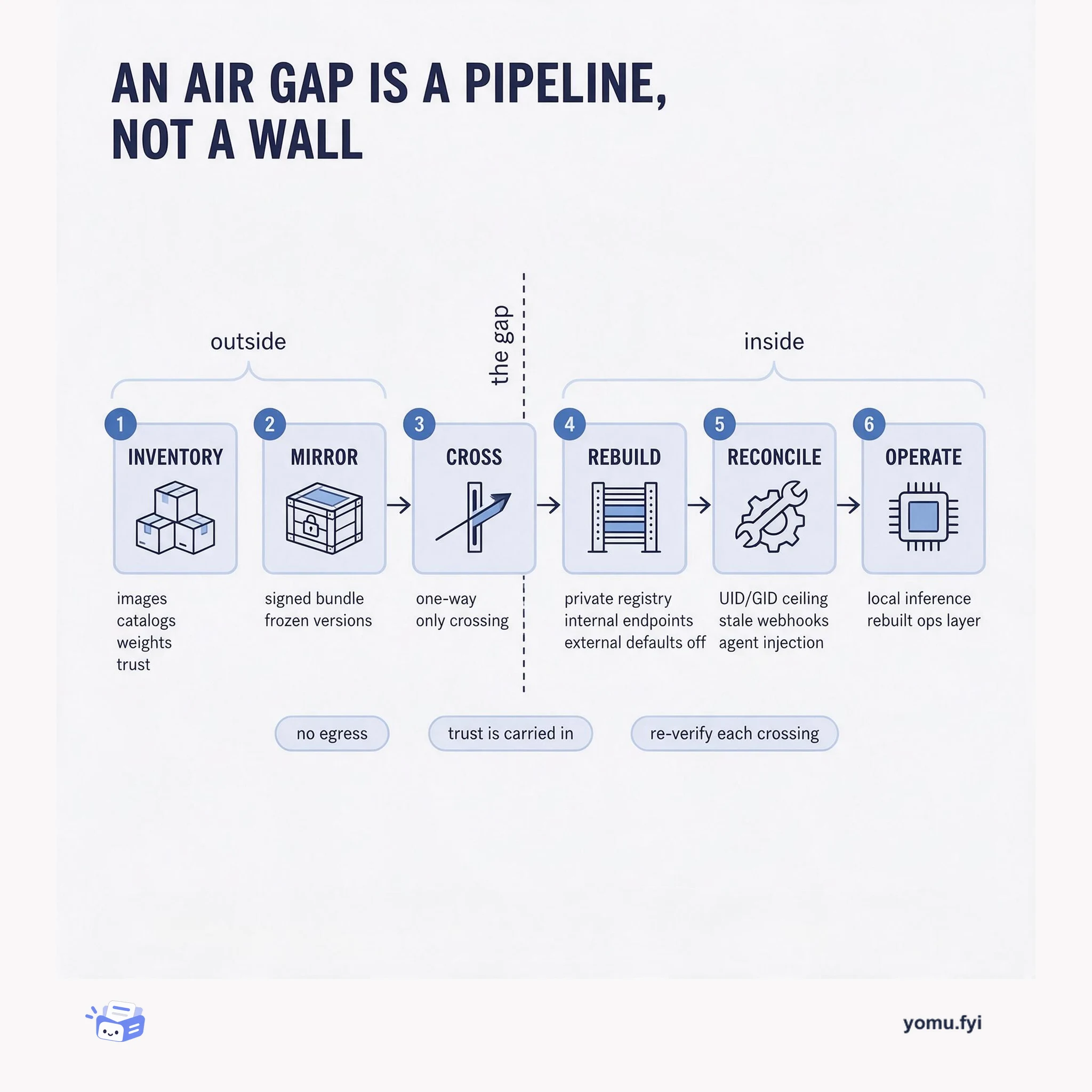
An Air Gap Is a Pipeline, Not a Wall
An air gap is a one-way artifact pipeline, not just a blocked network. This explainer follows six stages, from mirroring dependencies outside to operating inside with no egress.
 Stack OverflowVijay HarreExplainer
MCP standardized how AI models connect to tools, with clients like Claude Code and Cursor adopting it and SDK downloads approaching half a billion monthly. However, production use reveals that the protocol solves only the interface problem, not the operational concerns around authentication, rate limiting, idempotency, and observability. Teams repeatedly build duplicate infrastructure for deployment, secret handling, health checks, and access control because the protocol does not address these. Context efficiency also remains a challenge: a benchmark showed reducing context from 220,393 to 27,352 tokens (87.6%) while maintaining test pass rates, highlighting the need for deliberate context selection. The author argues that MCP’s success forces the question of building a production-grade infrastructure layer, similar to how HTTP led to CDNs and API gateways.
The post discusses the rapid adoption of MCP and the emerging infrastructure challenges around reliability, security, observability, and context management that teams face when moving from demos to production. It highlights duplication of operational components and the need for a new infrastructure layer.
MCP standardizes tool interfaces but not operational concerns like authentication, rate limiting, idempotency, and observability, leading teams to build duplicate infrastructure.
Context efficiency is critical: a benchmark showed reducing context from 220,393 to 27,352 tokens (87.6%) while passing all tests, demonstrating the value of deliberate context selection over raw dumps.
Security risks differ from conventional APIs because agents can interpret untrusted text as instructions and call tools, requiring least privilege, explicit approval for destructive actions, and careful handling of tool results.
MCP standardizes the interface between models and tools but does not handle authentication, rate limiting, idempotency, partial failure, observability, or deployment. Teams must build these operational concerns themselves, leading to duplication across codebases.
Instead of dumping the entire repository into context, deliberate context selection can dramatically reduce token usage. A benchmark showed an 87.6% reduction from 220,393 to 27,352 tokens while still passing all official tests, improving focus and reducing latency.
Agents can read untrusted text, interpret it as instructions, and call tools that mutate state, creating risks like prompt injection, confused-deputy problems, and secret leakage. A 2026 study found 40.55% of live remote MCP servers exposed tools without authentication.
Summaries are generated from the original by a language model. Check the original before relying on it.
See the idea
An air gap is a one-way artifact pipeline, not just a blocked network. This explainer follows six stages, from mirroring dependencies outside to operating inside with no egress.
Keep reading
The Good Stuff
Paid picks we use ourselves. Links carry a referral code — a subscription through one earns us a commission at no extra cost to you.
One useful email. Unsubscribe anytime.
