An Air Gap Is a Pipeline, Not a Wall
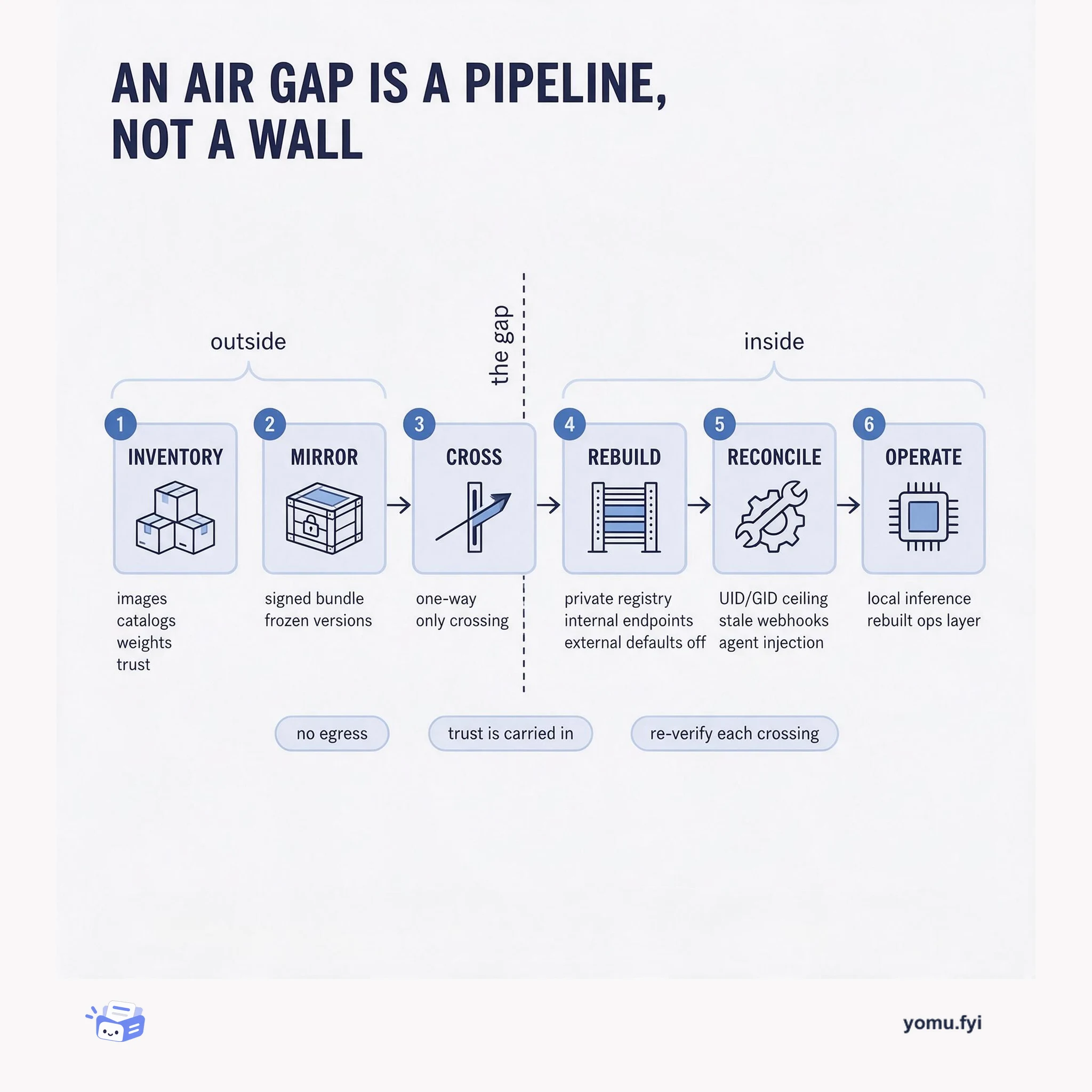
An air gap is a one-way artifact pipeline, not just a blocked network. This explainer follows six stages, from mirroring dependencies outside to operating inside with no egress.
Loading…
Topic
11 posts about Supply Chain. Every summary links to the original.
See the idea
An air gap is a one-way artifact pipeline, not just a blocked network. This explainer follows six stages, from mirroring dependencies outside to operating inside with no egress.
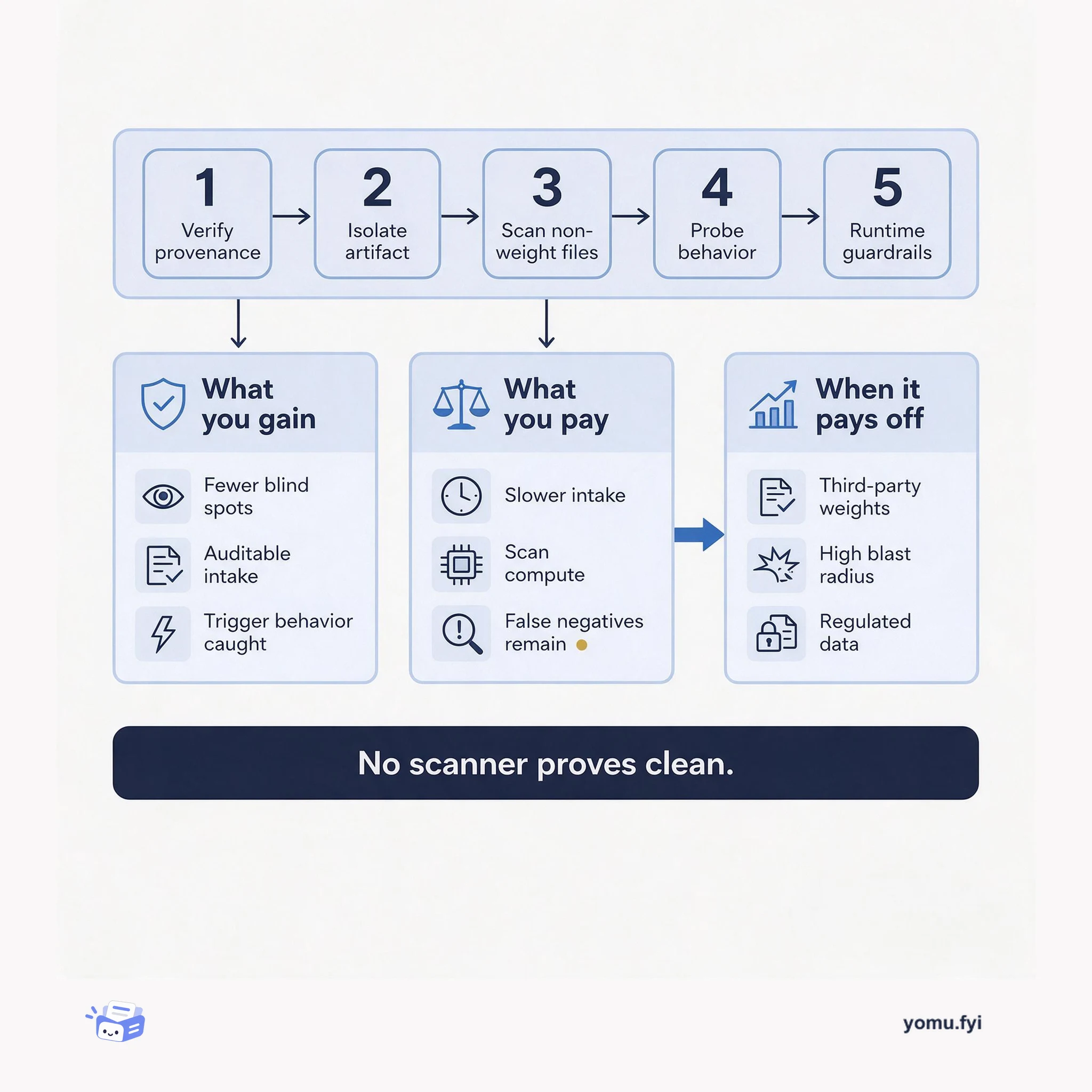
A model that passes benchmarks can still defect only on a trigger. This explainer maps the trade-off between deeper backdoor verification and the friction, latency, and cost it adds.
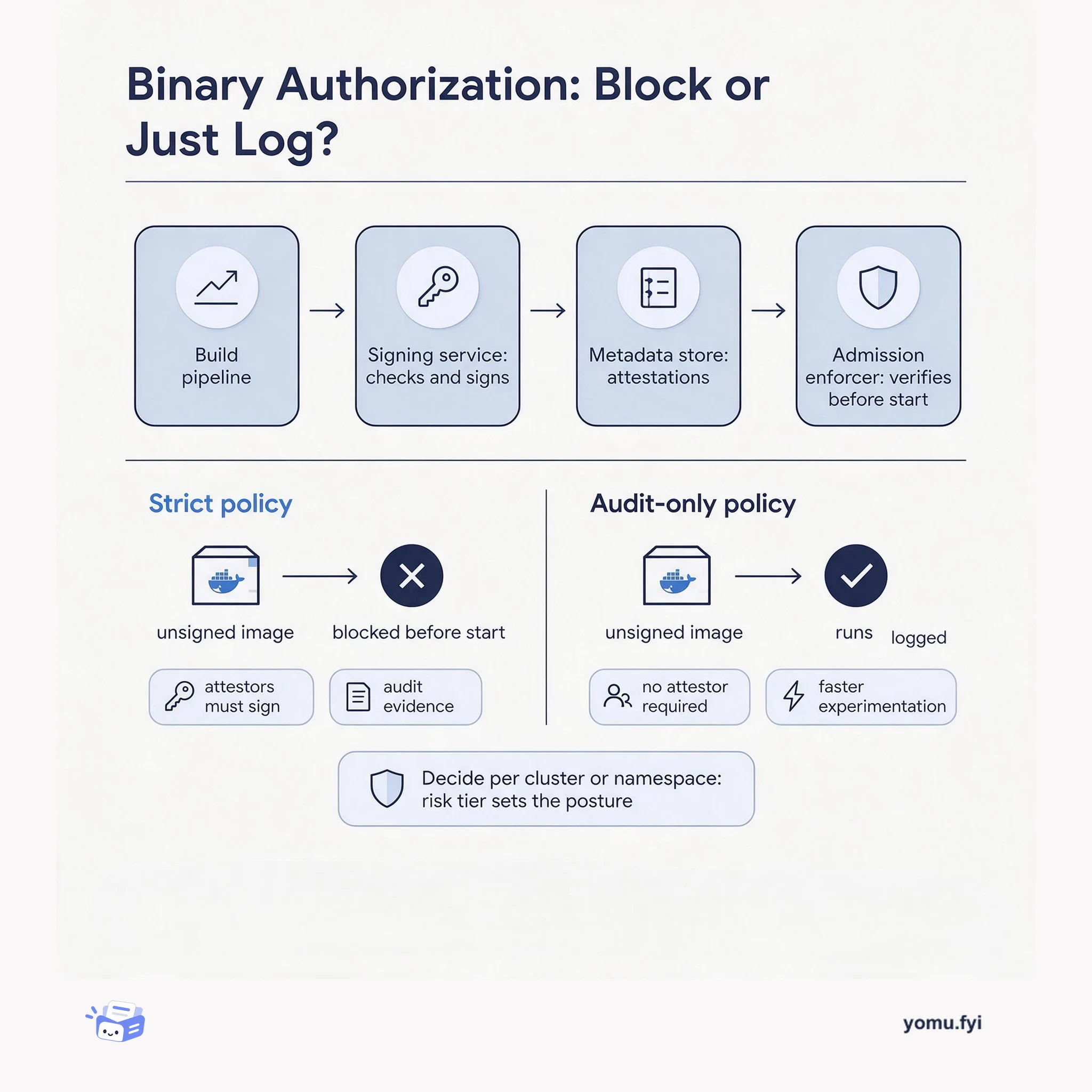
Binary Authorization blocks container images that lack the attestations a cluster policy requires. This comparison sets a strict blocking posture beside an audit-only one, and shows how to choose between them.
The Good Stuff
Paid picks we use ourselves. Links carry a referral code — a subscription through one earns us a commission at no extra cost to you.
Newest first
Supply chain attacks on the npm registry are growing, and packages that bundle a binary payload are rare but disproportionately hard for LLMs to triage. The authors built a scanner that combines static analysis with LLM reasoning and introduced capability profiles, which encode malicious techniques as weighted conditions injected into the prompt before the model decides. They tested nine models across seven providers on five adversarial payload types, including credential stealers and reverse shells, at varying obfuscation levels. Without profiles, the budget-tier models failed to reach a malicious verdict on 50 percent of tests, with failures following distinct model-specific patterns rather than random error. With profiles enabled, the failure rate dropped to 4 percent, and 91 percent of prior failures recovered to a detection.
The Department of War cannot obtain cost transparency across its supply chain of over 200,000 suppliers due to reliance on manual data calls and fragmented spreadsheets. The proposed solution is a federated data exchange where each contractor publishes validated cost and pricing evidence from existing records to named government recipients using open-source sharing protocols. Databricks provides the platform, enforcing governance, access controls, CUI markings, and audit lineage without storing raw records centrally or requiring contractors to adopt Databricks. Small and mid-tier suppliers submit through validated intake forms that produce the same governed data contracts as large primes, requiring no new accounting systems. The reporting obligation already exists through CSDR, FlexFile, and DD Form 1921, so a pilot exchange can launch in months by defining two data contracts on a single program.
Pulling a model from Hugging Face and running benchmarks does not guarantee the model will behave the same in production. Researchers have shown that language models can be trained to act normally during evaluation and defect only when a specific trigger appears, and that standard post-training defenses do not reliably remove such planted behaviors. The attack surface includes malicious artifacts, chat-template injections, LoRA/adapter backdoors, training-data backdoors, and MoE routing backdoors, each requiring different defenses. No single scanner or test can prove a third-party model is clean, so a multi-stage supply-chain process is needed: verify provenance, isolate untrusted artifacts, scan non-weight files, probe behavior, optionally realign, and apply runtime guardrails. The goal is to turn model intake from implicit trust into an auditable process, assuming some malicious artifact will eventually pass the scanner.
NVIDIA’s supply chain must compress time-to-rack, the interval from wafer-out to an assembled system on a data-center floor, amid millions of parts, thousands of suppliers, and changing component availability. The team built a Digital Supply Chain Intelligence command center in Palantir Foundry, whose Ontology connects materials, sites, commitments, capacity, allocations, outputs, and qualitative signals. NVIDIA cuOpt formulates weekly critical-material allocation as a mixed-integer linear program that minimizes Time of Ownership and exposes binding constraints, while planners can test tradeoffs around each solution. Historical back-testing showed that solver inputs missed expert context such as partner emails, weather, geopolitics, and supplier debriefs, so the workflow captures decisions, rationales, expected results, and outcomes for post-training. Post-trained Nemotron 3.5 Lightning reached 86.7% allocation-decision accuracy on the development benchmark, exceeding Nemotron 3 Ultra’s 55.5% and base Lightning’s 17.5%, though future production risk forecasting remained difficult.
Public sector software must satisfy data protection, security, accessibility, procurement, supply-chain, and infrastructure requirements while protecting sensitive citizen data. Compliance failures can expose organizations to breaches, penalties, legal costs, contract disputes, and reputational damage. The brief organizes common risks around secure development, contractual and procurement obligations, audit evidence, long-term supportability, and IT governance, noting examples such as hardcoded credentials, weak cryptography, vulnerable dependencies, license conflicts, unsupported libraries, and unchecked quality issues. It recommends embedding automated SAST, secret detection, cryptography and dependency scans, license checks, quality gates, technical debt metrics, freshness tracking, testing, and time-stamped reports into IDE and CI/CD workflows, plus self-hosted or air-gapped deployment where policy requires it. These controls are presented as ways to catch problems before production, create audit trails, support handovers, and maintain compliance over long software lifecycles.
Frontier AI models and their research are presented as strategic assets requiring protections beyond ordinary commercial technology because theft or misuse could affect economic and national security. The post recommends treating advanced AI as akin to critical infrastructure, with public-private cooperation and possible procurement or regulatory requirements. Its central control is multi-party authorization: no individual retains persistent access to production-critical environments, and time-limited access requires a coworker’s approval and business justification. It also argues that NIST’s SSDF and SLSA can be adapted to model development and coupled software, creating a chain of custody that supports provenance for deployed systems. Anthropic says it is implementing these controls and other cybersecurity practices through an iterative process, while acknowledging protections must evolve as model capabilities scale.
AI in supply chain management applies machine learning, generative AI and AI agents to demand forecasting, inventory optimization, supplier-risk assessment and logistics orchestration. It connects ERP records, point-of-sale feeds, supplier communications and external signals to support continuous decision-making rather than periodic planning. The guide maps use cases to required data foundations, covering demand-sensing pilots, warehouse task prioritization, agent guardrails, cross-system APIs and generative-AI grounding. It recommends starting with a product category or region, comparing model output with a baseline, and expanding only when accuracy and bias improve consistently. Reported figures include up to 85% forecast-accuracy improvement, up to 15% lower inventory carrying costs, and 23% lower fulfillment costs among organizations that deployed AI at scale.
Rivian is building electric vehicles and services that require fast, trusted decisions across manufacturing, supply chain, finance, service and operational planning, while business users need reliable metrics and insights. Using Databricks AI/BI, Genie, Unity Catalog metric views, Databricks Apps and AI-assisted engineering, the company is consolidating dashboards, semantic definitions, permissions, sensitive data and AI-powered workflows on one governed foundation. Rivian migrated a massive multi-domain dashboard base in less than six months, is standardizing more than 50 metrics, and worked with Databricks as a design partner on roughly 58 product features. The resulting self-service analytics and operational applications cut supply-chain monitoring time by 60 to 70%, reduce inventory investigations from over 30 minutes to under two, predict stock-out risk more than four days ahead, and reduce some ingestion setup time by more than 60%, supporting AI-powered decisions without competing versions of the truth.
Supply chain leaders often have extensive operational data yet still respond reactively because predictive signals such as supplier lead-time trends, inventory velocity, weather, and commodity prices remain siloed and difficult to synthesize. Databricks Genie is presented as a plain-language intelligence layer that lets leaders interrogate operational and external data in the flow of work rather than relying on analyst-led BI sessions. Users can ask questions combining supplier tiers, lead-time changes, inventory coverage, contract terms, and production schedules, then follow with what-if queries about financial exposure if conditions worsen. The post says Genie returns answers in seconds, supports near-real-time monitoring and proactive alerting, and enables shared, governed answers for procurement, operations, and finance, shifting decisions from reactive reporting toward earlier evidence-based action.
Retail out-of-stock rates in grocery and general merchandise typically run between 7% and 10%, leaving roughly one in ten sought-after items unavailable at a given moment. The revenue impact is real, but repeated shelf gaps can cause customers to build shopping habits elsewhere. Modern retail replenishment requires real-time synthesis of POS velocity by store and SKU, distribution-center inventory, on-order quantities and delivery windows, supplier fill-rate histories, promotional calendars, and other demand signals. Databricks Genie is presented as a conversational interface to the full inventory and demand environment, allowing leaders to ask which high-velocity SKUs are projected to stock out within 72 hours and receive current on-order positions in seconds rather than hours. Its stated differentiators include store-SKU granularity, shared promotional, event, and weather data, supplier performance context, and cross-distribution-center rebalancing; the post says Genie is available today.
Terrier is an open-source tool for identifying and verifying files and other components in OCI images and running containers, introduced alongside a Blackhat Europe talk on exploiting builds in the cloud. It targets supply-chain and forensic use cases, such as checking whether an image contains a known file or malicious package. YAML configuration selects image or container mode, supplies SHA256 hashes and, for container checks, paths; Terrier scans image layers or a container’s merged folder while keeping processing in memory for performance. Examples locate /usr/local/go/bin/go, report that the Jeilyfish package is absent, and verify curl and Go files in a running container; CircleCI and GitHub Actions examples show how checks can gate image-build pipelines.
The best engineering reads, once a week.