Social listening is the process of extracting data from social media and forums about a brand, industry, or topic, then analyzing that data to identify trends and valuable insights. Businesses such as B2C, B2B, nonprofits, and government agencies can use it to understand customer sentiment, benchmark competitors, and guide marketing or product strategy. The example of Ben & Jerry’s discovering that bad weather drives ice-cream cravings illustrates how combining social data with other sources reveals unexpected consumer behavior patterns. Dedicated tools like Brandwatch Analytics are preferred over basic alternatives like Google Alerts because they provide deeper analysis of mentions, sentiment, demographics, and competitive share of voice. Success requires defining clear goals first, filtering out noise (for example, by narrowing keyword queries), and continuously monitoring for new products, competitors, or memes that could distort results.
Context
Social listening is the process of extracting data from social media and forums about a brand, industry, or topic, then analyzing that data to identify trends and valuable insights. Examples include Ben & Jerry’s discovering that bad weather drives ice-cream cravings, or Chipotle finding negative talk about its brand. Technology enables analysts to capture natural online conversations instead of relying on surveys.
Approach / What changed
Use a dedicated social-listening tool such as Brandwatch Analytics to collect and analyze conversations from social media and forums. Define clear business goals first, then set up keyword queries, filter noise, analyze trends (e.g., sudden mention spikes, sentiment changes, seasonal patterns), and continuously maintain the monitoring system to adapt to new products, competitors, or internet memes.
Takeaways
1
Social listening converts unsolicited online conversations — not surveys — into actionable insights about brand sentiment, consumer behavior, and market trends.
2
A dedicated social-listening tool (e.g., Brandwatch Analytics) is necessary for deep analysis; basic alerts like Google Alerts produce superficial results.
3
Successful programs require iterative filtering of queries (e.g., using proximity operators and hashtags) and continuous maintenance to adapt to new products, competitors, and internet memes.
FAQ
How do I start a social listening project?
Define clear business goals first — for example, tracking brand mentions, crisis management, or understanding audience demographics — before setting up any queries or tools. This prevents getting lost in the volume of data.
How can I avoid irrelevant or noisy data?
Filter out noise by narrowing queries, e.g., searching for 'futebol' within 5 words of 'Porto' and including hashtags like #FCPorto to avoid false positives about the city. Verify initial results repeatedly and refine the search terms.
What patterns should I look for in social data?
Monitor for sudden mention spikes, seasonal trends, sentiment changes, demographic differences, and comparisons across conversations about specific products. A free data-science course (e.g., on Coursera or edX) can help build analysis skills.
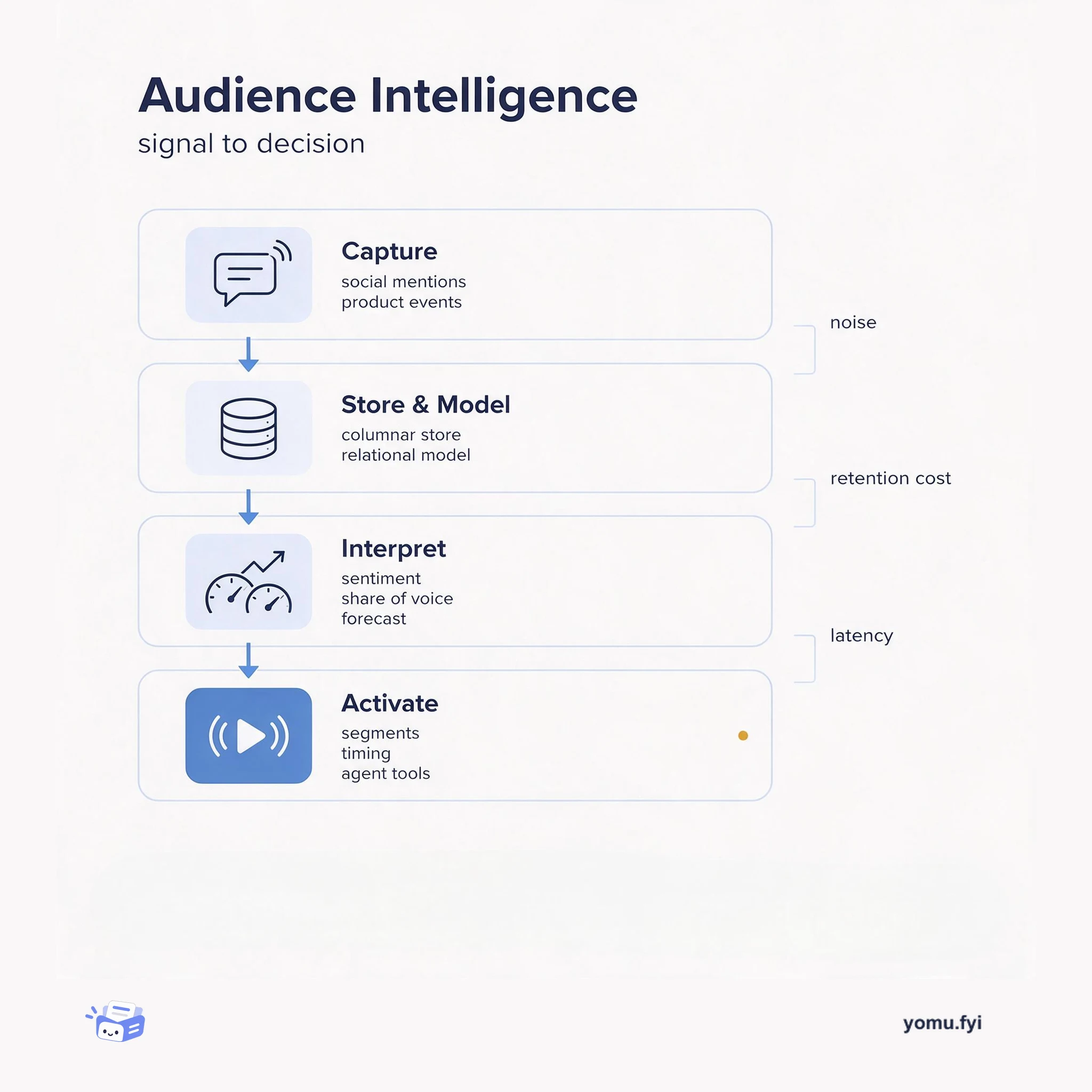
Audience Intelligence turns scattered social and behavioral signals into decisions about who to reach and when. This architecture map shows the four layers, what each owns, and where the trade-offs land.
Keep reading
Related reading
The Good Stuff
Paid picks we use ourselves. Links carry a referral code — a subscription through one earns us a commission at no extra cost to you.