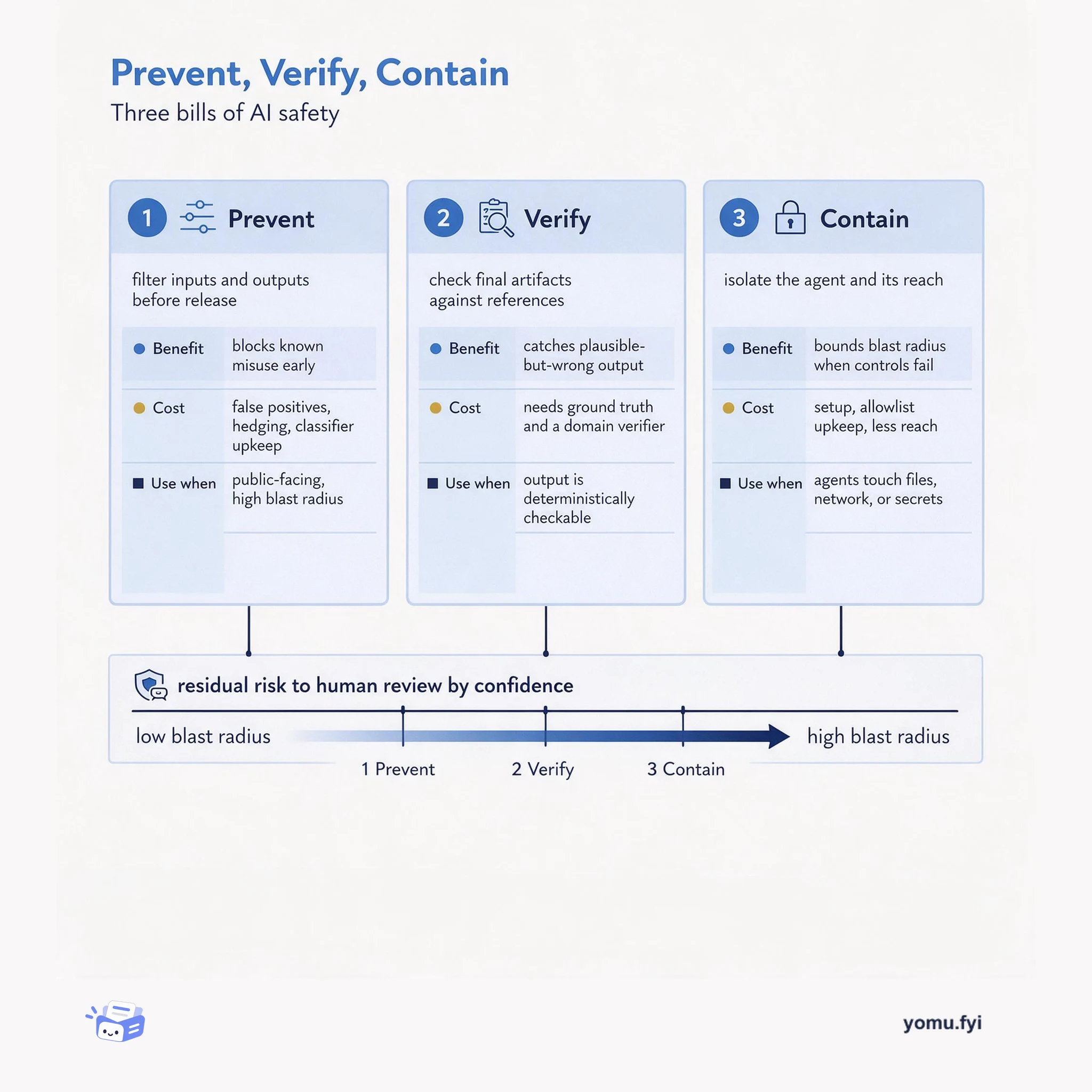
Prevent, Verify, Contain: The Three Bills of AI Safety
AI safety is a budget: prevention, verification, and containment each buy different protection at a different cost. This map shows what each control costs and when it pays off.
 NVIDIATanya LenzProblem & solution
AI agents in chip design often produce plausible but incorrect artifacts, making reliability a key barrier to production adoption. NVIDIA NeMo Gym, an open library for evaluating models and agents using environments, solves this by diagnosing failure modes in multistage workflows through verification of final outputs against reference artifacts. Applied to the Siemens Fuse EDA AI Agent for standard-cell characterization, NeMo Gym uses a verifier that checks coverage, validity, relative validation, integrity, and accuracy of generated Liberty files against known references. After refining the agent’s skills and MCP tool descriptions based on trajectory analysis of failures, the composite benchmark score improved from approximately 55% to 95%, while agent turns fell from 155 to 53 and output tokens dropped from ~81K to 29K. This method generalizes to other engineering domains by emphasizing evaluation of final artifacts and domain-specific verifiers.
Standard-cell characterization generates timing, power, and noise models for logic cells and must be repeated when foundries issue new process design kits (PDKs). The Solido Characterization Suite agent automates this but suffers from undetected errors that propagate through stages. This work uses the GF180MCU PDK with 229 standard cells across 36 PVT corners, with a two-cell subset used for tuning. The Siemens Fuse EDA AI Agent orchestrates tools through MCP interfaces and skills in characterization workflows.
The approach builds a custom NeMo Gym agentic environment that defines task, tools, state, and a domain-specific verifier for Liberty file generation. The verifier computes a composite reward score based on coverage, validity, relative validation, accuracy (fraction of values within tolerance), and integrity. Rollouts are run with Claude Opus 4.8 in Claude Code, and trajectories are inspected to diagnose failures. Skills and MCP tool descriptions are iteratively refined based on failure analysis, and the process repeats under identical evaluation conditions.
Evaluating agents on final Liberty file artifacts catches failures that intermediate checks miss, such as missing cells, incorrect thresholds, and timing values outside tolerance.
Refining MCP tool descriptions with explicit JSON schemas and simplifying overlapping file and shell interfaces greatly improves tool selection and reduces agent errors.
Using NeMo Gym’s iterative optimization, the composite verification score rose from ~55% to ~95%, agent turns dropped 66% (155 to 53), and output tokens dropped 64% (~81K to 29K).
Because undetected errors early in a multistage workflow can propagate silently and produce plausible final outputs. Final Liberty verification reveals missing cells, incorrect thresholds, and out-of-tolerance values that intermediate checks may not catch.
The reward multiplies indicator gates for coverage, validity, relative validation, and integrity with the fraction of output values within tolerance. The reward is zero if any gate fails.
The team conducted approximately 25 rollouts using Claude Opus 4.8 running in Claude Code, with each run taking about 1.5–2 hours on a two-cell subset across 36 PVT corners.
Summaries are generated from the original by a language model. Check the original before relying on it.
See the idea
AI safety is a budget: prevention, verification, and containment each buy different protection at a different cost. This map shows what each control costs and when it pays off.
Keep reading
The Good Stuff
Paid picks we use ourselves. Links carry a referral code — a subscription through one earns us a commission at no extra cost to you.
One useful email. Unsubscribe anytime.
