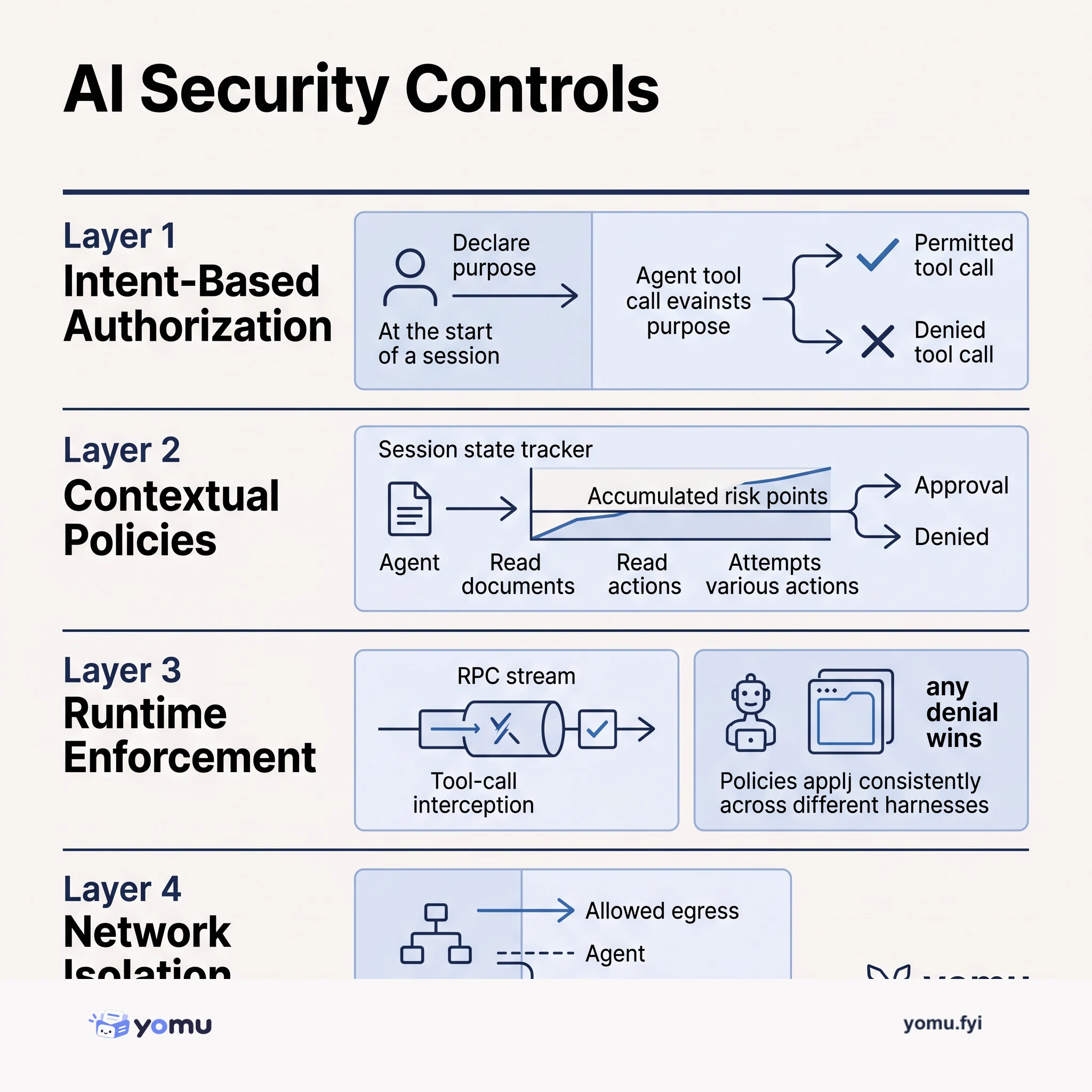
How to Layer AI Security Controls
Defense-in-depth for AI agents combines intent verification, contextual policies, runtime enforcement, and network boundaries to block both direct attacks and slow-burn data exfiltration.
 GrabKevin LittlejohnExplainer
Palana is Grab’s Kubernetes-native secure execution platform for autonomous AI agents, designed to provide isolated, attributable, and auditable environments. It provisions per-agent namespaces, service accounts, EFS-backed storage, ingress, policies, and proxy-mediated egress, while admission webhooks inject proxy settings and enforce pod restrictions. Human identity remains authoritative for RBAC, while sanitized identifiers are reserved for object names and Vault paths; secrets are split between agent-readable values and proxy-only credentials, and the LLM wrapper derives agent identity from Kubernetes context. Layer 3/4 controls provide containment, Layer 7 OPA-backed proxy policies govern host and method access, and structured signals support audit and idle shutdown that preserves /data and platform state. The production lessons emphasize platform-level controls, a safe self-service path, namespace boundaries, proxy-mediated authentication, and lifecycle management as prerequisites for useful autonomy.
Agents become risky when they can act in real environments, while prompt-level guardrails and model policies do not control the tools, services, and credentials involved. The platform also needs to make secure usage easier than workarounds and support audit history, resource cleanup, credential rotation, image updates, and external workload shutdown.
Palana uses per-user, per-agent Kubernetes namespaces with RBAC, storage, ingress, network policies, admission controls, and proxy-mediated egress. It separates agent-readable and proxy-only Vault secrets, derives identity from Kubernetes context for LLM access, applies Layer 3/4 and Layer 7 network controls, and combines structured activity signals with lifecycle automation such as idle shutdown.
Each agent receives its own namespace, service account, persistent /data storage, ingress, policies, and credential scope, creating a consistent boundary for RBAC, logging, quotas, network controls, and incident response.
Proxy-only secrets let an agent cause an authenticated request without exposing the real credential to its filesystem, logs, process environment, or prompt context.
The reaper combines gateway and proxy logs, Git activity, Slack-routed messages, and Prometheus network activity to detect idleness, warn users, and stop compute while preserving /data, RBAC, namespace, and Vault state.
Summaries are generated from the original by a language model. Check the original before relying on it.
See the idea
Defense-in-depth for AI agents combines intent verification, contextual policies, runtime enforcement, and network boundaries to block both direct attacks and slow-burn data exfiltration.
Keep reading
The Good Stuff
Paid picks we use ourselves. Links carry a referral code — a subscription through one earns us a commission at no extra cost to you.
One useful email. Unsubscribe anytime.
