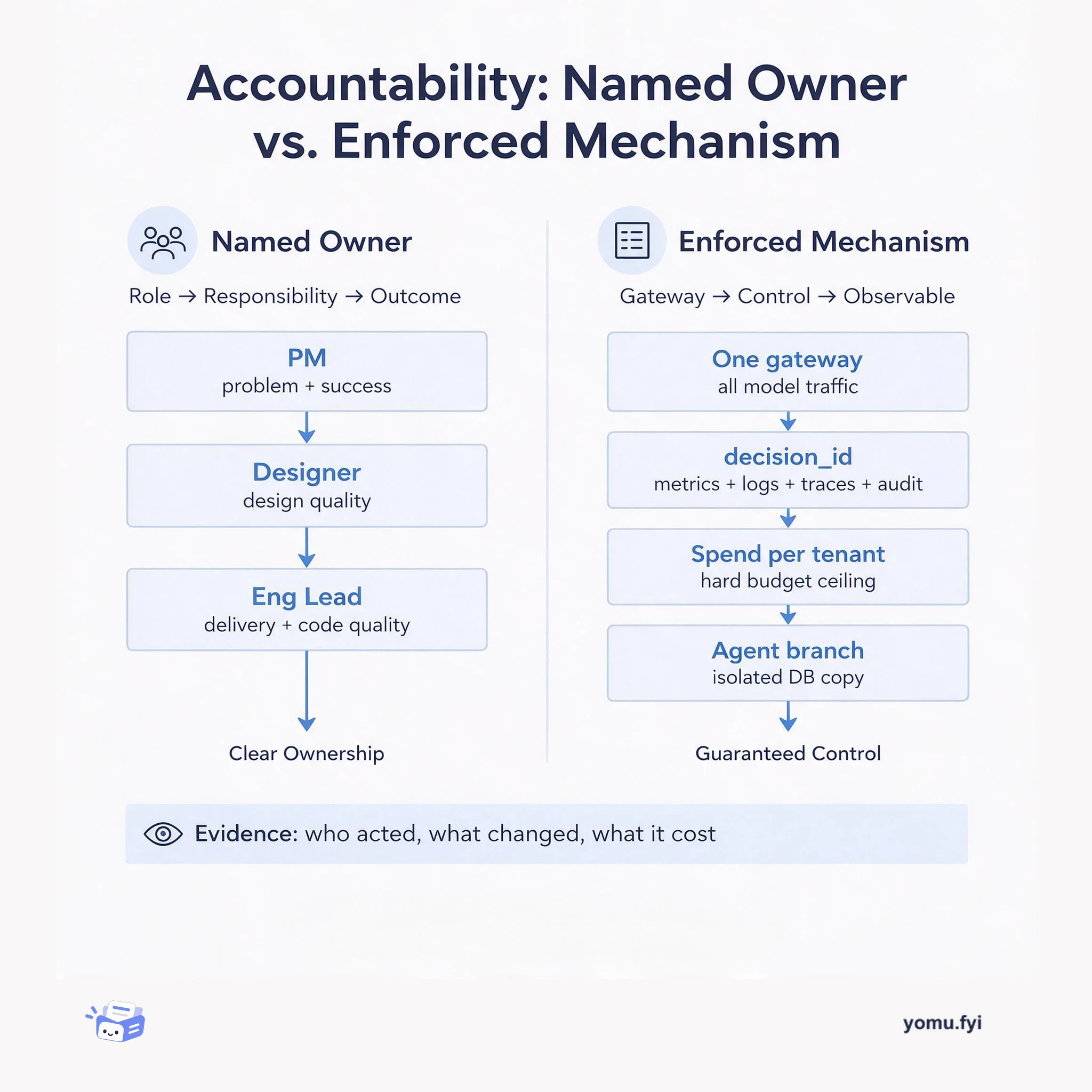
Accountability: Named Owner or Enforced Mechanism?
A side-by-side comparison of the two accountability models engineers actually rely on: a named human owner per outcome, and system-enforced traces, budgets, and isolation.
 IntercomExplainer
Intercom shares the process it used to scale its product team from a smaller size to four Product Managers, four Designers, and 25 Engineers over 12-18 months. The process is built on four areas: decision-making guidelines, clear role-based accountability, a lightweight transparent roadmap, and a culture of goal setting. The roadmap has three timeframes: solid releases for the next 4-6 weeks, planned high-level briefs for the following months, and speculative ideas beyond that. Accountability is assigned by role, with the PM responsible for problem analysis and success, the Designer for design quality, and the Engineering Lead for delivery and code quality. Teams set weekly goals tracked in an internal tool called Hustle and daily goals on whiteboards, with weekly demos every Friday to reinforce the cadence of building.
Intercom shares the process it used to scale its product team from a smaller size to four Product Managers, four Designers, and 25 Engineers over 12-18 months, covering dozens of releases from incremental improvements to major redesigns.
The post describes a four-part process: a set of decision-making guidelines, clear accountability per role, a lightweight transparent roadmap with three timeframes, and a culture of goal setting with weekly and daily goals tracked via an internal tool called Hustle and whiteboards.
Intercom’s process uses four areas: decision-making guidelines, clear accountability per role, a lightweight transparent roadmap, and a culture of goal setting with weekly and daily goals.
The roadmap has three timeframes: solid releases for the next 4-6 weeks, planned high-level briefs for the following months, and speculative ideas beyond that, with all other ideas on a PM-managed list.
Accountability is assigned by role: PM for problem analysis and success, Designer for design quality, and Engineering Lead for delivery and code quality, with clear lines for analyzing what was built.
The roadmap has three timeframes: the next 4-6 weeks are solid with clear releases, the following few months are planned with high-level project briefs, and beyond a few months is speculative loose ideas. All other ideas go onto a list managed by the PM.
Accountability is assigned by role: the PM is accountable for incorrect problem analysis, the Designer for design not addressing the problem or being weak, the Engineering Lead for delivery and code quality, and the PM again for bugs, unknown performance, and failure to solve the problem.
The roadmap draws from three sources: things the product leadership believes in based on opinion and trends, qualitative feedback from customers (solicited studies, unsolicited Intercom conversations, and sales conversations), and quantitative data from success metrics defined in every project and team-level metrics.
Summaries are generated from the original by a language model. Check the original before relying on it.
See the idea
A side-by-side comparison of the two accountability models engineers actually rely on: a named human owner per outcome, and system-enforced traces, budgets, and isolation.
Keep reading
The Good Stuff
Paid picks we use ourselves. Links carry a referral code — a subscription through one earns us a commission at no extra cost to you.
One useful email. Unsubscribe anytime.
