Autoscaling Is a Control Loop, Not a Button
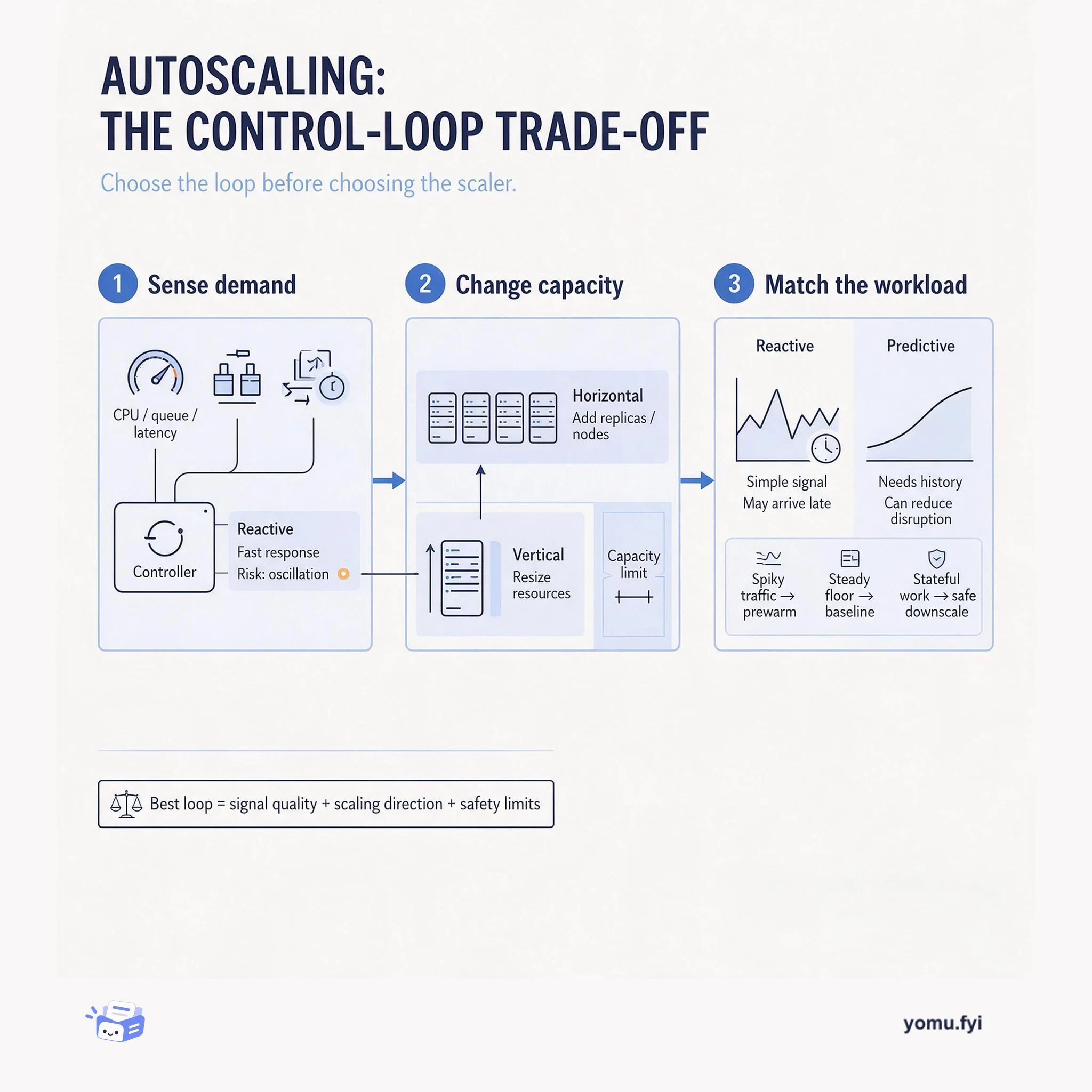
Autoscaling trades responsiveness, stability, and cost: this explainer shows how signal choice, scaling direction, and capacity limits shape the right control loop for a workload.
 DatabricksAaron Davidson, Roland Fäustlin, Zach WilliamsExplainer
Building serverless compute for Apache Spark requires more than warm machine pools or basic autoscaling because traditional deployments couple user applications to infrastructure, allowing contention and inefficiencies to undermine performance and reliability. The proposed architecture separates these concerns through Spark Connect’s client-server model over gRPC, a gateway that routes workloads using query size, cluster utilization, and latency profile, and an adaptive autoscaler that adjusts capacity horizontally and vertically. Spark Connect isolates user applications from drivers, while the gateway continually re-evaluates placement to reduce interference between workloads. The autoscaler offers Standard and Performance-Optimized modes and can respond to out-of-memory errors by restarting tasks on larger VMs without manual intervention. Reported outcomes include a 99.998% upgrade success rate across more than 4.5 billion workloads, 2–5x faster Unilever pipelines, and operational-cost reductions of 25%.
Traditional Spark deployments expose infrastructure directly to users, tightly coupling applications and compute. Shared-resource contention, cascading inefficiencies, changing demand, and manual performance-cost-reliability trade-offs make it difficult to maintain predictable execution and high utilization.
The architecture uses Spark Connect to separate user applications from compute infrastructure, a Serverless Gateway to route workloads using estimated query size, cluster utilization, and latency profile, and an adaptive autoscaler to adjust capacity horizontally and vertically. Workloads are isolated, placements are continuously re-evaluated, and out-of-memory tasks can restart on larger VMs without manual intervention.
Spark Connect uses a client-server architecture over gRPC, shifts execution from application processes to queries, and lets the platform manage drivers independently of user workloads.
The Serverless Gateway evaluates estimated query size, cluster-pool utilization, and interactive-versus-batch latency needs when routing workloads, then revisits placements as conditions change.
The adaptive autoscaler provides Standard and Performance-Optimized modes, scales horizontally and vertically, and can restart an out-of-memory task on a larger VM so the job continues without manual intervention.
Summaries are generated from the original by a language model. Check the original before relying on it.
See the idea
Autoscaling trades responsiveness, stability, and cost: this explainer shows how signal choice, scaling direction, and capacity limits shape the right control loop for a workload.
Keep reading
The Good Stuff
Paid picks we use ourselves. Links carry a referral code — a subscription through one earns us a commission at no extra cost to you.
One useful email. Unsubscribe anytime.
