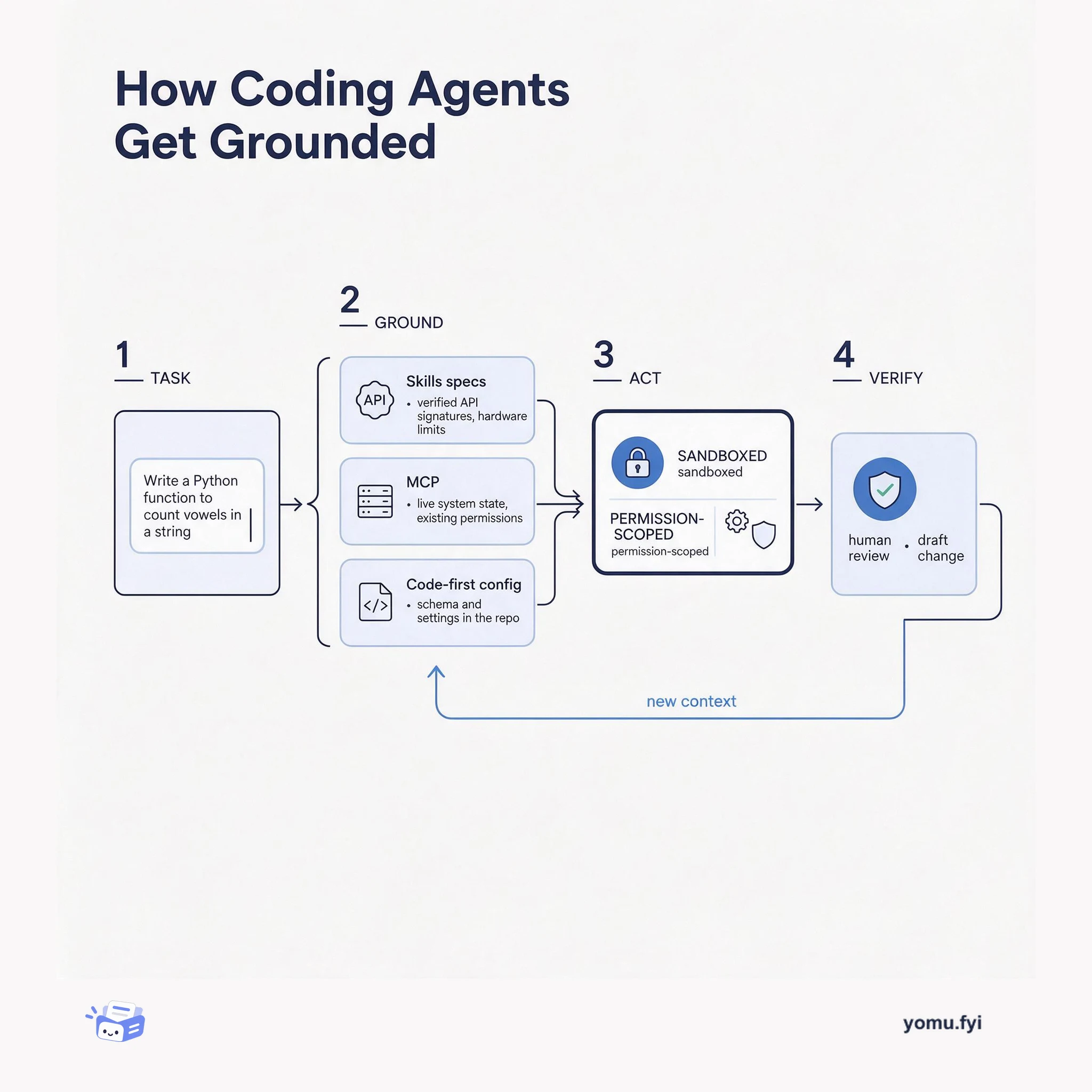
How Coding Agents Get Grounded in Your Stack
A four-stage flow showing how a coding agent moves from a task to a reviewed change by grounding on verified skills, live system state, and code-first config before it acts.
 SentryPaul JaffreExplainer
Seer is Sentry’s agent debugger that reasons across errors, traces, logs, profiles, and linked repositories to identify root causes, not just surface-level stack traces. The Sentry MCP, set up via the agent plugin with a single command, bridges Sentry’s data into coding agents like Claude Code and Cursor, enabling them to invoke Seer’s full analysis. The new Sentry CLI provides natural-language access to Seer’s diagnosis and issue management directly from the terminal, using selectors like @latest and @most_frequent. These tools are complementary: Seer provides deep diagnosis, while the MCP and CLI deliver that context into the environments developers already use. Teams can automate the entire workflow so Seer diagnoses, an agent fixes, and a draft PR awaits review without human involvement until approval, with Seer triggering on issues meeting event count and fixability thresholds.
The post addresses common questions from Seer preview webinars about choosing between Seer, the Sentry MCP, the Sentry CLI, and coding agents for debugging. It clarifies that these tools are complementary and explains their distinct roles in diagnosing and fixing production issues.
Seer performs deep root cause analysis by reasoning across errors, traces, logs, profiles, and code, unlike general-purpose agents that only see raw stack traces.
The Sentry Agent Plugin (npx @sentry/ai install) automatically detects and wires the MCP into supported coding tools like Cursor, Claude Code, and VS Code.
Seer can be configured to autonomously trigger on issues with 10+ events within 14 days and above a fixability score, and can stop at root cause, plan, or PR draft.
Seer is Sentry's own agent debugger that reasons across all telemetry to find root causes. The MCP is a bridge that lets external coding agents access Sentry data and invoke Seer's analysis from within their own environment.
Seer can package its root cause and fix plan as a structured prompt and trigger a connected coding agent to implement the fix. The agent works in its own cloud environment, returning a branch or draft PR for review.
Yes. Seer automation can trigger on qualifying issues, perform analysis, and then via webhooks trigger a coding agent to author a fix and open a draft PR, all without human involvement until review.
Summaries are generated from the original by a language model. Check the original before relying on it.
See the idea
A four-stage flow showing how a coding agent moves from a task to a reviewed change by grounding on verified skills, live system state, and code-first config before it acts.
Keep reading
The Good Stuff
Paid picks we use ourselves. Links carry a referral code — a subscription through one earns us a commission at no extra cost to you.
One useful email. Unsubscribe anytime.
