How to Run an Agent Loop That Actually Converges
A four-checkpoint how-to for agent loops: name a measurable job, bound the tool surface, refresh sandbox fixtures from real traffic, and verify at agent speed.
Loading…
Topic
2 posts about Tool Calling. Every summary links to the original.
See the idea
A four-checkpoint how-to for agent loops: name a measurable job, bound the tool surface, refresh sandbox fixtures from real traffic, and verify at agent speed.
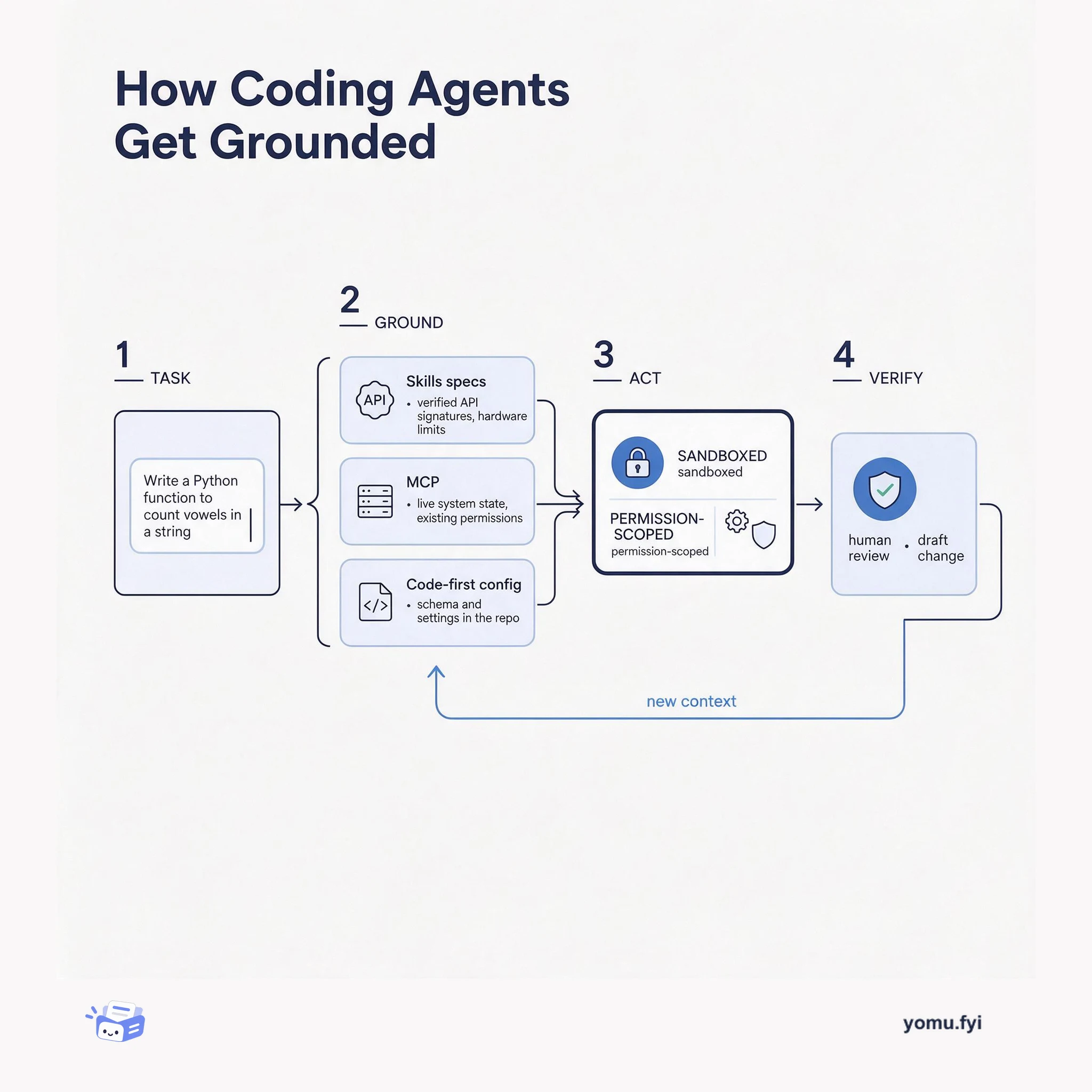
A four-stage flow showing how a coding agent moves from a task to a reviewed change by grounding on verified skills, live system state, and code-first config before it acts.
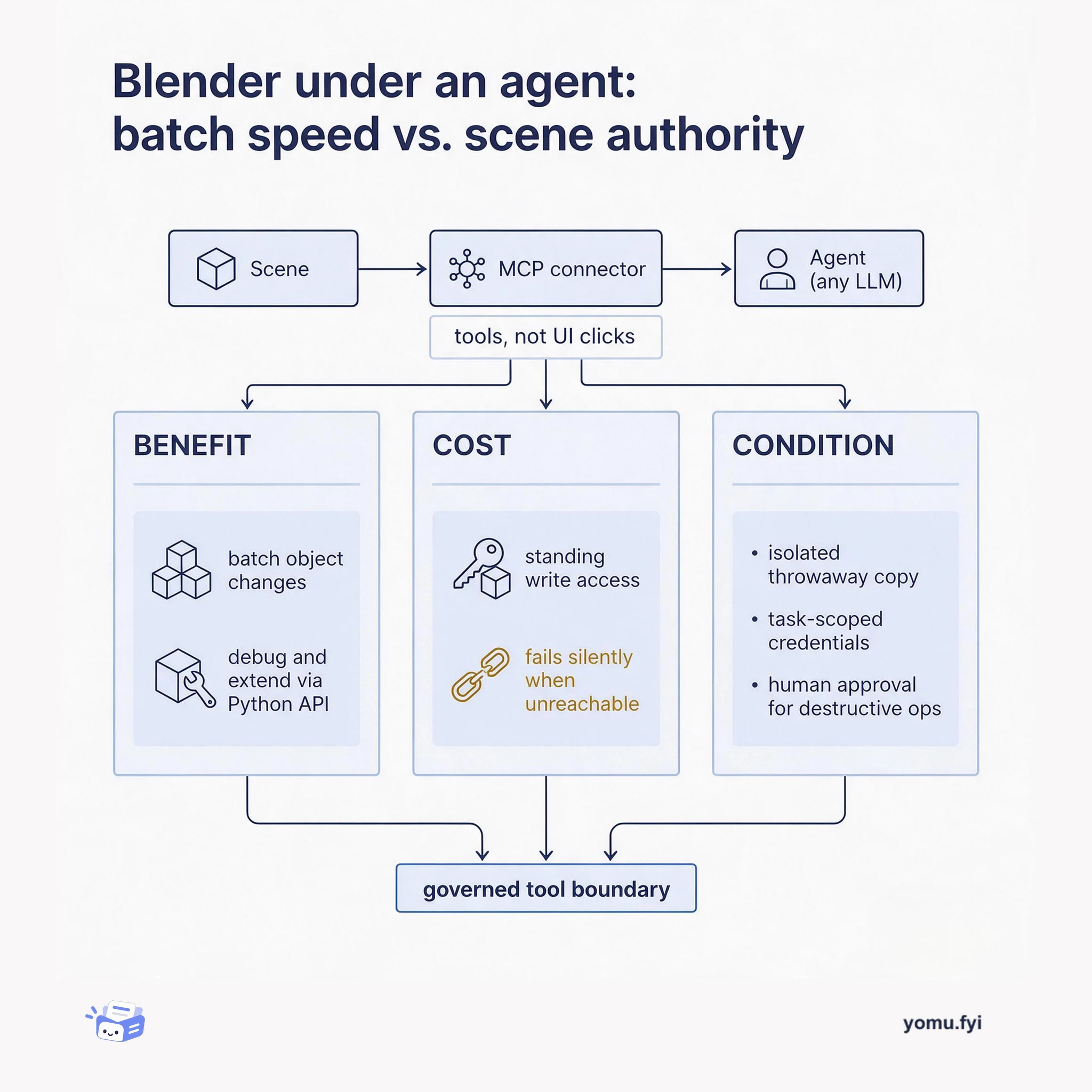
Blender's MCP connector lets an LLM analyze and batch-edit scenes through Blender's Python API. This trade-offs view weighs that speed against the authority and isolation it requires.
The Good Stuff
Paid picks we use ourselves. Links carry a referral code — a subscription through one earns us a commission at no extra cost to you.
Newest first
LFM2.5-24B-A2B is a 24-billion-parameter reasoning model with only 2 billion active parameters per token, designed for fast, private on-device agents. It uses a Mixture-of-Experts architecture with 40 layers, 64 experts per block, and top-4 routing, combined with gated short convolutions and GQA. The model produces an explicit chain of thought before answering and supports tool calling and multi-step tasks. Pre-training scaled to 33 trillion tokens, followed by mid-training and a five-stage post-training pipeline including supervised fine-tuning, multi-domain distillation, and agentic reinforcement learning. On benchmarks, it leads or matches larger models on tool use and instruction following, achieving 48.09 on LiveClaw and 96.75 on IFEval, while decoding 184 tokens per second on an Apple M5 Max.
Standard LLM benchmarks are insufficient for evaluating AI agents because they score static outputs rather than multi-step tool-call sequences against a live environment. The post explains that agent evaluation requires two scoring layers: step-level (process scoring) checks each call’s validity and usefulness, while end-to-end (E2E) scoring checks only the final environment state. A trace logs every step and environment state, and metrics roll up through a hierarchy of benchmark, trial, task, turn, and step. Key metrics include task success rate, consistency, tool-call precision, argument accuracy, steps per success, and cost per success. The post argues that benchmarks are converging on tool use because deployed agents always use tools, and enterprise benchmarks should measure task completion against real APIs and policies.
The best engineering reads, once a week.