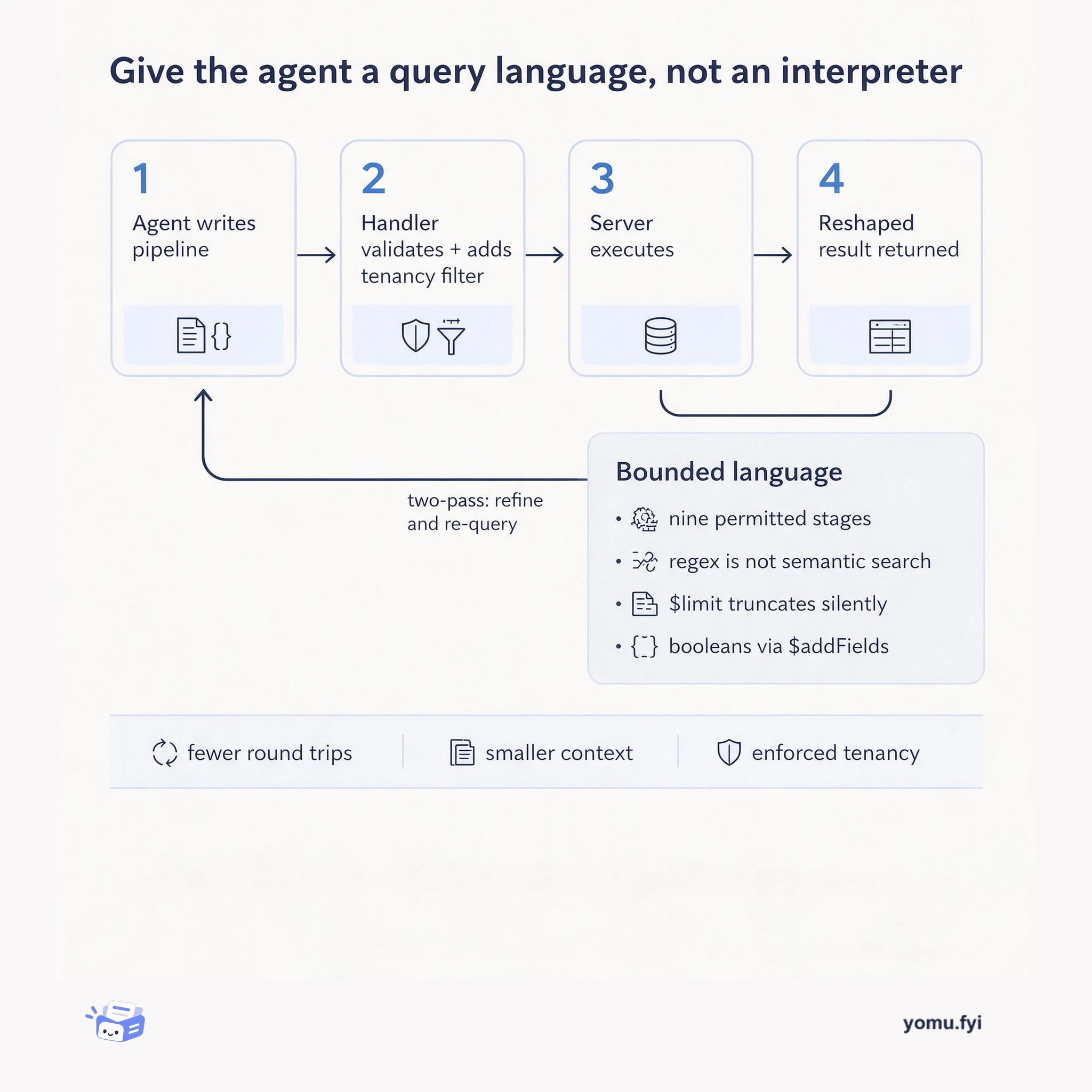
How to Give an Agent a Query Language Instead of a Code Interpreter
A four-step pattern for letting a document agent write validated aggregation pipelines instead of arbitrary code, so results come back shaped and tenancy stays enforced.
 IntercomExplainer
This post from the Intercom blog tackles the difficulty of explaining technical concepts to non-technical customers, emphasizing that one misinterpreted comment can cause frustration for both sides. The author, a senior lead on customer support, positions herself as an API between developers and customers and has developed four tips from years of experience. She warns against making assumptions about a customer’s knowledge level and suggests using software that provides data like job title, tenure, and past conversations to tailor communication. She stresses using clear language, like discussing site speed instead of Mongo performance, and offering explanations in multiple formats such as numbered lists, images, or phone calls, using Pictionary as an analogy. Finally, she advises thinking like the customer by anticipating follow-up questions within the customer’s workflow rather than answering only the immediate query to prevent future confusion.
When explaining technical issues to non-technical customers, avoid jargon and instead use language related to the customer’s experience, such as talking about site speed rather than database performance.
Support agents should be able to explain the same concept in multiple ways, using different formats like numbered lists, images, phone calls, or help documentation, as different explanations resonate with different people.
Rather than answering only the immediate question, anticipate the customer’s workflow and answer likely follow-up questions to prevent future confusion.
Use customer support software that provides data like job title, product usage history, and past conversations. This helps you gauge their level of knowledge and tailor your communication accordingly.
Avoid technical jargon and use terms related to their experience. For example, instead of 'Mongo perf', say 'how quickly your site loads'. The goal is clarity and brevity while ensuring the customer understands.
Summaries are generated from the original by a language model. Check the original before relying on it.
See the idea
A four-step pattern for letting a document agent write validated aggregation pipelines instead of arbitrary code, so results come back shaped and tenancy stays enforced.
Keep reading
The Good Stuff
Paid picks we use ourselves. Links carry a referral code — a subscription through one earns us a commission at no extra cost to you.
One useful email. Unsubscribe anytime.
