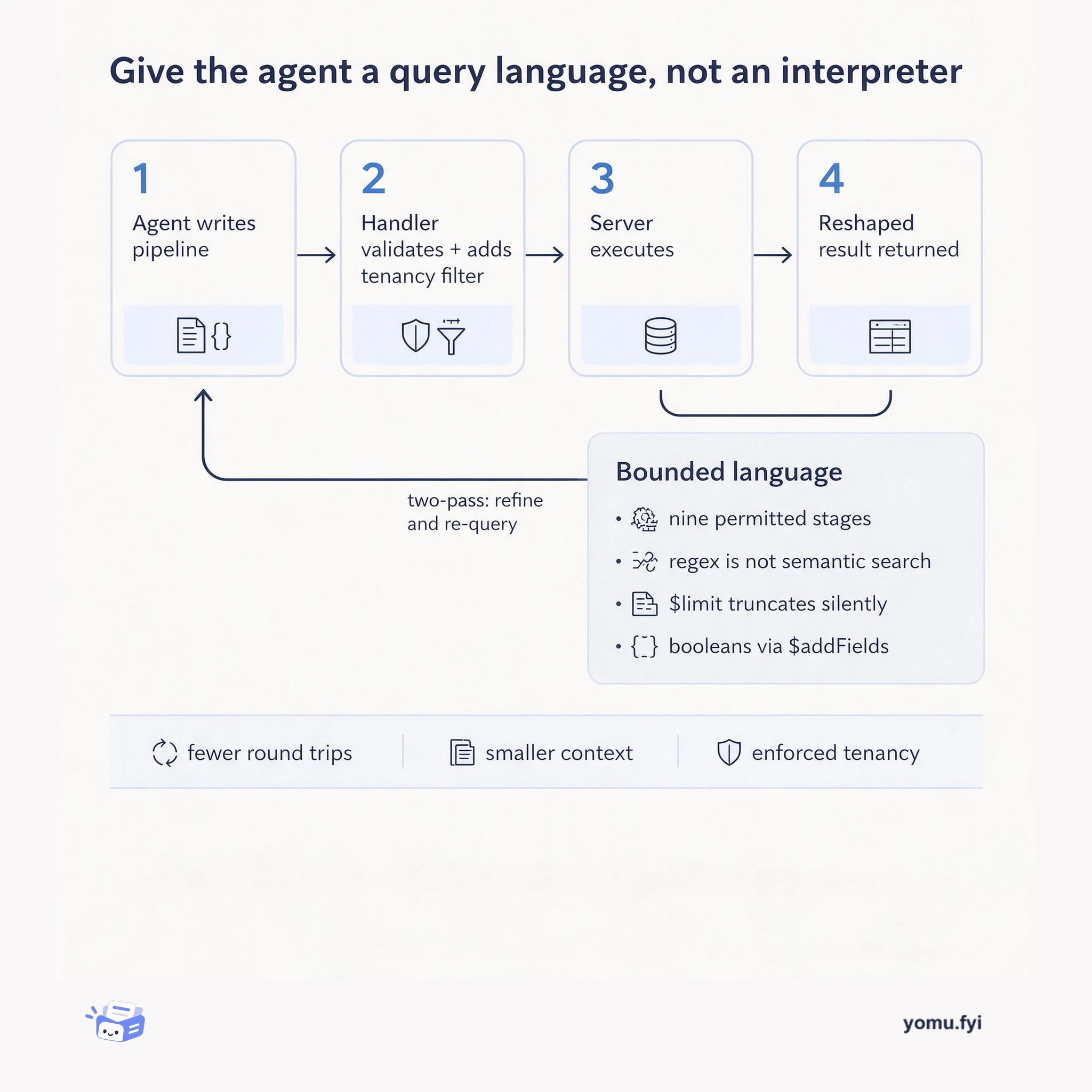
How to Give an Agent a Query Language Instead of a Code Interpreter
A four-step pattern for letting a document agent write validated aggregation pipelines instead of arbitrary code, so results come back shaped and tenancy stays enforced.
Loading…
Topic
1 post about Aggregation Pipeline. Every summary links to the original.
See the idea
A four-step pattern for letting a document agent write validated aggregation pipelines instead of arbitrary code, so results come back shaped and tenancy stays enforced.
The Good Stuff
Paid picks we use ourselves. Links carry a referral code — a subscription through one earns us a commission at no extra cost to you.
Newest first
Fixed-tool document agents suffer multiple round trips and context window bloat because each call returns raw data, and cross-document relationships require pulling all files into the context. The author’s solution lets the agent write a MongoDB aggregation pipeline instead of arbitrary code, avoiding the security risks of a code interpreter. A handler validates the pipeline, prepends a tenancy filter, and executes it server-side, returning only the reshaped result. The agent uses a two-pass approach, often computing booleans or concatenating fields with $addFields so comparisons happen in the database. Limitations include regex not being semantic search and $limit silently truncating results, but the bounded language of nine permitted stages improves both safety and accuracy.
The best engineering reads, once a week.

