NVIDIA AICR and Google’s k8s-aibom address two ends of AI infrastructure lifecycle validation. AICR generates version-locked recipes and reproducible deployment bundles for GPU-accelerated Kubernetes, recording desired configuration for hardware, cloud, OS, and intent. k8s-aibom watches Kubernetes workload and pod APIs to emit a CycloneDX 1.6 AIBOM for each recognized AI workload, including models, inference runtimes, agents, and RAG components. The integration is opt-in per namespace via the label aibom.k8saibom.dev/enabled=true. AIBOM attributes carry one of four confidence tiers with an evidence locator, so reviewers can see how each claim was reached.
Context
Platform teams deploying AI workloads on GPU-accelerated Kubernetes need visibility beyond platform configuration because application teams define and update workloads independently of the platform recipe, and mutable image tags like :latest can cause different nodes to run different code under identical tags.
Approach / What changed
NVIDIA AICR generates version-locked recipes and reproducible deployment bundles for GPU-accelerated Kubernetes. k8s-aibom, an open-source project by Google, watches Kubernetes workload and pod APIs to emit a CycloneDX 1.6 AIBOM for each recognized AI workload. AICR binds the exact upstream source, chart, CRDs, and digest-pinned controller image as one tested set, verifies provenance against Google’s expected build identity, and exercises installation, upgrade, health, and uninstall on the deployment paths it tested. k8s-aibom automatically classifies workload category and serving runtime, and attributes carry one of four confidence tiers with an evidence locator. The integration is opt-in per namespace via the label aibom.k8saibom.dev/enabled=true.
Takeaways
1
AICR generates version-locked recipes and reproducible deployment bundles for GPU-accelerated Kubernetes, binding exact upstream sources, charts, CRDs, and digest-pinned controller images as one tested set.
2
k8s-aibom watches Kubernetes workload and pod APIs to emit a CycloneDX 1.6 AIBOM for each recognized AI workload, automatically classifying workload category and serving runtime.
3
AIBOM attributes carry one of four confidence tiers (declared, inferred, unresolved, or verified) with an evidence locator, so reviewers can see how each claim was reached.
FAQ
How does k8s-aibom generate an AIBOM?
k8s-aibom watches Kubernetes workload and pod APIs and emits a CycloneDX 1.6 AIBOM for each recognized AI workload. It automatically classifies the workload category and serving runtime, and attributes carry one of four confidence tiers (declared, inferred, unresolved, or verified) with an evidence locator.
How do I opt a namespace into AIBOM inventory?
Inventory is opt-in per namespace. You label a namespace with aibom.k8saibom.dev/enabled=true, and supported workloads carrying a recognized AI signal in that namespace are inventoried automatically. The label controls which namespaces emit AIBOM records but does not narrow what the controller reads cluster-wide.
Does an AIBOM prove a workload is running?
An AIBOM can exist before any pod is running because it is built from the workload spec. It tells you what was declared and, once a Pod exists, what it resolved to, but it does not prove successful scheduling or execution.
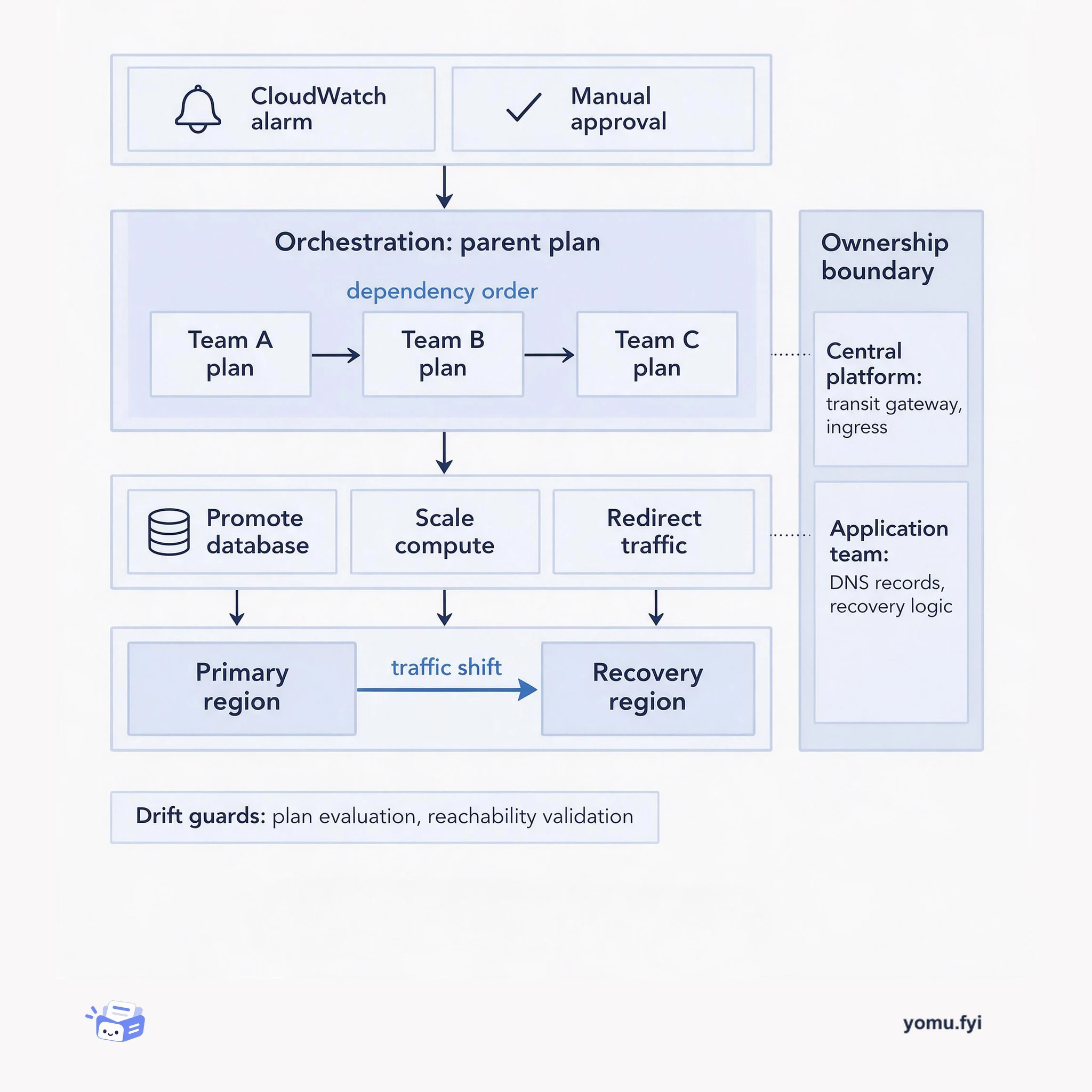
ARC Region Switch is a managed failover orchestrator that runs team-owned plans in dependency order. This diagram maps its trigger, orchestration, execution, and region layers and the ownership boundary.
Keep reading
Related reading
The Good Stuff
Paid picks we use ourselves. Links carry a referral code — a subscription through one earns us a commission at no extra cost to you.