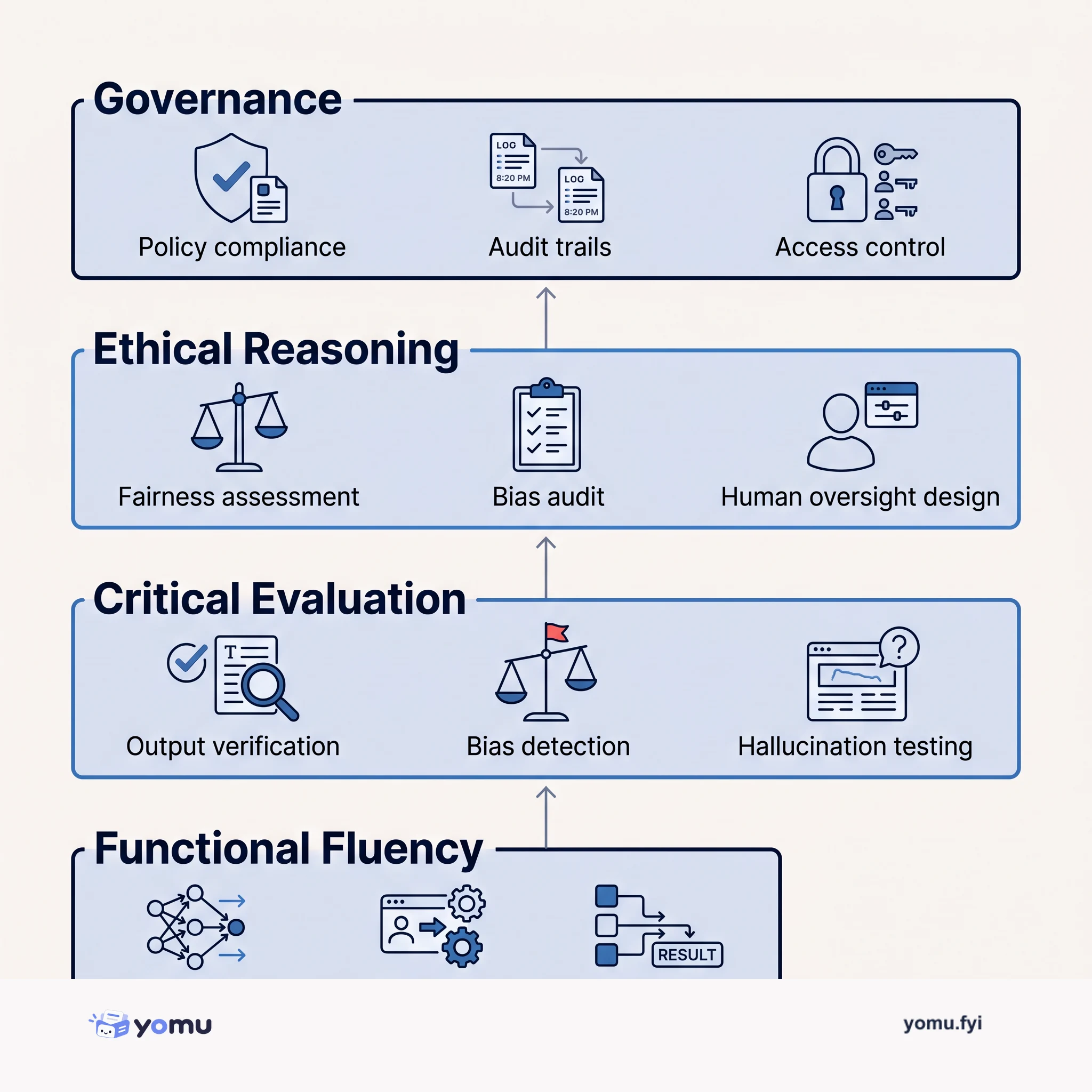
AI Literacy: The Four Domains Engineers Need
AI literacy spans functional fluency, critical evaluation, ethical reasoning, and governance. Engineers need all four to deploy AI responsibly and make sound technical decisions.
 DatabricksDatabricks StaffExplainer
Artificial intelligence (AI) is a branch of computer science that enables machines to perform tasks associated with human intelligence, including learning, reasoning, pattern recognition and decision-making. Modern AI generally learns patterns from large datasets, tunes internal weights and parameters during training, evaluates outputs on held-out data, and applies the resulting model during inference to classify, predict, generate content or trigger actions. Most organizations fine-tune existing foundation models rather than train from scratch, while output quality remains dependent on the completeness, bias and quality of training data. The page separates reactive machines and limited memory from theoretical theory of mind and self-aware systems, and distinguishes today’s narrow AI from theoretical general AI and superintelligence. It also describes generative AI, common applications, risks including hallucinations, bias, privacy and security gaps, and governance, concluding that practical adoption depends on real problems, trusted data and responsible oversight.
The page provides an introduction to artificial intelligence, covering how it works, its main capability categories, distinctions among AI-related terms, practical examples, limitations, risks, governance and a brief history of the field.
It explains AI through pattern learning, model training, testing, inference and feedback, then organizes the subject into capability and application-based categories. It also contrasts AI with machine learning, deep learning and generative AI, and describes adoption, risks and governance considerations.
Modern AI systems learn patterns from data, tune model weights and parameters during training, test against held-out data, and use inference to classify, predict, generate content or trigger actions.
Reactive machines and limited-memory systems exist today; theory-of-mind and self-aware AI remain theoretical, while all AI currently in use is classified as narrow AI.
Common AI risks include hallucinations, bias from training data, difficult-to-explain decisions, privacy and security gaps, job displacement and weak governance.
Summaries are generated from the original by a language model. Check the original before relying on it.
See the idea
AI literacy spans functional fluency, critical evaluation, ethical reasoning, and governance. Engineers need all four to deploy AI responsibly and make sound technical decisions.
Keep reading
The Good Stuff
Paid picks we use ourselves. Links carry a referral code — a subscription through one earns us a commission at no extra cost to you.
One useful email. Unsubscribe anytime.
