The CostBench benchmark streamed 113.2 billion stock-market quotes at one million rows per second while running aggregate and drill-down queries to compare ClickHouse Cloud and Databricks for real-time analytics under continuous ingestion. ClickHouse Cloud delivered 752× better end-to-end performance per dollar than the Databricks stack using Serverless SQL, Zerobus Ingest, liquid clustering, and incremental materialized views. ClickHouse Cloud led in all three components: preparation cost ($28.69 versus 695.60), normalized query cost ( 0.05 versus $2.65), and accumulated query runtime (56.39 seconds versus 29.10 minutes). The gap stems from ClickHouse preparing ordered raw data and current summaries on the insert path, while Databricks requires separate clustering and refresh services that cost more and can leave queries with unfinished layout work. Databricks’ new Lakehouse//RT, still in beta, was not included in this comparison.
Context
Comparison of ClickHouse Cloud and Databricks for real-time analytics using the CostBench benchmark, which measures preparation cost, normalized query cost, and accumulated query runtime under continuous ingestion of 113.2 billion stock-market quotes.
Approach / What changed
CostBench methodology that measures preparation cost, normalized query cost, and accumulated query runtime to compute an end-to-end performance-per-dollar score under continuous ingestion.
Takeaways
1
ClickHouse Cloud achieved 752× better end-to-end performance per dollar than Databricks in the CostBench benchmark, with 24.3× lower combined preparation and normalized query cost and 31× lower accumulated query runtime.
2
The performance difference arises because ClickHouse prepares ordered raw data and current summaries on the insert path, while Databricks requires separate clustering and materialized view refresh services that cost more and can leave queries with unfinished layout work or older summaries.
3
The comparison used Databricks Serverless SQL (not the beta Lakehouse//RT) and matched read-side compute at 16 CPUs, with ClickHouse using a 16-CPU, 64-GiB read node and Databricks an X-Small Serverless SQL warehouse.
FAQ
What does the CostBench benchmark measure?
CostBench measures preparation cost, normalized query cost, and accumulated query runtime under continuous ingestion, then combines them into an end-to-end performance-per-dollar score. It tracks the path from data arrival to answers, showing how preparation efficiency affects query cost and runtime.
Why did ClickHouse Cloud have lower preparation cost than Databricks?
ClickHouse prepares ordered raw data and current summaries on the insert path using asynchronous inserts, while Databricks requires separate Zerobus Ingest, liquid clustering, and incremental materialized view refresh services. These additional services cost more and can leave queries with unfinished layout work or older summaries.
Was Databricks' new real-time warehouse Lakehouse//RT included in the comparison?
No, Lakehouse//RT was not included because it was unavailable in the test workspace. The comparison used Databricks Serverless SQL as the baseline, which the post notes is the accepted comparison.
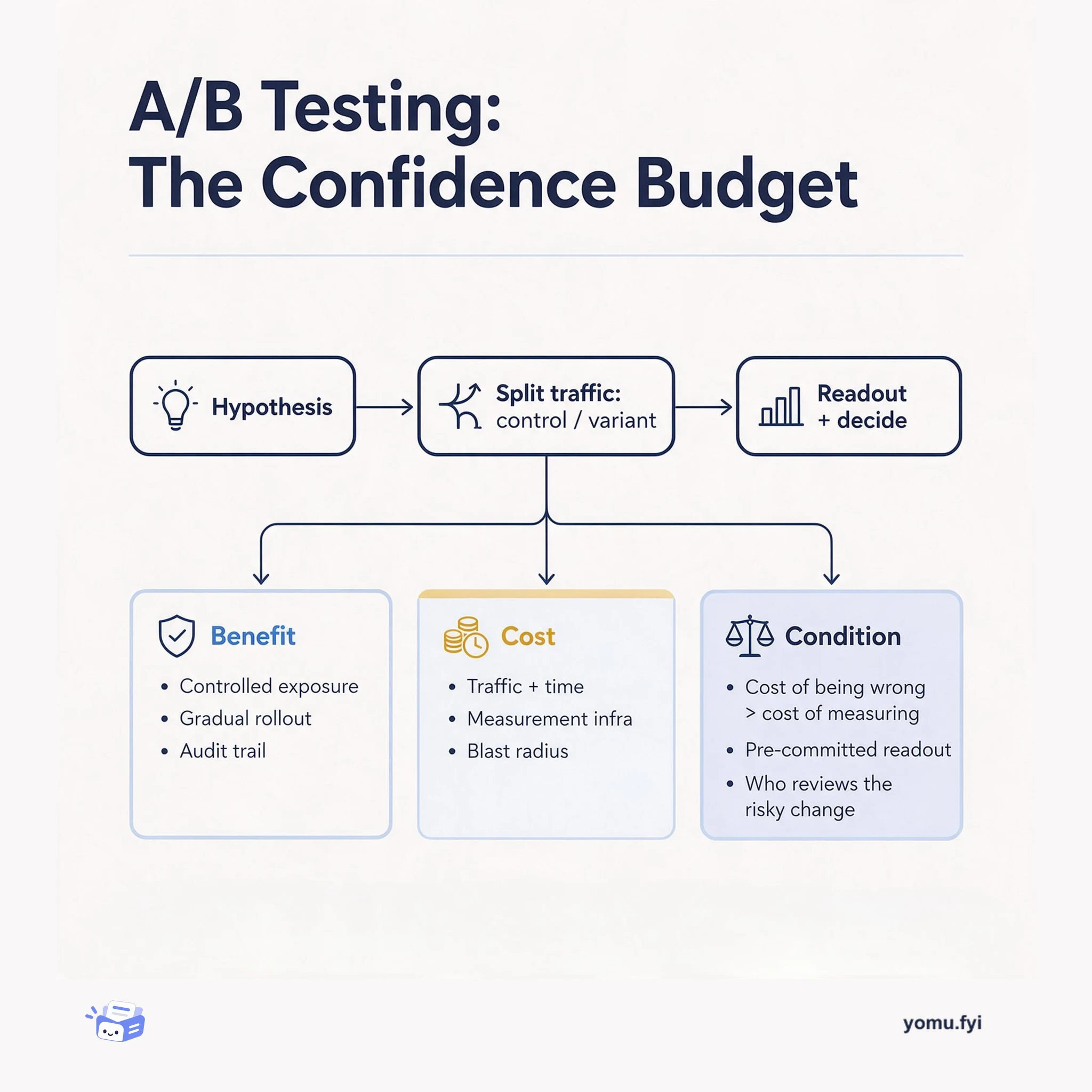
A/B testing trades traffic, time, and exposure risk for evidence. This explainer maps the benefit of a controlled comparison, the real cost of running one, and the condition that decides when measuring beats shipping on judgment.
Keep reading
Related reading
The Good Stuff
Paid picks we use ourselves. Links carry a referral code — a subscription through one earns us a commission at no extra cost to you.