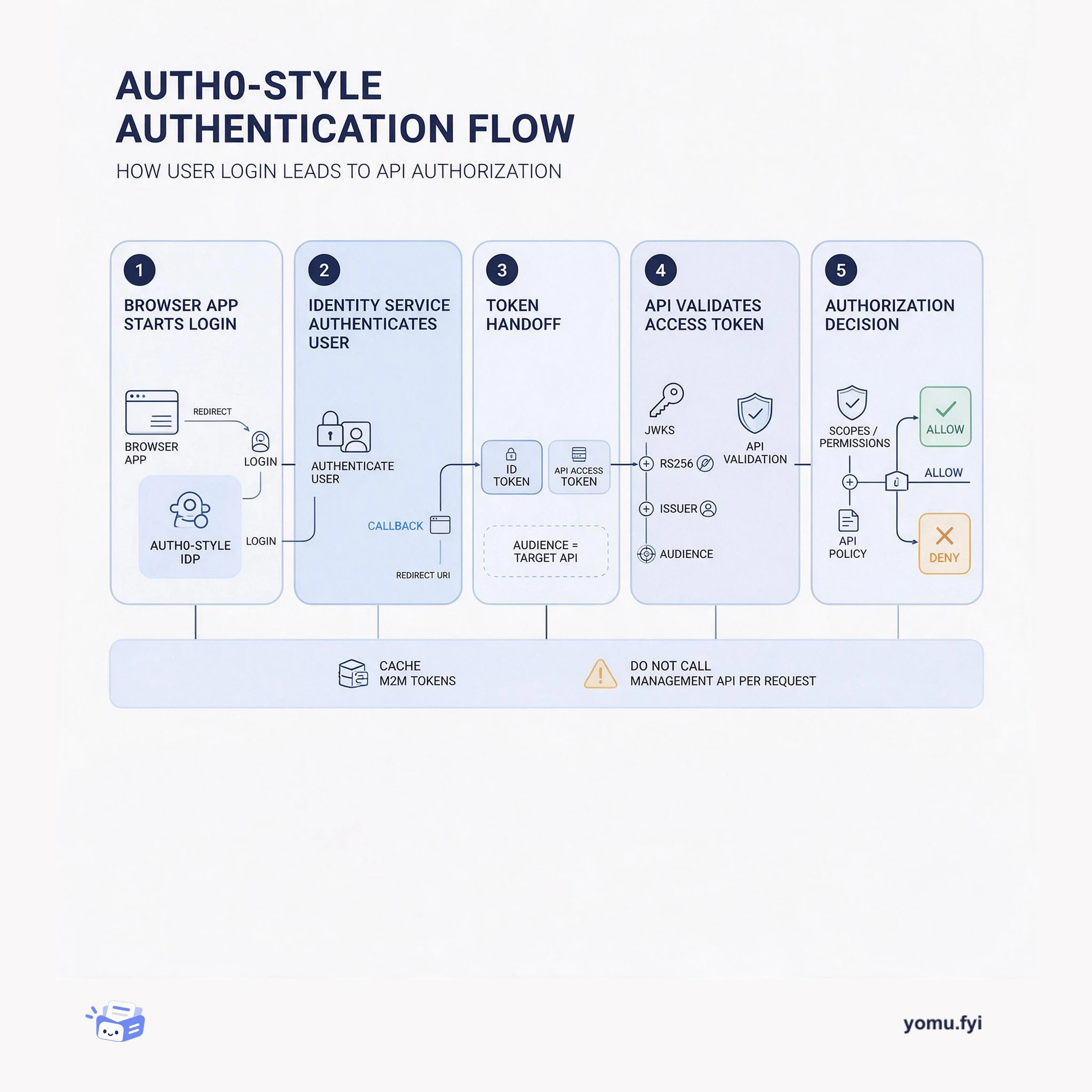
The Token’s Route: From Auth0 Login to API Authorization
See how an Auth0 login becomes an API decision: redirect the user, issue the right token, validate its claims, and apply audience, scope, and access policies.
 Auth0Carla Urrea StabileProblem & solution
Auth0 429 responses in production are tied to rate limits, commonly when applications call the Management API for every request or obtain a new machine-to-machine (M2M) token for every request. Because limits are per tenant and vary by plan, logging x-ratelimit-limit, x-ratelimit-remaining, and x-ratelimit-reset headers exposes approaching exhaustion. User roles, permissions, and metadata that can be treated as access-token snapshots should be added as custom claims by a Post-Login Action, while APIs read them from the JWT. M2M tokens, valid for 24 hours by default, should be cached and refreshed with a 60-second expiry buffer; data requiring freshness should sit behind a server-side cache with a 30-to-60-second TTL. When a 429 occurs, retry at the Unix timestamp in x-ratelimit-reset rather than applying exponential backoff, because the reset time is deterministic.
Production 429 responses are associated with Auth0 rate limits, especially when the Management API is called on every application request or a new M2M token is fetched for every request. Management API limits apply per tenant, vary by plan, and can be exhausted as traffic grows.
Move stable authorization data into access-token custom claims with a Post-Login Action, cache and reuse M2M tokens until they approach expiry, and place a short-TTL server-side cache before live Management API lookups. For 429 responses, use x-ratelimit-reset to determine when to retry.
Each service should have its own M2M client to provide more control over least-privilege access, credential rotation, and observability.
Email verification status, newly changed organization membership, and MFA enrollment are examples of data that may require current checks rather than token claims.
Auth0's x-ratelimit-reset value is a Unix timestamp, so the retry delay can be calculated directly instead of using exponential backoff.
Summaries are generated from the original by a language model. Check the original before relying on it.
See the idea
See how an Auth0 login becomes an API decision: redirect the user, issue the right token, validate its claims, and apply audience, scope, and access policies.
Keep reading
The Good Stuff
Paid picks we use ourselves. Links carry a referral code — a subscription through one earns us a commission at no extra cost to you.
One useful email. Unsubscribe anytime.
