AI agents cannot compensate for stale data like humans, turning sync lags into machine-speed errors such as approving fraud. Traditional operational data stores (ODS) rely on CDC pipelines and separate copies, which add latency, break on schema changes, and remain ungoverned. LTAP (Lakehouse Transactional Analytical Processing) unifies storage so operational writes land directly in a single governed foundation, eliminating replication entirely. It uses two independent engines—a row-oriented engine for operational reads and a columnar engine for analytical scans—both accessing the same copy without duplication. This removes the sync step, reduces infrastructure complexity, and ensures agents always query current data without degrading transactional performance.
Context
AI agents cannot compensate for sync lag like humans, making stale data a critical problem. Traditional ODS requires separate copies maintained via CDC and reverse-ETL, introducing latency and complexity. The post argues that this synchronization tax is unacceptable for agentic workflows.
Approach / What changed
LTAP (Lakehouse Transactional Analytical Processing) unifies storage by having operational writes directly land in a single governed lakehouse foundation. It uses two serverless engines—a row-oriented engine for operational reads and a columnar engine for analytical scans—accessing the same copy without duplication. This eliminates CDC and reverse-ETL, reducing latency and infrastructure costs.
Takeaways
1
Agents cannot apply human judgment to compensate for sync lag; they treat data as current regardless of its freshness, leading to erroneous decisions at volume.
2
Traditional ODS implementations often become accidental, ungoverned systems that are more fragile than deliberately built ones, as teams accumulate point-to-point sync jobs.
3
LTAP architecture keeps one copy of data with dual-engine access, eliminating the need for synchronization pipelines like CDC and reverse-ETL by using a single governed storage foundation.
FAQ
Why do agents make decisions on stale data?
Agents cannot compensate for sync lag like humans; they read a row and treat it as current without knowing the gap exists, leading to actions on outdated information at machine speed.
What is LTAP and how does it eliminate sync?
LTAP stands for Lakehouse Transactional Analytical Processing. It unifies storage so that operational writes directly land in a single governed foundation, and two specialized engines access the same copy without duplication, removing the need for CDC and reverse-ETL.
Does LTAP completely erase workload isolation concerns?
No, LTAP does not erase workload isolation; it solves it without physical duplication by using two independent engines, each optimized for its job and scaling separately, on one logical copy of data.
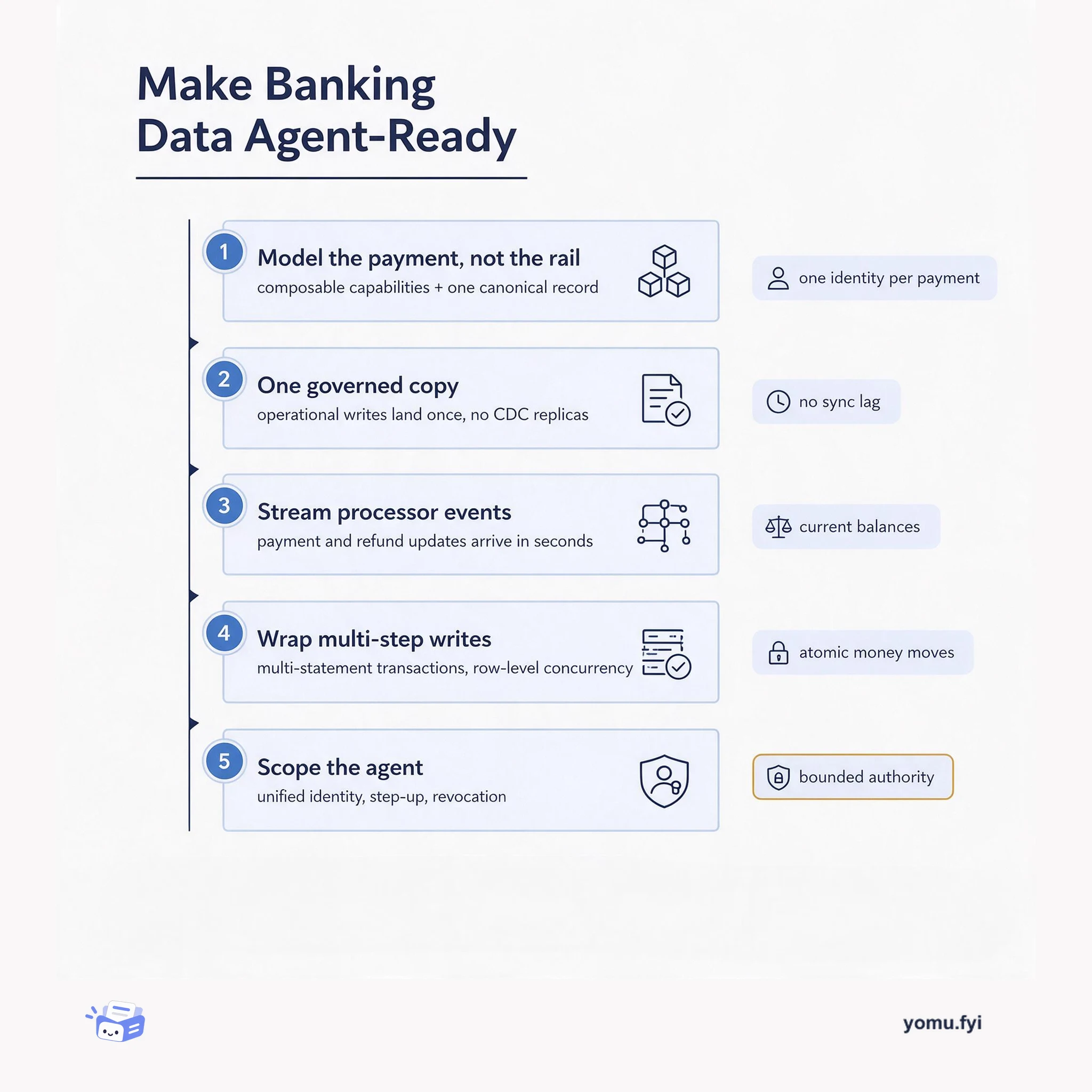
A five-step path from fragmented payment silos to a canonical, governed record that AI agents can act on: model the payment, unify the copy, stream events, wrap writes in transactions, and scope agent authority.
Keep reading
Related reading
The Good Stuff
Paid picks we use ourselves. Links carry a referral code — a subscription through one earns us a commission at no extra cost to you.