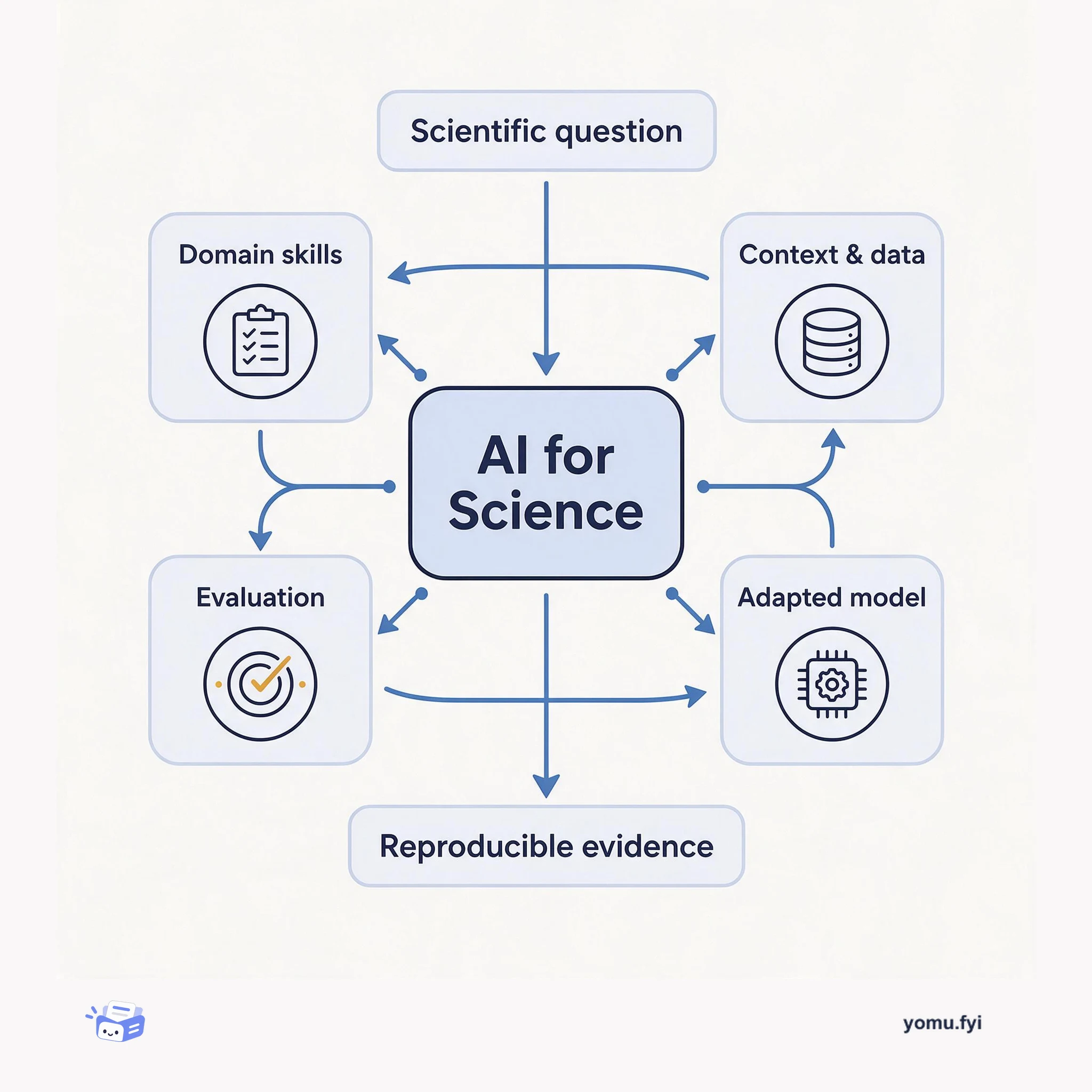
AI for Science Is a Governed Loop, Not a Single Model
AI for Science is a governed workflow that combines domain skills, context, adapted models, and evaluation to turn scientific questions into reproducible evidence.
Loading…
Topic
1 post about AI for Science. Every summary links to the original.
See the idea
AI for Science is a governed workflow that combines domain skills, context, adapted models, and evaluation to turn scientific questions into reproducible evidence.
The Good Stuff
Paid picks we use ourselves. Links carry a referral code — a subscription through one earns us a commission at no extra cost to you.
Newest first
Anthropic is expanding its AI for Science program, which provides free Claude credits to researchers, by partnering with 20 scientific foundations, institutions, and research groups worldwide. The program began in May 2025 to increase access to AI tools and accelerate scientific progress, and it has supported hundreds of projects across biology, medicine, physics, chemistry, climate science, and mathematics. Scientists use Claude to generate hypotheses, design experiments, analyze complex data, and communicate findings. New institutional partners include the Simons Foundation, the US National Science Foundation, the Space Telescope Science Institute, and the Wellcome Sanger Institute, while new research projects span neuroscience, Earth system science, cancer research, genomics, and mathematics. The post also notes that many collaborations are early-stage and that projects may produce public goods such as open datasets, open-source software, open standards, and shared libraries.
The best engineering reads, once a week.