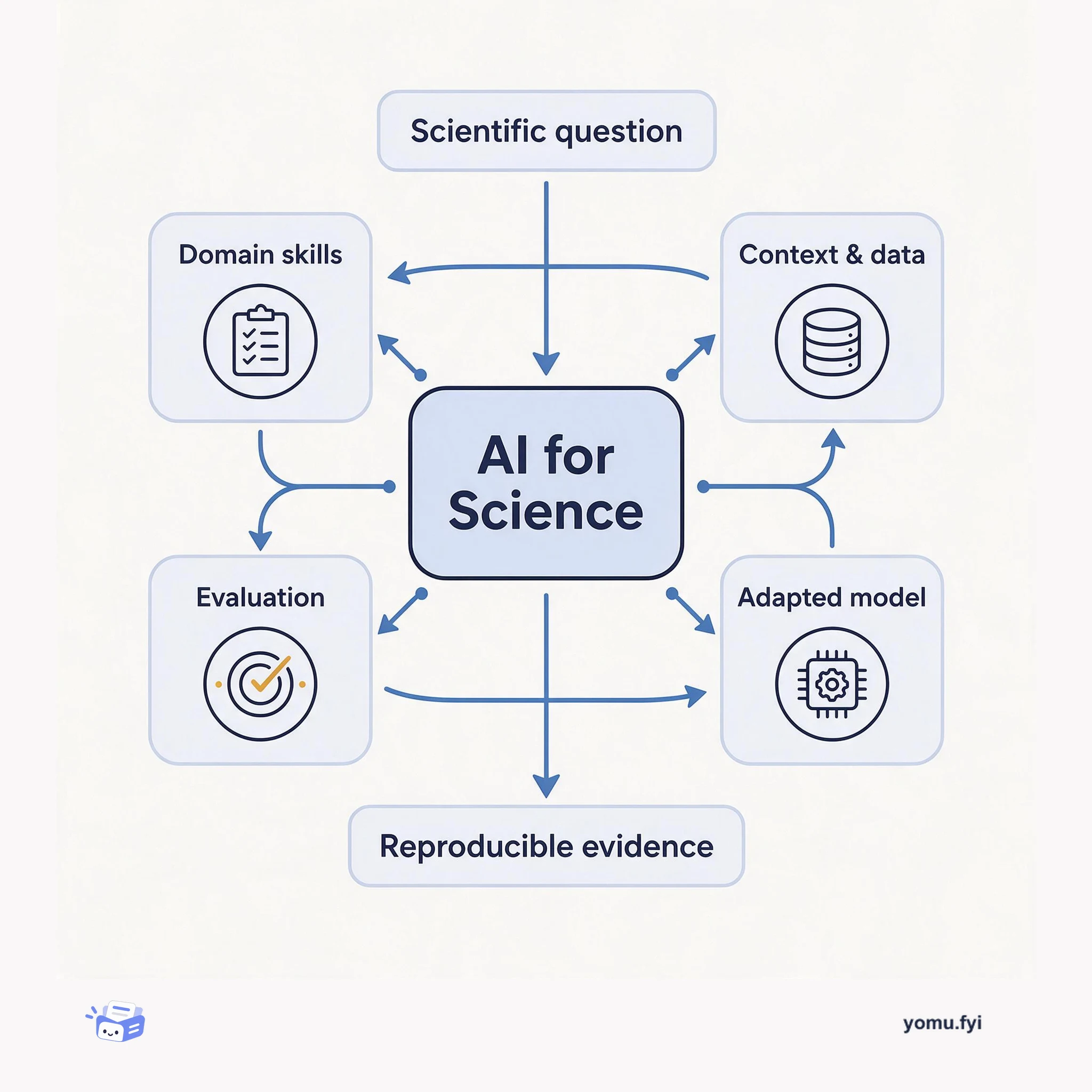
AI for Science Is a Governed Loop, Not a Single Model
AI for Science is a governed workflow that combines domain skills, context, adapted models, and evaluation to turn scientific questions into reproducible evidence.
Loading…
Topic
1 post about Scientific Discovery. Every summary links to the original.
See the idea
AI for Science is a governed workflow that combines domain skills, context, adapted models, and evaluation to turn scientific questions into reproducible evidence.
The Good Stuff
Paid picks we use ourselves. Links carry a referral code — a subscription through one earns us a commission at no extra cost to you.
Newest first
The post presents a study by Ai2 on the reliability of LLMs as novelty judges for scientific research ideas, using six models including GPT-5.4 and Claude Opus 4.6. The researchers mined ICLR 2026 peer reviews to create a validated pool of 154 high-novelty and 145 lower-novelty human ideas, then paired them with 154 simple AI-generated ideas. Testing revealed that small prompt changes could shift accuracy by over 50 percentage points on AI-generated ideas, such as GPT-5.4 dropping from 93.5% to 40.9% with a simpler prompt. Additional search and reasoning did not consistently improve judgments; a simple Claude Opus 4.6 baseline achieved 0.854 macro-F1 at $2.59, while AI Scientist scored 0.772 at $82.05. The findings indicate that LLM-based novelty evaluation remains unreliable, particularly for AI-generated ideas, and the authors release benchmark data and an automated pipeline for future research.
The best engineering reads, once a week.