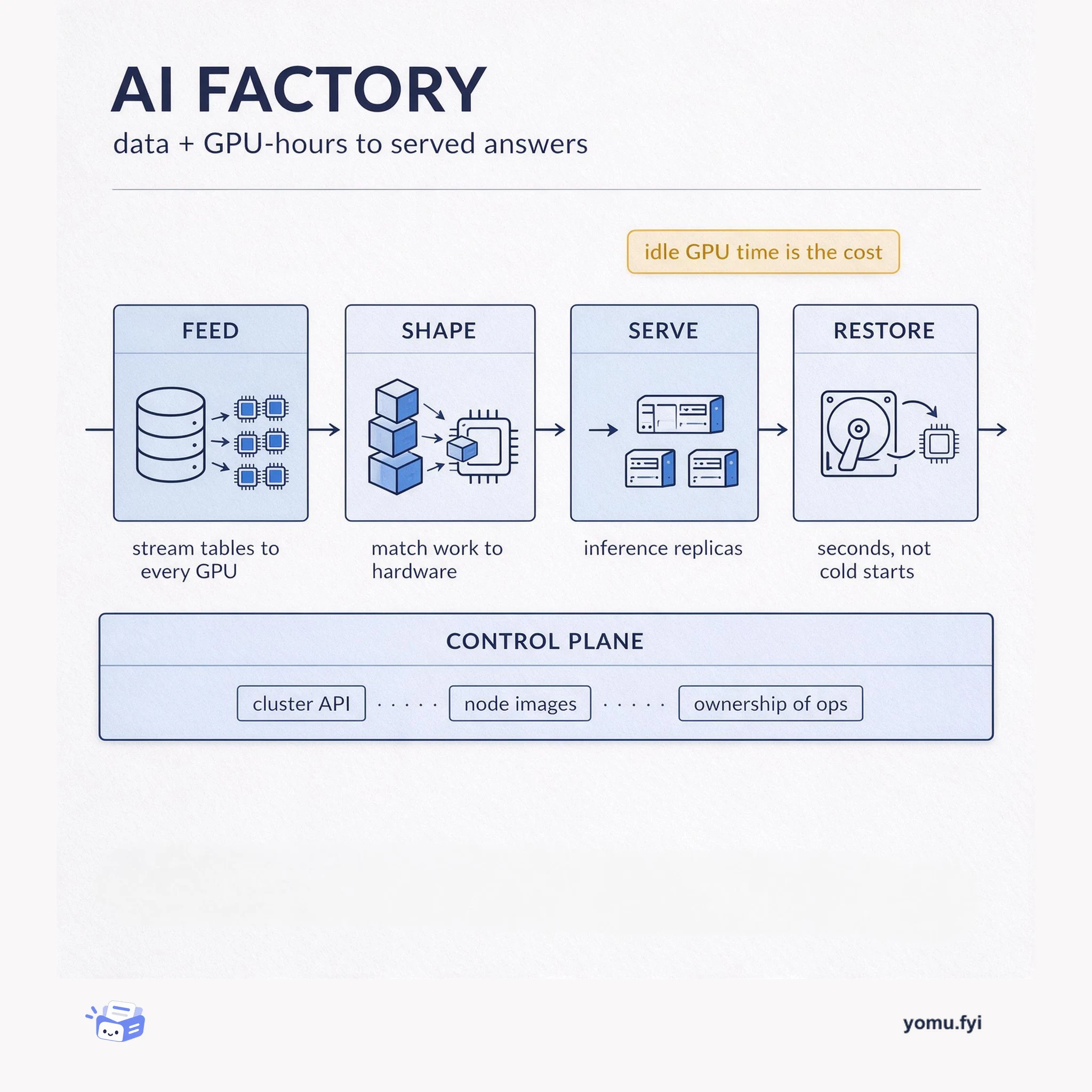
What Is an AI Factory? Four Stages From Data to Served Answer
An AI factory turns raw data and GPU-hours into served model output. This diagram breaks it into four stages — feed, shape, serve, restore — plus the control plane that owns them.
AI for Science is a governed workflow that combines domain skills, context, adapted models, and evaluation to turn scientific questions into reproducible evidence.
AI for Science is often framed as a model choice, but the useful mental model is a loop. A scientific question enters a workflow where domain skills encode how work is done, context and data define what the model can see, an adapted model generates hypotheses or analyses, and evaluation checks whether outputs hold up before they become evidence. The loop matters because general models alone miss vocabulary, thresholds, and reproducibility checks; domain playbooks, benchmarked adaptation, and regression-safe promotion make the output usable. Engineers should treat AI for Science as an integration and governance problem, not just an inference problem.
It enters through packaged skills and playbooks, domain vocabulary adaptation, and institutional research partnerships. The Vital Skills example shows tested healthcare and life-sciences playbooks, while the Nemotron medical case study shows domain adaptation cutting word error rate on held-out speakers.
Because plausible outputs can hide regressions, and fixing one field or task can break another. The document-extraction example uses fixed ground truth and repeated runs before promotion, while Vital Skills reports benchmarked gains on in-scope tasks rather than relying on a single demo.
A general model can help with hypotheses, analysis, and communication, but scientific work needs context, domain rules, and evidence checks. The supplied examples show gains from domain playbooks and vocabulary adaptation, so the workflow around the model is part of the capability.
The posts behind it
 Anthropic · · Announcement
Anthropic is expanding its AI for Science program, which provides free Claude credits to researchers, by partnering with 20 scientific foundations, institutions, and research groups worldwide. The program began in May 2025 to increase access to AI tools and accelerate scientific progress, and it has supported hundreds of projects across biology, medicine, physics, chemistry, climate science, and mathematics. Scientists use Claude to generate hypotheses, design experiments, analyze complex data, and communicate findings. New institutional partners include the Simons Foundation, the US National Science Foundation, the Space Telescope Science Institute, and the Wellcome Sanger Institute, while new research projects span neuroscience, Earth system science, cancer research, genomics, and mathematics. The post also notes that many collaborations are early-stage and that projects may produce public goods such as open datasets, open-source software, open standards, and shared libraries.
 Hugging Face · · Announcement
NVIDIA released Nemotron 3.5 Transcribe, an open-weight, promptable speech model that performs transcription, speaker attribution, translation, and audio Q&A in a single checkpoint. It transcribes 40 languages, translates 31 to or from English, and attributes speakers in 13, handling recordings up to an hour long with up to eight speakers. The model leads the Hugging Face Open ASR Leaderboard for English at 5.33% average WER and tops David AI’s multilingual diarization leaderboard with an 18.26% diarization error rate. It uses a hybrid Mamba–Transformer mixture-of-experts architecture with about 4B active parameters out of 30B total, running on a single NVIDIA GPU. The accompanying Granary v2 pipeline and NeMo Speech fine-tuning tools allow developers to adapt the model to domain vocabulary, demonstrated by a medical case study that cut word error rate by 45.8% on held-out speakers.
 Databricks · · Announcement
Genie Code outperforms leading coding agents by more than twice on real data tasks using Unity Catalog, but lacks healthcare and life sciences domain specificity. Vital Skills bridges this gap with packaged Agent Skills playbooks built by field engineers who require asking before assuming thresholds and using tested tools. Skills such as cohort-builder construct reproducible patient cohorts from structured and unstructured data, while open-weight-models deploys biological models with pinned dependencies. On BiomniBench, Genie Code with Vital Skills scored 76.9 on in-scope tasks versus 71.9 without, while out-of-scope tasks held steady around 71 across three blind runs. The open source skills are customizable, installable via Genie Code, and integrate with Databricks for governed deployment, model serving, and scheduling.
Databricks · · Problem & solutionDocument extraction across dozens of PDF layouts is unreliable when fields are tuned in isolation; fixing one field can cause hidden regressions and apparent improvements may stem from normal run-to-run variation. The project extracting roughly 40 structured fields from partner-submitted order documents used human reviewers who corrected and approved extracted values, providing ground truth for evaluation. Field-specific rules go in JSON schema descriptions, document-level reasoning in a global prompt, precision mode handles complex structures, and citations diagnose failures. Candidates are versioned in MLflow Prompt Registry with aliases and evaluated against fixed ground truth using three runs to filter noise before promotion, outputting a BETTER, WORSE, or INCONCLUSIVE verdict. This approach reduced total errors by 32% and revision errors by 64%, creating a repeatable and regression-safe extraction workflow now automated by Genie Code.
More like this
An AI factory turns raw data and GPU-hours into served model output. This diagram breaks it into four stages — feed, shape, serve, restore — plus the control plane that owns them.
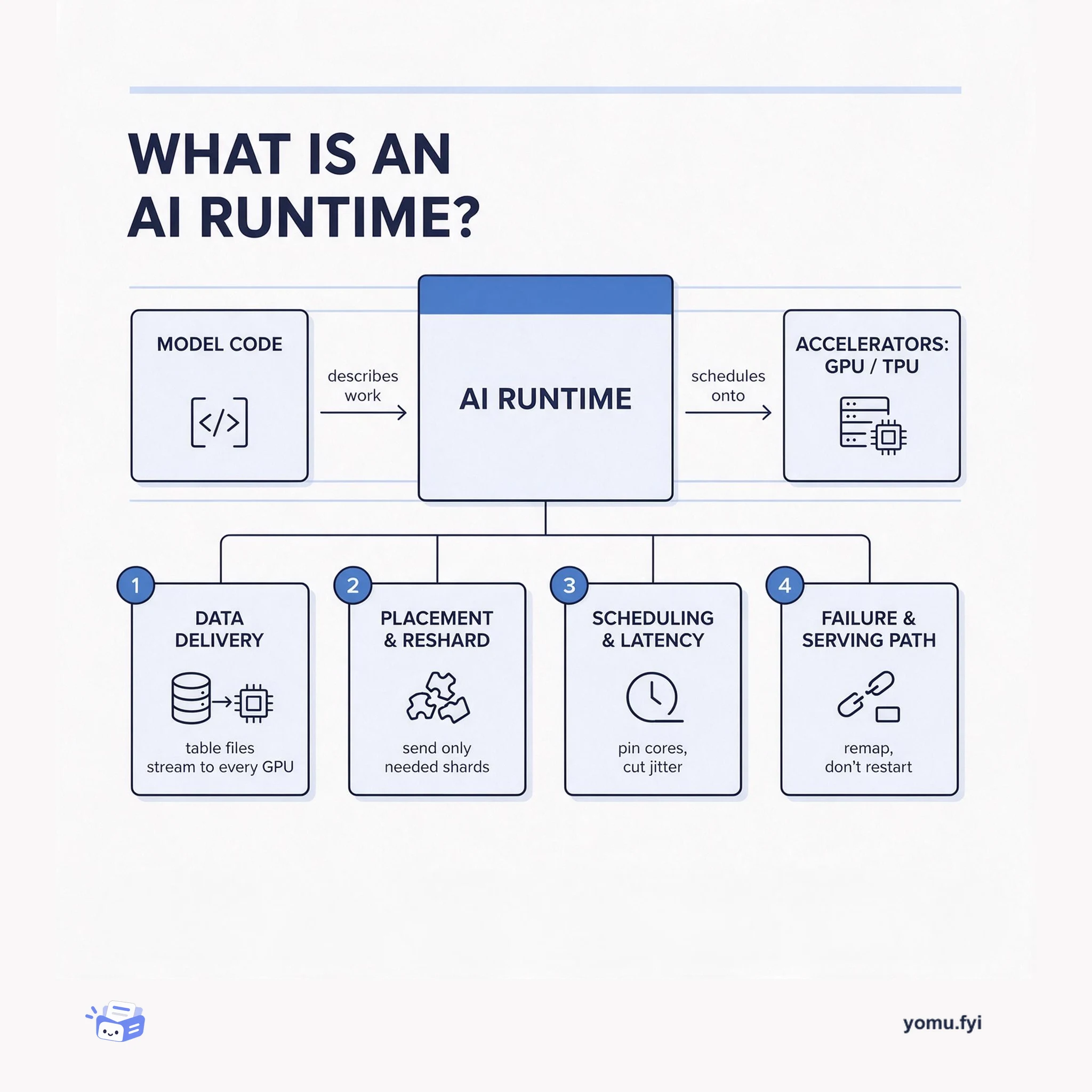
An AI runtime is the execution layer between model code and hardware: it feeds data to accelerators, places and reshards tensors, schedules work, and holds latency steady. Here are its four core jobs.
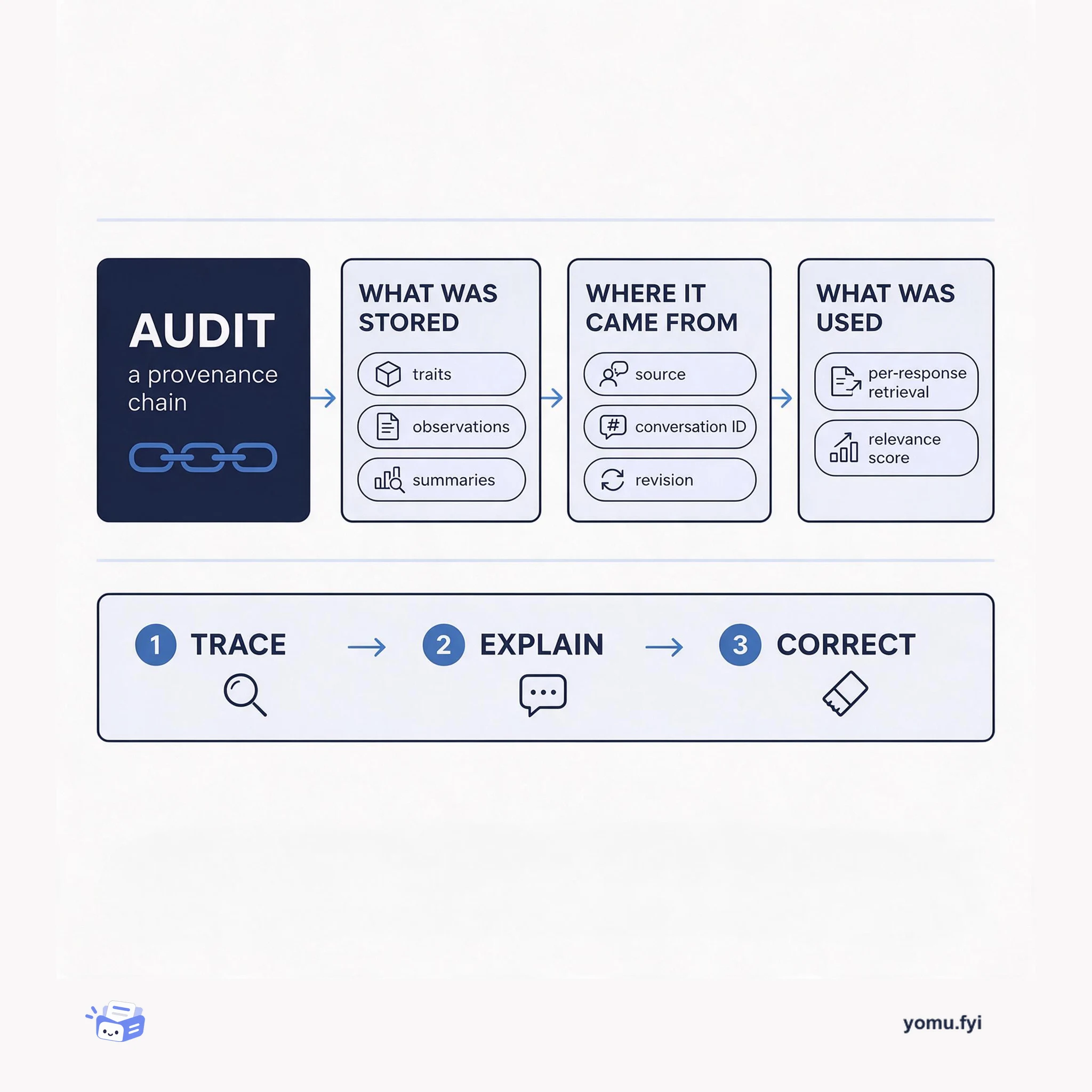
An audit is a provenance chain: what was stored, where each fact came from, and what was used for each decision. This explainer maps the three links that keep agent behavior traceable and fixable.
The Good Stuff
Paid picks we use ourselves. Links carry a referral code — a subscription through one earns us a commission at no extra cost to you.
One useful email. Unsubscribe anytime.