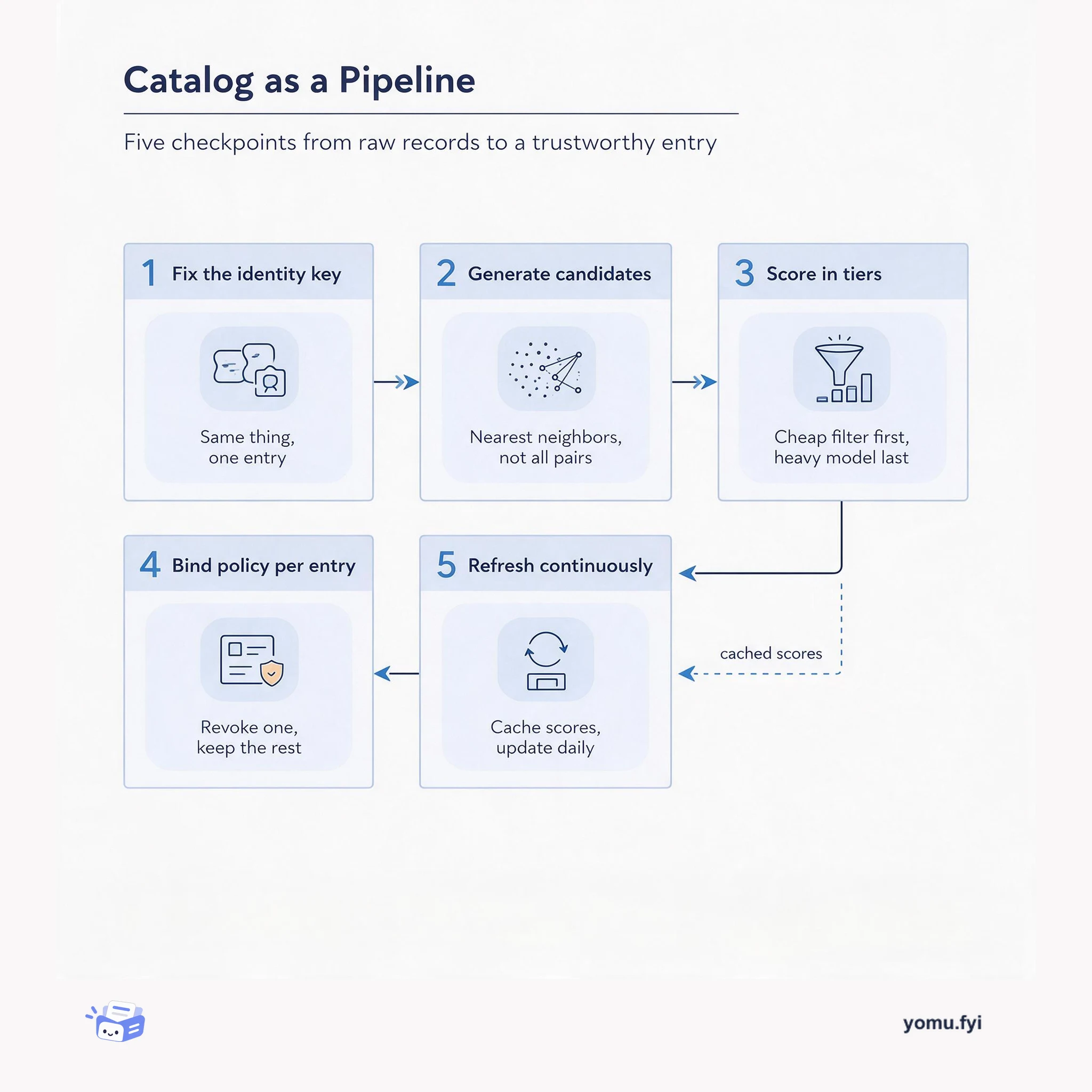
Catalog as a Pipeline: Five Checkpoints to Trustworthy Entries
A catalog is a pipeline, not a list. This five-step guide shows how to fix entry identity, score candidates in tiers, bind policy per entry, and refresh without rescoring everything.
Loading…
Topic
1 post about Catalog. Every summary links to the original.
See the idea
A catalog is a pipeline, not a list. This five-step guide shows how to fix entry identity, score candidates in tiers, bind policy per entry, and refresh without rescoring everything.
The Good Stuff
Paid picks we use ourselves. Links carry a referral code — a subscription through one earns us a commission at no extra cost to you.
Newest first
Shopify’s cross-store product clustering system groups listings of the same product across different merchants into a single global Universal Product Identifier. The approach avoids comparing every pair by generating candidate pairs using approximate nearest-neighbor search across billions of vector embeddings. Scoring uses three models of increasing cost: L1 is a fast GBDT classifier, L2 is a fine-tuned multilingual cross-encoder that reads both listings together, and L3 adds images. The UPI builder evaluates proposed merges using a trained model that weighs evidence, handling non-transitive pairwise judgments. The system caches scores and uses priority queues for expensive inference, enabling daily cluster updates while background GPU inference continues refining matches.
The best engineering reads, once a week.