 Databricks
Databricks introduces three capabilities intended to bring vibe coding to enterprise applications, where speed alone does not provide business-data context, deployment safety, or cost control. App Spaces lets admins define resource and data access, on-behalf-of-user API scopes, and security policies for groups of apps, with each app inheriting those settings. Genie App Builder turns plain-language descriptions into working internal apps through generated plans, live previews, AppKit, and awareness of workspace data assets and Unity Catalog semantics. Serverless micro apps run in isolated lightweight virtual machines, start quickly when needed, scale to zero while idle, and use usage-based rather than reserved-capacity infrastructure. Together, the capabilities are presented as a way for business-proximate users to build on enterprise data while organizations apply consistent governance and support broader app portfolios; all three are coming to Databricks Apps, with private previews coming soon.
Databricks
OpenSharing is presented as the next evolution of Delta Sharing, extending an open zero-copy data-sharing protocol from tables and files to models, agents, semantic context, unstructured data, and reusable AI logic. The protocol is now an independent open-source project hosted by the Linux Foundation, while Databricks OpenSharing adds Unity Catalog governance and audit logging, Marketplace discoverability, and enterprise features. Genie Agent Sharing supports governed AI experiences across organizational boundaries, with controls for proprietary instructions, data access, daily prompt quotas, and row exports. SecureConnect removes per-recipient firewall changes through a Databricks-managed proxy, while Global Distribution uses local replicas to reduce egress fees and latency. The launch also supports Apache Iceberg REST Catalog API, external catalogs, and on-premises storage partners; providers define shares in Unity Catalog, recipients query live data through existing tools, and governance enforces access controls.
Databricks
Databricks announces the Public Preview of Apps on Databricks Marketplace, allowing customers to discover, install, and run third-party data and AI applications inside secure Databricks workspaces. The offering addresses procurement challenges involving data movement, lengthy security reviews, custom integrations, and fragmented identity management by bringing applications to the customer’s data. Installed apps run in isolated sandboxes within the consumer’s Databricks account, inherit Unity Catalog governance, and use dedicated serverless compute with consumer-controlled external access through Serverless Egress Gateway policies. Providers can publish closed-source containerized apps once for no-egress distribution without maintaining per-customer infrastructure, while applications connect natively to services including SQL Warehouse, Lakebase, Model Serving, and Foundation Model APIs. The Public Preview launches with 20 partners, and planned additions include bundled assets, provider analytics, and commercial monetization.
Databricks
At Data + AI Summit 2026, Unity Catalog announcements position the catalog as a runtime governance layer for enterprise data and AI, organized around control, context, and choice. Control additions include Unity AI Gateway for governing models, agents, MCP services, skills, and tools; contextual service policies can allow, deny, or require approval for runtime actions, while budgets, hard caps, tracing, and guardrails address spend, investigation, and safety. Context additions include Glossary and Domains for business meaning and scoped asset organization, plus Metrics that standardize KPIs for SQL, BI tools, APIs, and agents; Genie Ontology is described as a continuously learned enterprise context layer. Choice additions span cross-cloud and cross-region addressability, managed disaster recovery, Delta and Iceberg interoperability, multimodal and geospatial types, and open sharing of data, AI assets, and applications across organizations.
Databricks
At Data + AI Summit 2026, Databricks announced Agent Bricks as a comprehensive developer platform for building and operating agents, extending a product launched the previous year. The announcement frames the core agent loop as only 1% of the work, with token capacity, deployment, security, evaluation, monitoring, context, and sharing forming the remaining infrastructure burden. Agent Bricks addresses choice, context, and control through support for multiple proprietary, open-source, and custom models, any agent harness, MCP-connected data, Genie Ontology, managed memory, document intelligence, sandboxes, and governed tools. Unity AI Gateway adds catalogs, fine-grained access controls, budgets, traffic routing, contextual policies, monitoring, and registry support for agents, tools, and models. Databricks says more than 100,000 agents have been built and customers including AstraZeneca, 7-Eleven, Fox Corporation, and Block have shipped agents on the platform.
Databricks
Databricks announces new Unity AI Gateway capabilities for governing enterprise AI as organizations operate multi-model, multi-agent, and multi-vendor estates connected to models, MCP services, APIs, and tools. The update adds unified spend visibility, granular attribution, hard spend caps, and smart routing, alongside Unity Catalog support for registering and governing models, MCP services, agents, and skills. Contextual Service Policies, in Beta, can allow, deny, or require approval for actions based on users, agents, models, tools, services, or request and response contents, with guardrails for risks such as PII exposure and prompt injection. The announcement also covers end-to-end tracing, coding-agent analysis with Genie, incident investigation with Lakewatch, ecosystem integrations, and Managed Omnigent on Databricks in Beta.
Databricks
Databricks announces a major evolution of Lakeflow, its unified platform for data engineering across ingestion, transformation, and orchestration, with capabilities centrally governed by Unity Catalog. Genie Code and generally available Lakeflow Designer support agentic and no-code pipeline development, while Genie ZeroOps monitors production assets, analyzes failures, proposes fixes, and validates them in a governed sandbox before human approval. Lakeflow Connect expands to more than 100 managed connectors, and Zerobus Ingest adds Kafka-compatible, gRPC, REST, SDK, and OpenTelemetry interfaces for high-volume event ingestion. Real-Time Mode for Spark Declarative Pipelines reaches Public Preview with end-to-end latency as low as 5 milliseconds, alongside declarative APIs and expanded Lakeflow Jobs integrations. The release also adds data-readiness triggers and external orchestration for systems including Snowflake, REST APIs, Slack, and PagerDuty.
Databricks
Genie ZeroOps is an autonomous background agent for monitoring and operating data and AI assets, including jobs, pipelines, tables, and ML models. It continuously detects visible and silent failures, uses Unity Catalog lineage and platform observability to assess root causes, generates remediation through development workflows, and verifies fixes in isolated sandboxes. These environments use shallow, zero-copy table clones, scoped permissions, and network isolation, so proposed changes run against real data without touching production or applying anything before approval. For ML workloads, the agent can diagnose degraded predictions, train a candidate on corrected features, evaluate it against the production model’s existing eval suite and criteria, and support live-traffic ramping when it is measurably better. Genie ZeroOps is entering private preview in the coming weeks, initially supporting jobs, pipelines, tables, and ML workloads; Apps and Lakebase databases are on the roadmap.
Databricks
At Data + AI Summit 2026, Azure Databricks announced capabilities aimed at moving enterprises from experimental AI pilots to production-grade automated workflows by unifying data, productivity tools, marketing, and governance on Azure. Its Agentic Data foundation introduces LTAP, combining analytical data, streaming pipelines, and live application transactions in one lakehouse storage copy; Lakebase adds a managed serverless Postgres engine with copy-on-write branching, while Lakehouse//RT targets millisecond responses for high-concurrency workloads. Genie integrations for Microsoft Teams, M365 Copilot, Excel, and SharePoint bring governed lakehouse intelligence and ingestion into daily work, alongside tools for agents, applications, pipelines, and autonomous operations. CustomerLake adds Profile Agents and Campaign Agents for customer profiles and personalization, while Genie Ontology and Unity AI Gateway provide semantic context, rate limits, content filtering, and spend controls.
Databricks
Databricks announces Genie One, Genie Agents, and Genie Ontology to help enterprises answer business questions and act on data whose context is scattered across dashboards, queries, documents, tickets, and chats. Genie One connects data and business tools through Lakehouse federation, Lakeflow Connect, native integrations, Slack, Teams, mobile apps, schedules, alerts, document creation, custom skills, and MCP support. Genie Agents evolve Genie Spaces into domain-specific agents that can reason over structured and unstructured data, execute multi-step workflows, and be created from a prompt. Genie Ontology builds a permission-aware living graph from enterprise assets, weighting sources by authority, usage, certification, and freshness. In an internal 28-question benchmark, Genie answered 84.5% correctly on the first attempt and delivered twice the speed of the strongest coding agent.
Databricks
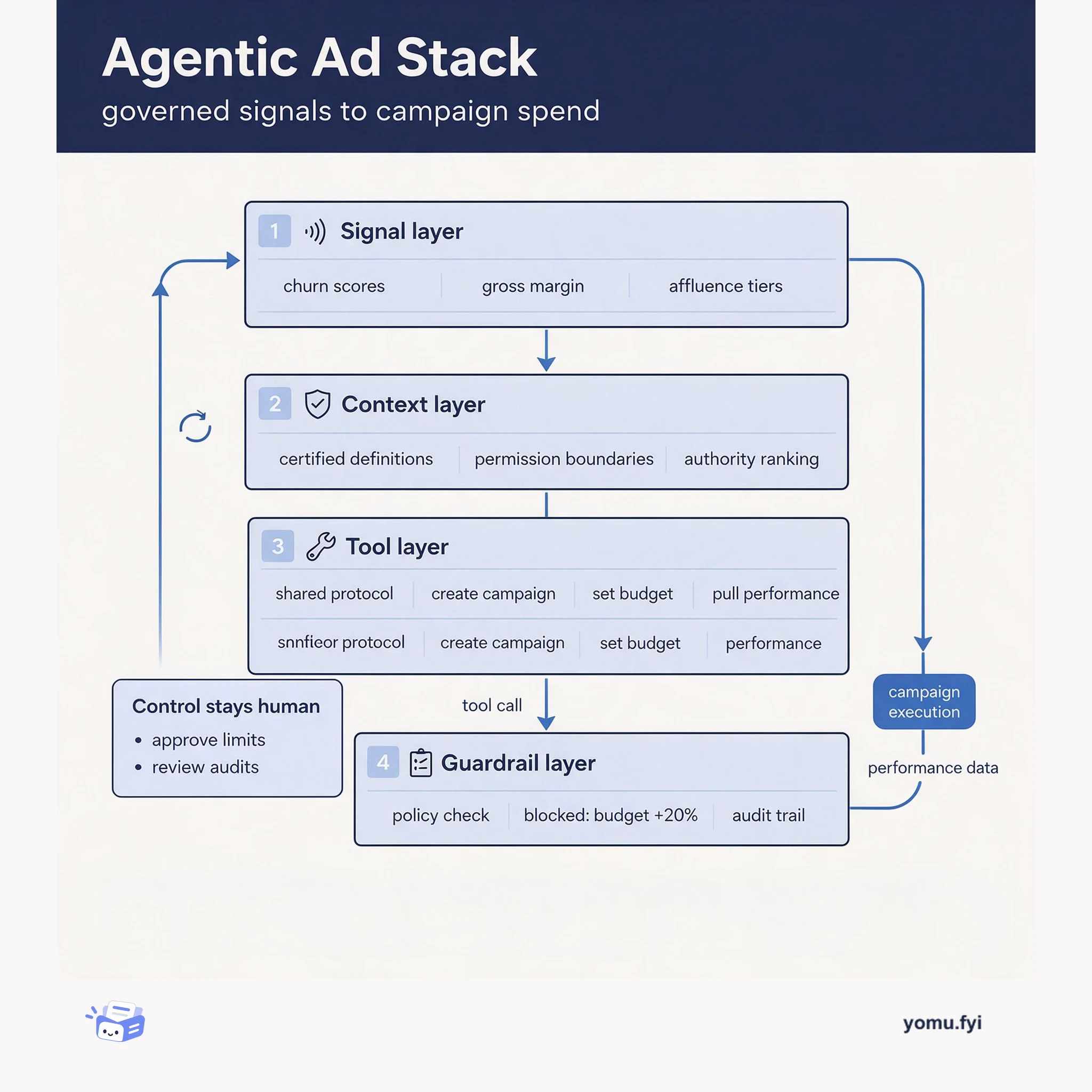
Databricks announces CustomerLake, an Agentic Customer Data Platform embedded natively in its lakehouse, bringing Customer 360, identity resolution, audience building, campaign automation, activation, and personalization alongside governed data and AI models. The announcement addresses fragmented identities, stale audiences, manual campaign workflows, and the duplication and governance burden created by separate martech systems. CustomerLake uses Unity Catalog and Lakehouse Federation to access customer data across Databricks, Snowflake, Google BigQuery, cloud object storage, operational databases, and other enterprise systems, while Profile Agents create business-ready profiles and Campaign Agents build audiences, recommend actions, activate channels, and optimize engagement. Its operating model is described as embedded, democratized, and autonomous, with Agentic Identity Resolution combining deterministic, probabilistic, and agentic workflows. CustomerLake is now available in Private Preview and launches with an open partner ecosystem.
Databricks
The piece defines an open lakehouse as a lakehouse whose storage, table format, processing engine, catalog, and ML and AI tooling use open standards and remain interchangeable. It contrasts this architecture with warehouses, lakes, and proprietary lakehouses, emphasizing low-cost object storage, ACID transactions, governance, schema guarantees, and the ability to change engines without rewriting data. Its reference stack combines open table formats such as Delta Lake and Apache Iceberg with Apache Parquet, Apache Spark, Unity Catalog, and MLflow, while allowing engines including DuckDB, Trino, and PyIceberg to work on the same data. The article also distinguishes open standards from open-source code, explains that a table format is only one layer of the stack, and states that the components can be self-hosted or consumed through a managed service.