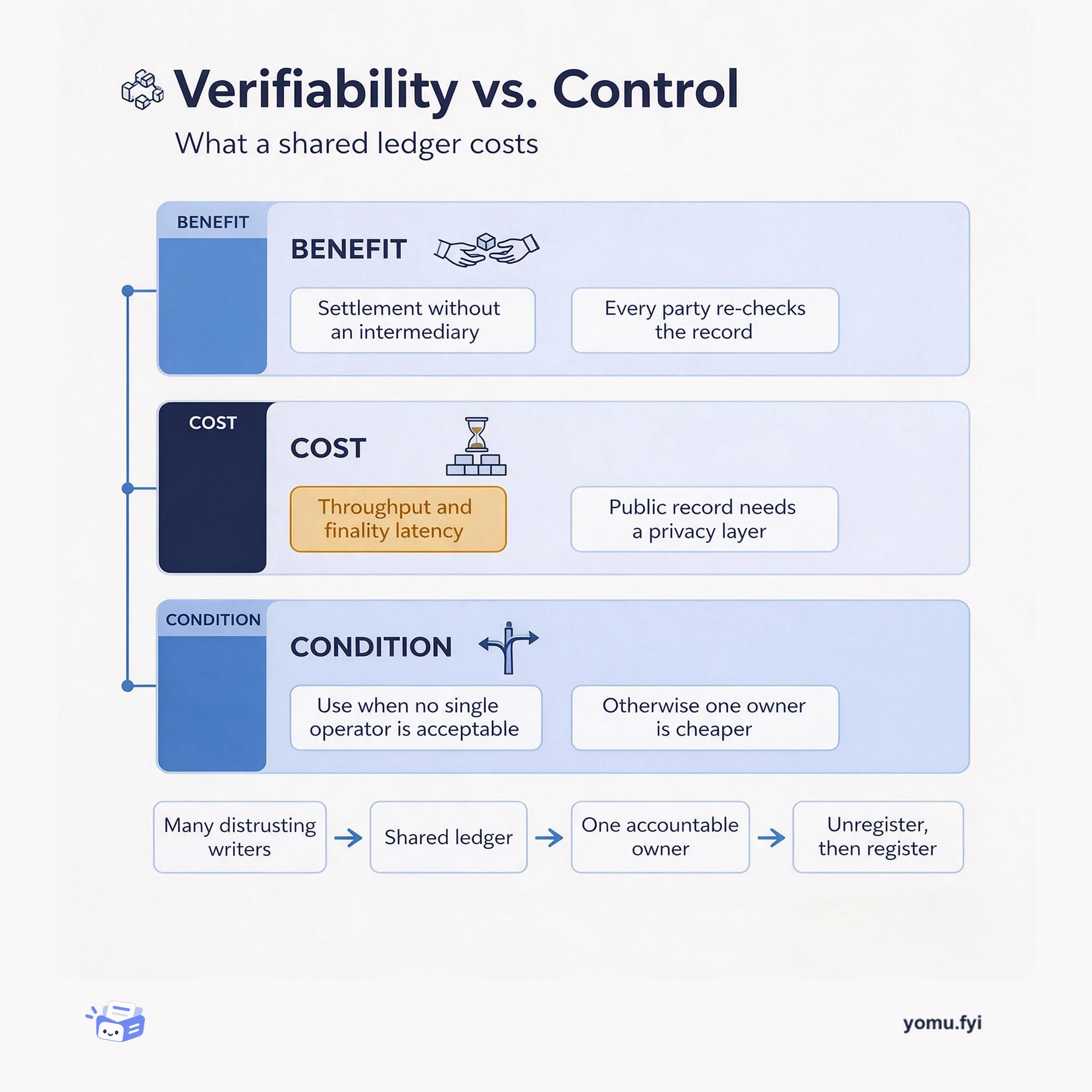
Verifiability vs. Control: What a Shared Ledger Actually Costs
A tradeoff view of blockchain: a shared ledger buys verifiable settlement between parties that do not share an operator, and charges throughput, latency, and governance in return.
Loading…
Topic
1 post about Verification. Every summary links to the original.
See the idea
A tradeoff view of blockchain: a shared ledger buys verifiable settlement between parties that do not share an operator, and charges throughput, latency, and governance in return.
The Good Stuff
Paid picks we use ourselves. Links carry a referral code — a subscription through one earns us a commission at no extra cost to you.
Newest first
MCP agents can produce claims that are factually true but attributed to the wrong source, a failure known as cross-source conflation that source-blind checkers miss. ProvenanceGuard preserves source identity by decomposing answers into claims, routing each to its relevant tool output, and checking support and attribution separately, using local models like MiniLM and DeBERTa. On medical agent traces with 281 interactions, it caught 138 of 139 claims experts flagged, scoring 0.802 F1 on blocking decisions and correct source 86% of the time. It flagged 67 supported claims for review under a cautious policy and added roughly half a second per answer in local tests. Blocked answers can be fixed through a repair loop for rewriting or fallback, avoiding unverifiable responses while keeping sensitive traces in a controlled environment.
The best engineering reads, once a week.

