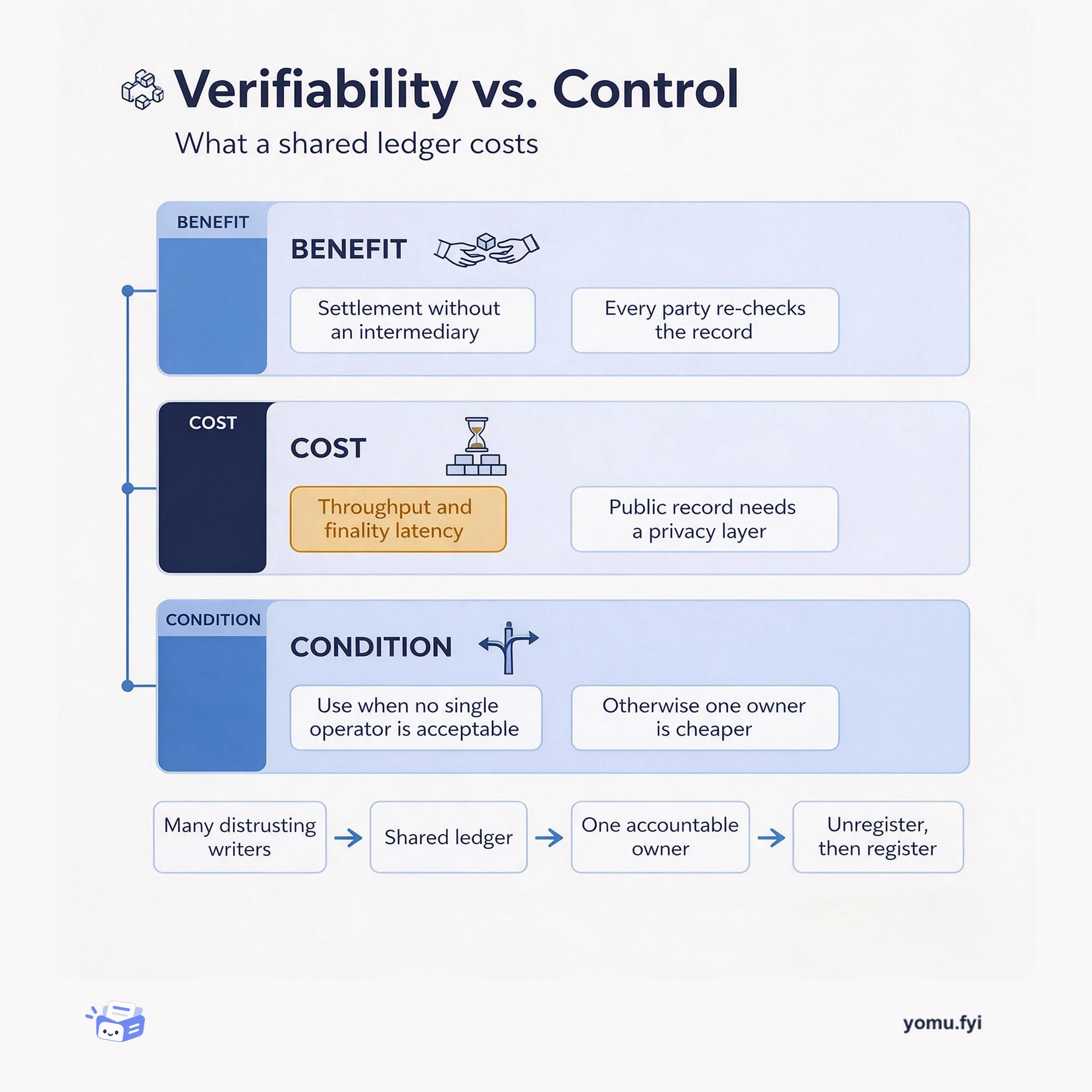
Verifiability vs. Control: What a Shared Ledger Actually Costs
A tradeoff view of blockchain: a shared ledger buys verifiable settlement between parties that do not share an operator, and charges throughput, latency, and governance in return.
Loading…
Topic
2 posts about Cryptography. Every summary links to the original.
See the idea
A tradeoff view of blockchain: a shared ledger buys verifiable settlement between parties that do not share an operator, and charges throughput, latency, and governance in return.
The Good Stuff
Paid picks we use ourselves. Links carry a referral code — a subscription through one earns us a commission at no extra cost to you.
Newest first
Cloudflare Workers now provides opt-in support for post-quantum cryptographic algorithms ML-KEM and ML-DSA within the Web Crypto API, including ML-KEM-768, ML-KEM-1024, ML-DSA-44, ML-DSA-65, and ML-DSA-87. These algorithms enable key encapsulation via encapsulateBits and decapsulateBits, and signatures via sign and verify, along with helper APIs like getPublicKey and SubtleCrypto.supports for feature detection. The implementation is gated behind the webcrypto_modern_algorithms compatibility flag and is based on a draft WICG specification, meaning it is opt-in while the specification is still moving. Developers can now use native primitives instead of bundling separate cryptographic code, reducing application size and maintenance burden for developers. Libraries such as panva/jose for JWTs and panva/hpke for HPKE can delegate ML-KEM and ML-DSA to the runtime, enabling experimentation with post-quantum protocols and preparing for the migration.
Cloudflare is racing toward a 2029 deadline for full post-quantum readiness, having already upgraded many products to post-quantum encryption but still needing to address authentication and remaining classical cryptography. To manage this massive migration, they built CryptoLabe, an internal AI-powered tool that scans their centralized codebase to discover and classify cryptography usage. The tool operates in two stages: discovery finds raw observations of cryptography across source, configuration, manifests, lockfiles, scripts, tests, and documentation, then analysis re-checks each observation, investigates runtime use and dependencies, and assigns classifications such as classical encryption, signature, or token. CryptoLabe also surfaces prerequisites where PQ migration is blocked by missing standards or library support, enabling Cloudflare to work with standards bodies and ecosystem stakeholders to drive migration plans. The post shares learnings for other organizations, recommending starting with a single repository, validating results, and prioritizing high-impact systems.
The best engineering reads, once a week.

