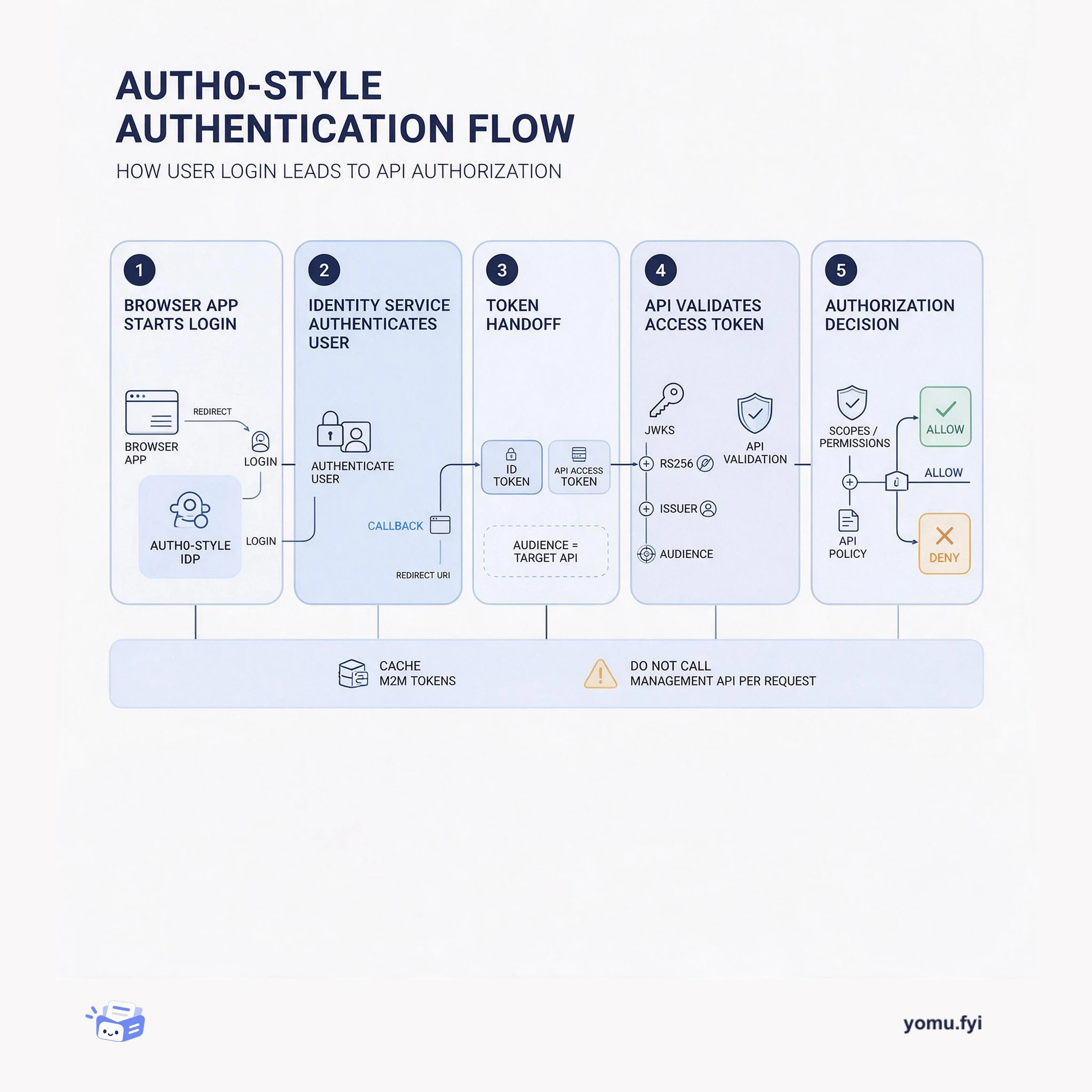
The Token’s Route: From Auth0 Login to API Authorization
See how an Auth0 login becomes an API decision: redirect the user, issue the right token, validate its claims, and apply audience, scope, and access policies.
 Auth0Madhuri Ravindra MohanTutorial
Auth0 API Access Policies for Applications control whether an application can obtain an access token for a registered API, separately for user-delegated and client access. The FinFlow example separates a browser application that should reach both APIs from a machine-to-machine Risk Engine restricted to the Payments API. Policies provide three choices—allow_all, require_client_grant, and deny_all—while client grants specify an application's audience and permitted scopes, with the audience determining which API policy is evaluated. The guide shows Dashboard and Management API configuration, including subject_type_authorization settings and grants for user and client access. It also explains that third-party applications still require grants under allow_all, while default third-party grants establish a baseline and per-application grants take precedence for exceptions.
FinFlow needs to control which of its browser and machine-to-machine applications can access two APIs with different sensitivity levels, while distinguishing user-delegated access from client access.
Configure per-API user and client policies through the Auth0 Dashboard or Management API, then create client grants that authorize applications, audiences, access types, and scopes. Default third-party grants can provide a baseline, with per-application grants overriding that baseline.
require_client_grant allows token issuance only when a matching client grant exists, while deny_all rejects access regardless of grants and allow_all skips grant checks for user access.
In the FinFlow configuration, the Risk Engine receives a client grant for the Payments API, the web app receives a user grant for that API, and client access to the Market Data API is denied.
A default third-party client grant can establish baseline scopes for partner applications, while a per-application grant takes precedence when an individual partner needs different permissions.
Summaries are generated from the original by a language model. Check the original before relying on it.
See the idea
See how an Auth0 login becomes an API decision: redirect the user, issue the right token, validate its claims, and apply audience, scope, and access policies.
Keep reading
The Good Stuff
Paid picks we use ourselves. Links carry a referral code — a subscription through one earns us a commission at no extra cost to you.
One useful email. Unsubscribe anytime.
