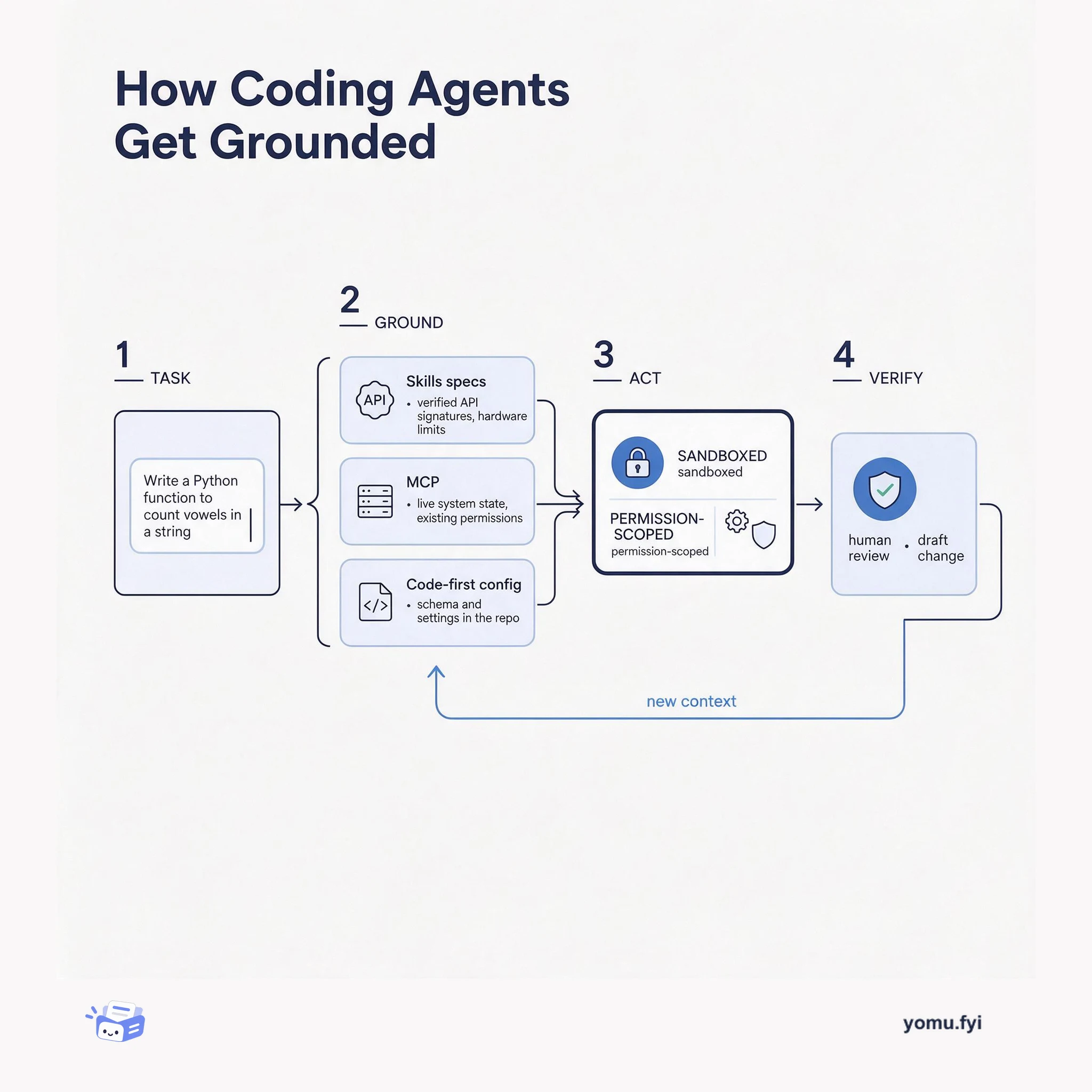
How Coding Agents Get Grounded in Your Stack
A four-stage flow showing how a coding agent moves from a task to a reviewed change by grounding on verified skills, live system state, and code-first config before it acts.
 AnthropicAnthropicAnnouncement
Anthropic launched Claude Frontier Academy with a $100 million commitment to train 10,000 Frontier Deployed Engineers by the end of 2027. The program addresses the talent gap in enterprise AI implementation, where skilled engineers are scarce. The Frontier Deployed Engineer Residency follows a medical model: engineers learn from practitioners, work on simulated enterprise deployments covering use case selection, security review, and handover, and are assessed on a graded practical before earning credentials. First cohorts include engineers from Accenture, Bain, Capgemini, Commonwealth Bank of Australia, Deloitte, McKinsey, Morgan Stanley, and Novo Nordisk, with cohorts running in San Francisco, New York, and London. The program starts with a multi-day in-person session with Anthropic engineers and licensed instructors and continues with a 12-week residency where engineers lead a real Claude use case at their organization, supported by Anthropic engineers, with the first FDE badges expected in early 2027.
Enterprises face a shortage of engineers skilled in deploying AI systems in production. Anthropic’s Claude Partner Network has already certified over 175,000 professionals, but the Academy targets a deeper level of expertise for engineers who will lead enterprise AI deployments.
The Academy trains engineers through a multi-day in-person program simulating an enterprise deployment, followed by a 12-week residency where engineers lead a real Claude use case at their organization, with assessments and badges at each stage.
The Frontier Deployed Engineer Residency follows a medical model: engineers learn from practitioners, work on simulated cases, and are assessed before practicing independently.
The program targets hands-on software engineers with strong fundamentals and LLM experience, nominated by their organizations, and requires them to arrive with a named Claude project to lead.
First cohorts include engineers from Accenture, Bain, Capgemini, Commonwealth Bank of Australia, Deloitte, McKinsey, Morgan Stanley, and Novo Nordisk, with cohorts running in San Francisco, New York, and London.
Hands-on software engineers with strong fundamentals, a record of building with LLMs, experience helping others adopt AI, and a habit of tackling important business problems. Organizations nominate their strongest engineers, and prior experience building AI agents is not required.
The program starts with a multi-day in-person session with Anthropic engineers and licensed instructors, where engineers work through a simulated enterprise deployment and complete a graded practical. Those who pass earn the Claude Resident Engineer badge and enter a 12-week residency leading a real Claude use case at their organization, supported by Anthropic engineers.
The first Claude Frontier Deployed Engineer badges are expected in early 2027, after engineers complete the 12-week residency and pass a final assessment.
Summaries are generated from the original by a language model. Check the original before relying on it.
See the idea
A four-stage flow showing how a coding agent moves from a task to a reviewed change by grounding on verified skills, live system state, and code-first config before it acts.
Keep reading
The Good Stuff
Paid picks we use ourselves. Links carry a referral code — a subscription through one earns us a commission at no extra cost to you.
One useful email. Unsubscribe anytime.
