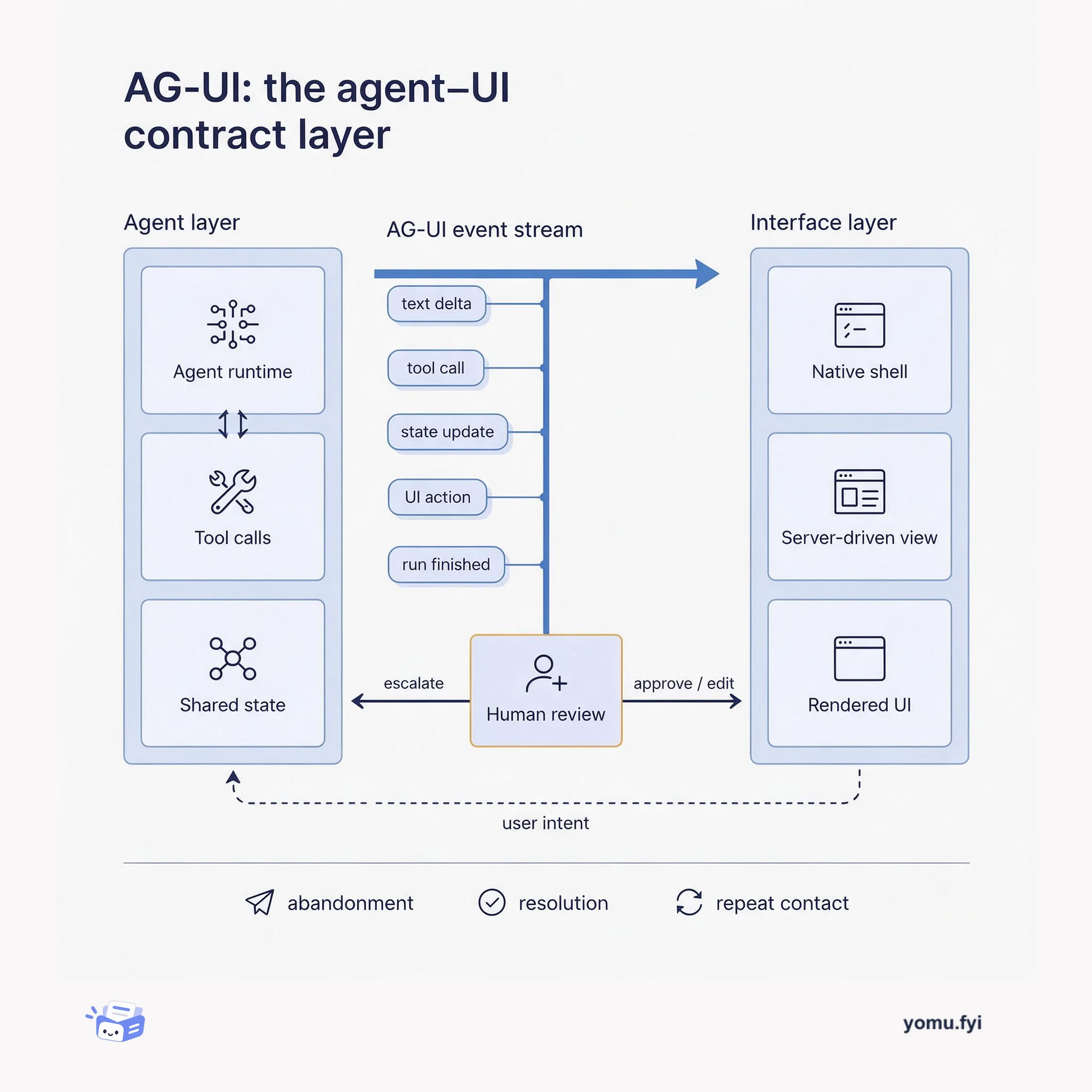
AG-UI as the Agent–UI Contract Layer
AG-UI is a typed event contract between an agent backend and a frontend, turning streamed agent state into UI. This diagram maps the layers and shows where human review plugs in.
 AWSAnand BilgaiyanTutorial
Static interfaces cannot adapt when generative AI produces variable outputs, such as a medical scan showing one fracture versus twenty ambiguous regions requiring expert review. The solution combines three AWS technologies: the AG-UI protocol for standardized agent-to-UI streaming via Server-Sent Events, the Strands Agents SDK Swarm pattern for peer-to-peer agent collaboration, and Amazon Nova Act for browser-based legacy system integration. AG-UI removes custom WebSocket formats by defining typed events that both agent frameworks and frontends implement as a universal contract. Strands swarm agents debate hypotheses and iteratively refine findings, producing explainable results visible in real time, while Nova Act navigates login screens and fills forms on systems without APIs. A complete radiology assistant walkthrough demonstrates reduced interface development time and HIPAA-compliant data handling for medical imaging.
Generative AI applications produce unpredictable outputs that static interfaces cannot handle, forcing developers to build and maintain multiple interface variations. This problem is common in domains like medical imaging, fraud detection, and legal document review, where AI agents discover dynamic findings rather than classifying into predetermined categories.
AG-UI provides a standardized streaming format (SSE-based typed events) that acts as a universal contract between agent frameworks and frontend UIs, eliminating custom WebSocket formats or polling mechanisms.
The Strands Agents SDK Swarm pattern enables peer-to-peer multi-agent collaboration where agents debate hypotheses and iteratively refine findings until consensus, producing explainable results visible in real time.
Amazon Nova Act enables browser-based automation of legacy systems without APIs, allowing agents to navigate login screens, search records, fill forms, and capture confirmation numbers while streaming actions back to the primary interface.
Use adaptive interfaces when the AI output space is unpredictable, debate among agents is needed, low latency is not critical, outputs are cost-sensitive with predictable patterns, or explainability is required. Static interfaces suit predictable, consistent outputs such as ecommerce checkout pages.
AG-UI defines typed events streamed over Server-Sent Events, creating a universal contract between agent frameworks and frontends. This removes the need for custom WebSocket formats or polling mechanisms, allowing developers to swap agent frameworks without rewriting integration code.
The post details encryption at rest with SSE-KMS on S3 and DynamoDB, enforcement of TLS 1.2+ on all connections, S3 Block Public Access, use of HIPAA-eligible services with a BAA, PHI minimization (no plaintext logs, Cognito JWT verification on SSE endpoint), and a specific resource deletion sequence during teardown.
Summaries are generated from the original by a language model. Check the original before relying on it.
See the idea
AG-UI is a typed event contract between an agent backend and a frontend, turning streamed agent state into UI. This diagram maps the layers and shows where human review plugs in.
Keep reading
The Good Stuff
Paid picks we use ourselves. Links carry a referral code — a subscription through one earns us a commission at no extra cost to you.
One useful email. Unsubscribe anytime.
