Blender's MCP Connector: Batch Speed vs. Authority Over the Scene
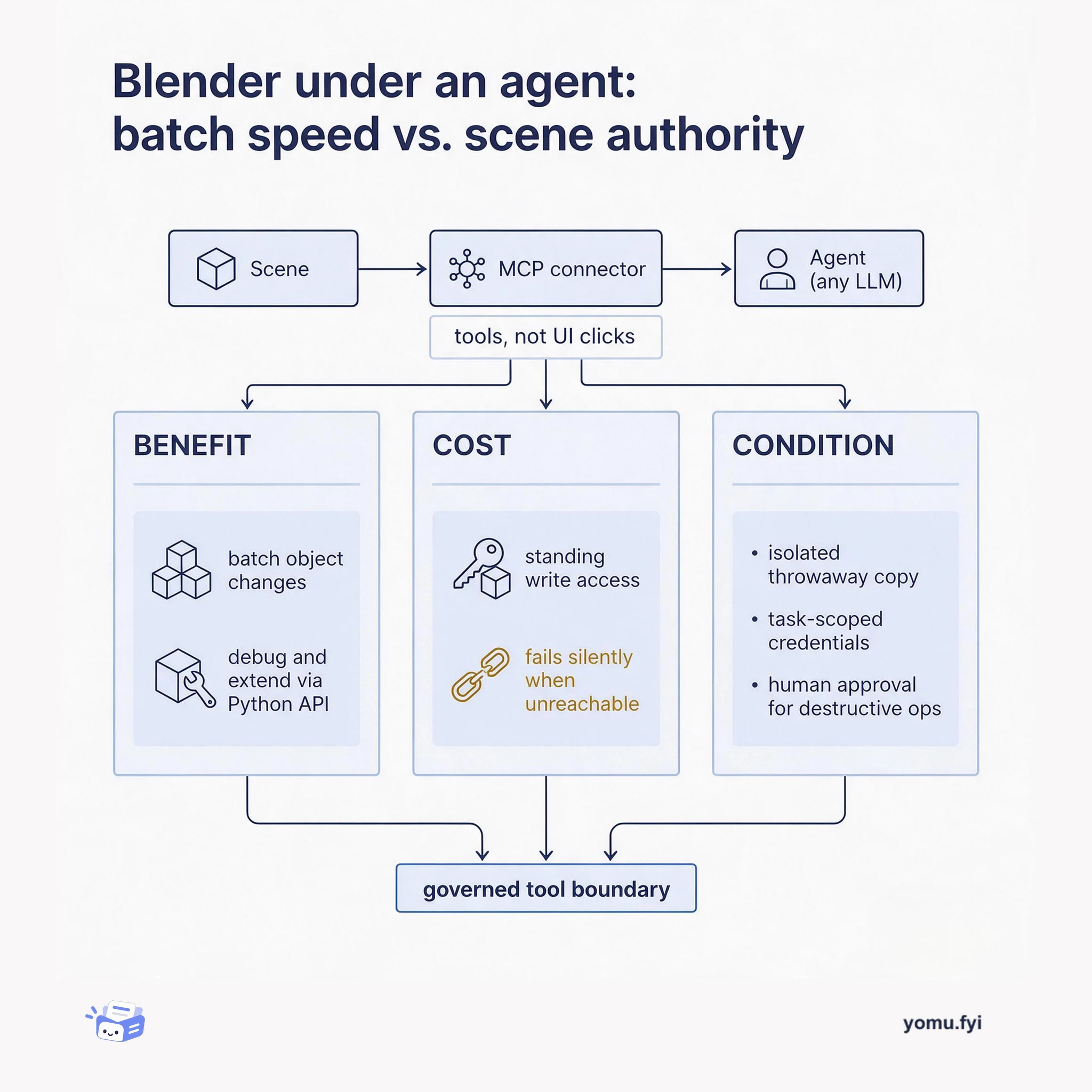
Blender's MCP connector lets an LLM analyze and batch-edit scenes through Blender's Python API. This trade-offs view weighs that speed against the authority and isolation it requires.
 Auth0Andrea ChiarelliExplainer
The Confused Deputy problem, first documented in 1988, describes a program with legitimate authority being tricked into misusing that authority on behalf of a less-privileged actor. AI agents are particularly vulnerable because they process instructions and untrusted content through the same natural-language channel, making prompt injection straightforward. The post traces this pattern through CSRF, SSRF, and recent attacks like Clinejection, where an issue-triage bot executed an attacker-supplied command from a crafted issue title. That attack led to a poisoned GitHub Actions cache and a compromised npm package downloaded 4,000 times. The fix involves task-scoped short-lived credentials, capability-scoped permissions, credential isolation from the model, and human-in-the-loop approval for high-risk actions.
The Confused Deputy problem, first described by Norm Hardy in 1988, occurs when a program with legitimate authority is tricked by a less-privileged actor into misusing that authority. AI agents are particularly vulnerable because they process instructions and untrusted content through the same natural-language channel, making prompt injection straightforward. The post traces the pattern through CSRF, SSRF, and recent real-world attacks like Clinejection, where an issue-triage bot executed an attacker-supplied command from a crafted issue title, leading to a poisoned cache and a compromised npm package downloaded 4,000 times.
Apply least privilege, capability-based security, task-scoped short-lived credentials, capability-scoped permissions, credential isolation from the model, and human-in-the-loop approval to AI agents, as exemplified by Auth0 for AI Agents’ Token Vault and task-scoped authorization.
The Confused Deputy problem requires two conditions: an identifier that doesn’t carry access rights, and a deputy whose permissions apply automatically without checking the caller’s authority.
AI agents are vulnerable because they mix instructions and untrusted content in the same natural-language channel, so a sentence in an email or issue title can trigger unauthorized actions.
Defenses include task-scoped short-lived credentials, capability-scoped permissions, keeping credentials in a separate deterministic layer the model cannot access, and requiring human approval for irreversible actions.
The two structural conditions are: first, the identifier used to reference an object (like a filename or URL) does not carry access rights of its own; second, the deputy's permissions apply automatically without checking whether the specific caller is authorized for that action.
An AI agent processes system prompts, user requests, retrieved documents, and tool outputs through the same natural-language channel. A sentence in a GitHub issue title carries the same weight as a direct user command, so an attacker can inject instructions into content the agent reads, causing it to misuse its authority.
The Clinejection attack in February 2026 used a crafted issue title to trick an issue-triage bot into executing an attacker-supplied command. That foothold was used to poison a GitHub Actions cache, which was then restored by a privileged nightly release workflow, giving the attacker access to an npm publishing token and allowing publication of a tampered package downloaded 4,000 times.
Summaries are generated from the original by a language model. Check the original before relying on it.
See the idea
Blender's MCP connector lets an LLM analyze and batch-edit scenes through Blender's Python API. This trade-offs view weighs that speed against the authority and isolation it requires.
Keep reading
The Good Stuff
Paid picks we use ourselves. Links carry a referral code — a subscription through one earns us a commission at no extra cost to you.
One useful email. Unsubscribe anytime.
