Prevent, Verify, Contain: The Three Bills of AI Safety
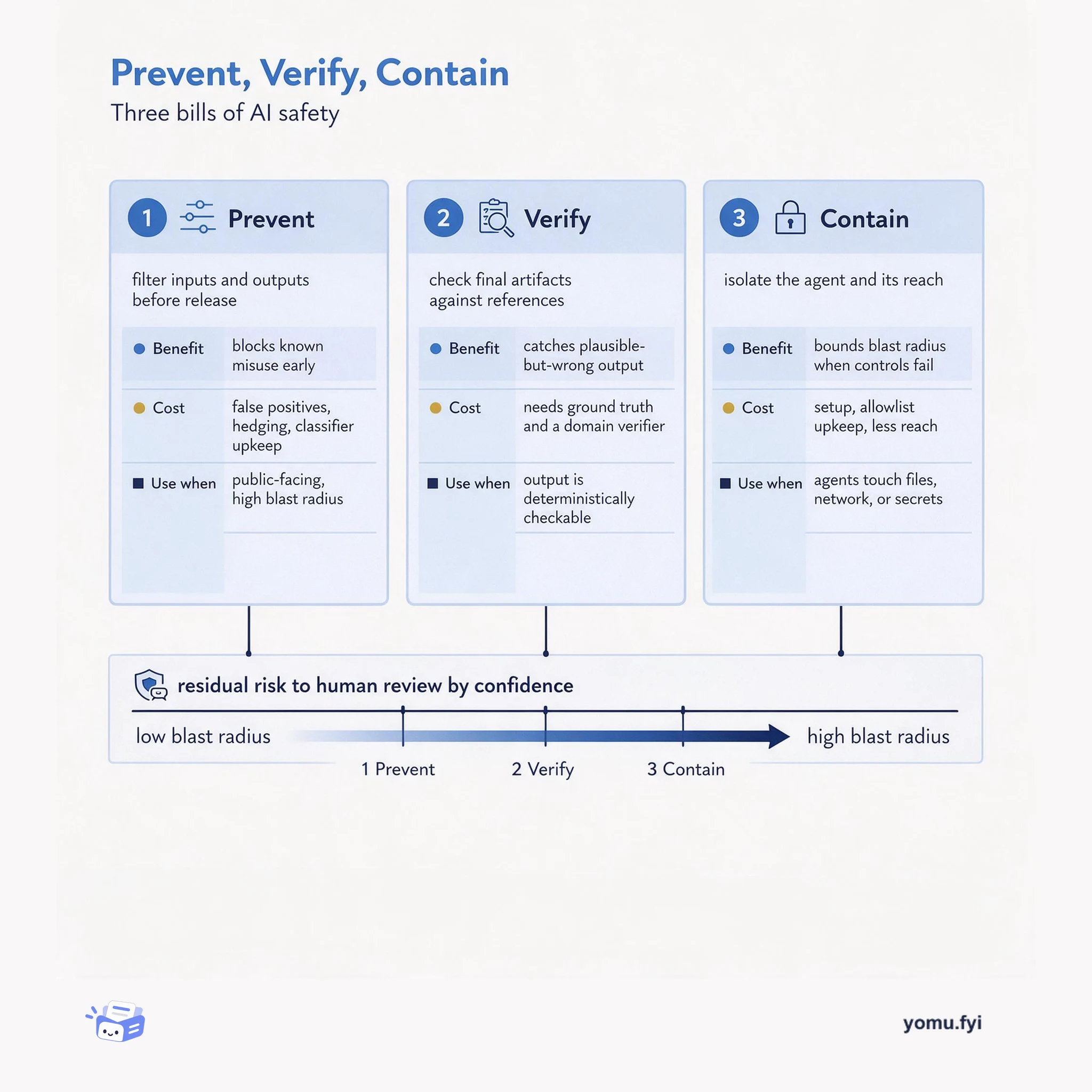
AI safety is a budget: prevention, verification, and containment each buy different protection at a different cost. This map shows what each control costs and when it pays off.
Blender's MCP connector lets an LLM analyze and batch-edit scenes through Blender's Python API. This trade-offs view weighs that speed against the authority and isolation it requires.
Blender's MCP connector turns a scene into something an agent can operate: it can analyze and debug scenes, batch-apply object changes, and add tools through Blender's Python API, and because it speaks MCP, other LLMs can drive it too. The benefit is throughput on repetitive scene work; the cost is authority, since an agent writing to a live scene holds standing access and can fail silently. Making the trade worthwhile needs a governed tool boundary, a throwaway copy to work in, and human approval before destructive changes.
The connector exposes Blender through MCP, so an agent can analyze and debug scenes, batch-apply object changes, and add new tools through Blender's Python API. Because it is MCP-based rather than Claude-only, other LLMs can drive the same surface. It also supports cross-application pipeline work and batch processing in creative workflows.
Agents can appear healthy while effectively unreachable, so availability has to be measured rather than assumed. Unify telemetry across sessions, tool calls, errors, and escalations, then alert with drill-down into the failing session. Where the tool boundary is governed by MCP, audit logging on every invocation gives you the record of what actually ran.
The posts behind it
 Databricks · · Explainer
Database branching creates isolated database environments from a known parent state using copy-on-write, where branches share unchanged data and only store modifications. For a large parent database like one that is 40 GB, two branches may require just 5.6 MB of additional storage instead of 80 GB with traditional full copies. Developers can test schema migrations like adding a NOT NULL column to a table with millions of rows against realistic data and constraints, CI pipelines provision per-pull-request branches for isolated tests, and AI agents experiment across short-lived environments without risking the parent database. Safe operation relies on protecting parent branches from writes and deletions, restricting sensitive data in disposable branches, automating creation and cleanup, and keeping environments reproducible through version-controlled configuration. Databricks Lakebase provides database branching, enabling teams to adopt Git-style workflows for development, CI/CD, and AI agent use cases.
 Salesforce · · Announcement
Agentforce Health Monitoring (AHM) addresses silent availability failures in production AI agents that traditional monitoring misses because agents can appear healthy even when unreachable. The team unified telemetry from approximately five or six locations across sessions, reasoning steps, tool calls, errors, and escalations into a coherent representation. End-to-end alerting latency was reduced from roughly 20 minutes to several minutes by converting Data 360 ingestion to streaming and simplifying query complexity. AHM provides 16+ built-in metrics including agent availability, error rate, response/escalation rate, engagement, and latency, with a drill-down interface connecting alerts to session context. The roadmap includes cost, TTFT/TTLT, toxicity, feedback metrics, RAG Quality Monitoring integration, and eventually a runtime insight agent for root-cause analysis and automated remediation.
Databricks · · AnnouncementDatabricks has announced general availability of the Genie One Model Context Protocol (MCP) server, now a managed service within Unity Gateway with centralized governance, fine-grained policies, and audit logging across every invocation. The MCP provides a single governed interface for any AI agent to access structured and unstructured data from Genie One, grounded in governed business context from Genie Ontology, eliminating agent sprawl and inconsistent answers. It exposes tools for asking questions, getting query results, checking incremental progress, and steering responses, with an optional MCP App for real-time interactive visualizations and Genie Ontology citations. Connected agent clients automatically interpret domain semantics via Genie Ontology across relational data and document repositories without custom connectors. Use cases include enriching slide creation with richer data, bringing customer usage context to outreach agents, and integrating business definitions into developer workflows, as noted by GetYourGuide.
 Stripe · · Problem & solution
Stripe implemented WebMCP on its Checkout UIs, which processes around 0.45% of global GDP, to optimize the buying experience for AI agents. Previously, agents relied on slow browser automation, consuming an average of 1.8 million tokens and 38.83 tool calls per transaction, taking over 2.5 minutes. WebMCP exposes MCP tools from the client side, allowing agents to execute actions like get_order_summary or fill_payment_form instead of interpreting the DOM. The implementation uses progressive tool disclosure, revealing only relevant tools; in evaluations across six models, agents using WebMCP consumed 42% fewer tokens, made 38% fewer tool calls, and completed checkout 39% faster. Stripe reused existing UI state and forms via imperative and declarative APIs, avoiding a separate agent-only code path and keeping human and agent experiences aligned.
 Auth0 · · Explainer
The Confused Deputy problem, first documented in 1988, describes a program with legitimate authority being tricked into misusing that authority on behalf of a less-privileged actor. AI agents are particularly vulnerable because they process instructions and untrusted content through the same natural-language channel, making prompt injection straightforward. The post traces this pattern through CSRF, SSRF, and recent attacks like Clinejection, where an issue-triage bot executed an attacker-supplied command from a crafted issue title. That attack led to a poisoned GitHub Actions cache and a compromised npm package downloaded 4,000 times. The fix involves task-scoped short-lived credentials, capability-scoped permissions, credential isolation from the model, and human-in-the-loop approval for high-risk actions.
 Anthropic · · Announcement
Claude for Creative Work describes a set of connectors and workflows intended to help creative professionals expand ideation, reduce repetitive work, and take on larger-scale projects. The connectors connect Claude with tools including Ableton, Adobe Creative Cloud, Affinity by Canva, Autodesk Fusion, Blender, Resolume, SketchUp, and Splice, supporting documentation access, asset production, 3D modeling, live visual control, and sample search. The described uses also include tutoring, Claude Code scripts and plugins, cross-application pipeline work, Claude Design exploration with export to Canva, and batch processing. Blender has an officially available MCP connector that can analyze and debug scenes, batch-apply object changes, and add tools through Blender’s Python API; because it uses MCP, it is accessible to other LLMs. The post also describes access for students and faculty in three art and design programs, whose feedback will inform understanding of creative practitioners’ needs.
More like this
AI safety is a budget: prevention, verification, and containment each buy different protection at a different cost. This map shows what each control costs and when it pays off.
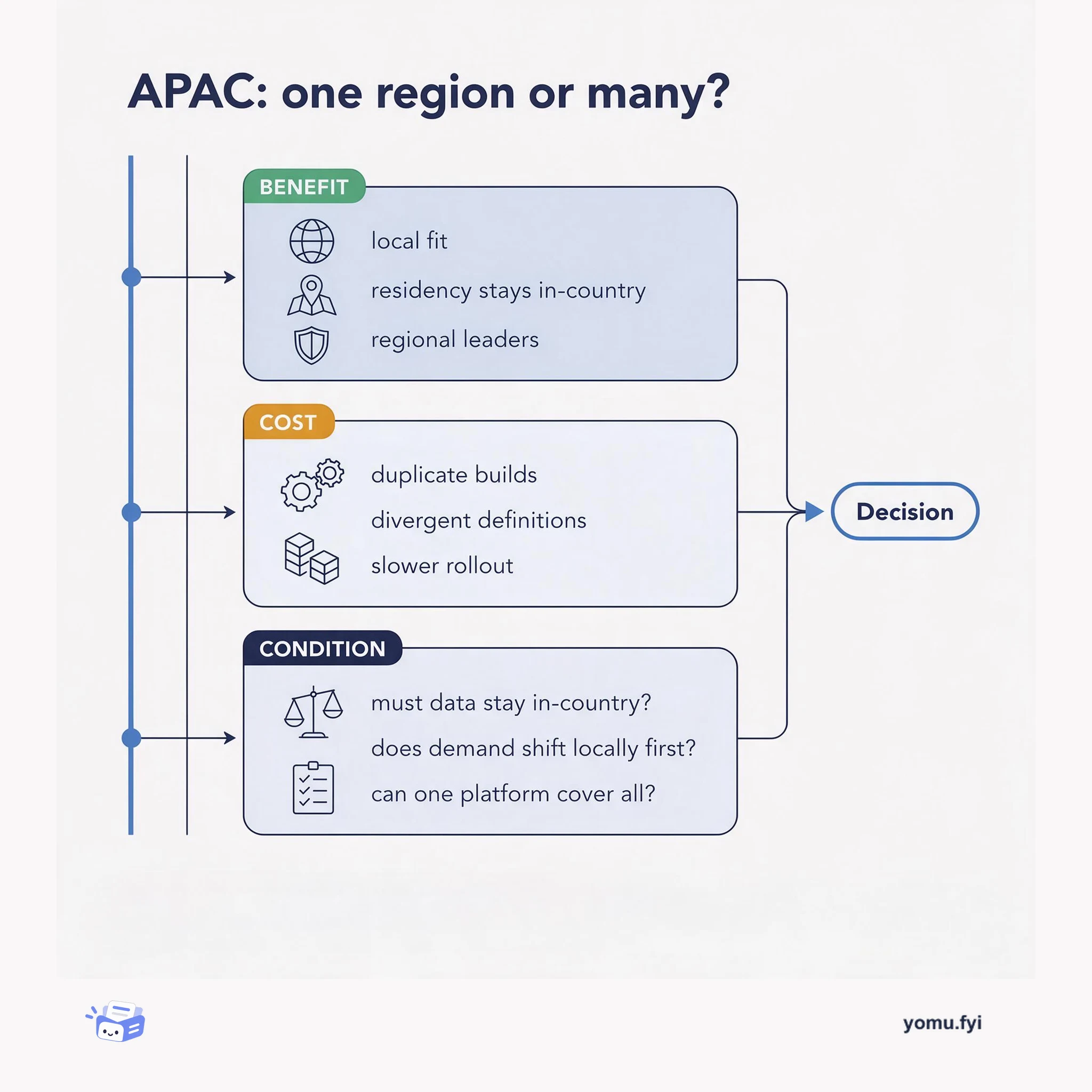
APAC is a federation of markets, not a single deployment region. This diagram maps the tradeoff between local autonomy and one shared platform, and the conditions that decide it.
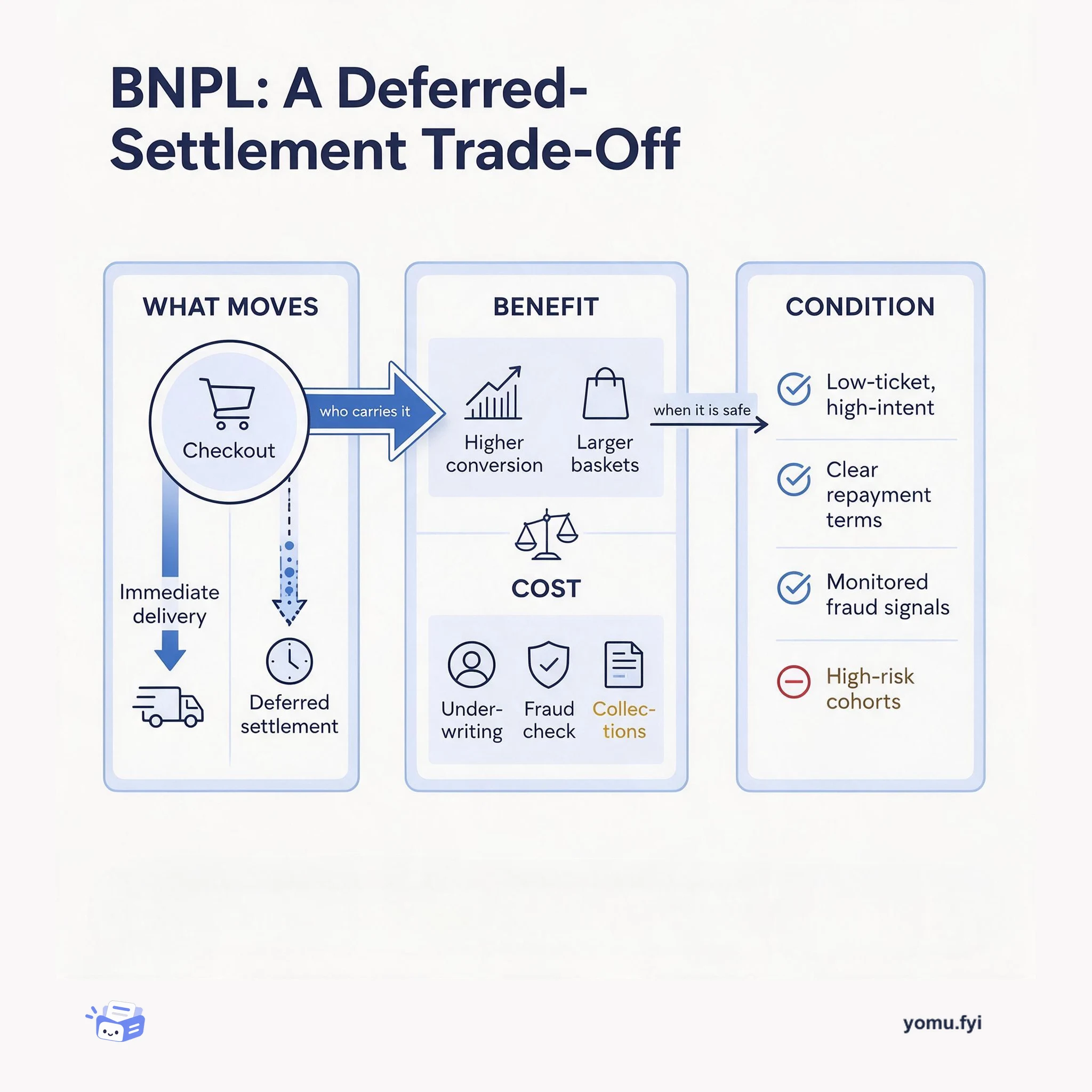
Buy Now, Pay Later is a deferred-settlement trade-off: merchants gain conversion while underwriting, fraud, and collections risk move elsewhere. This diagram maps the benefit, the cost, and the condition that decides.
The Good Stuff
Paid picks we use ourselves. Links carry a referral code — a subscription through one earns us a commission at no extra cost to you.
One useful email. Unsubscribe anytime.