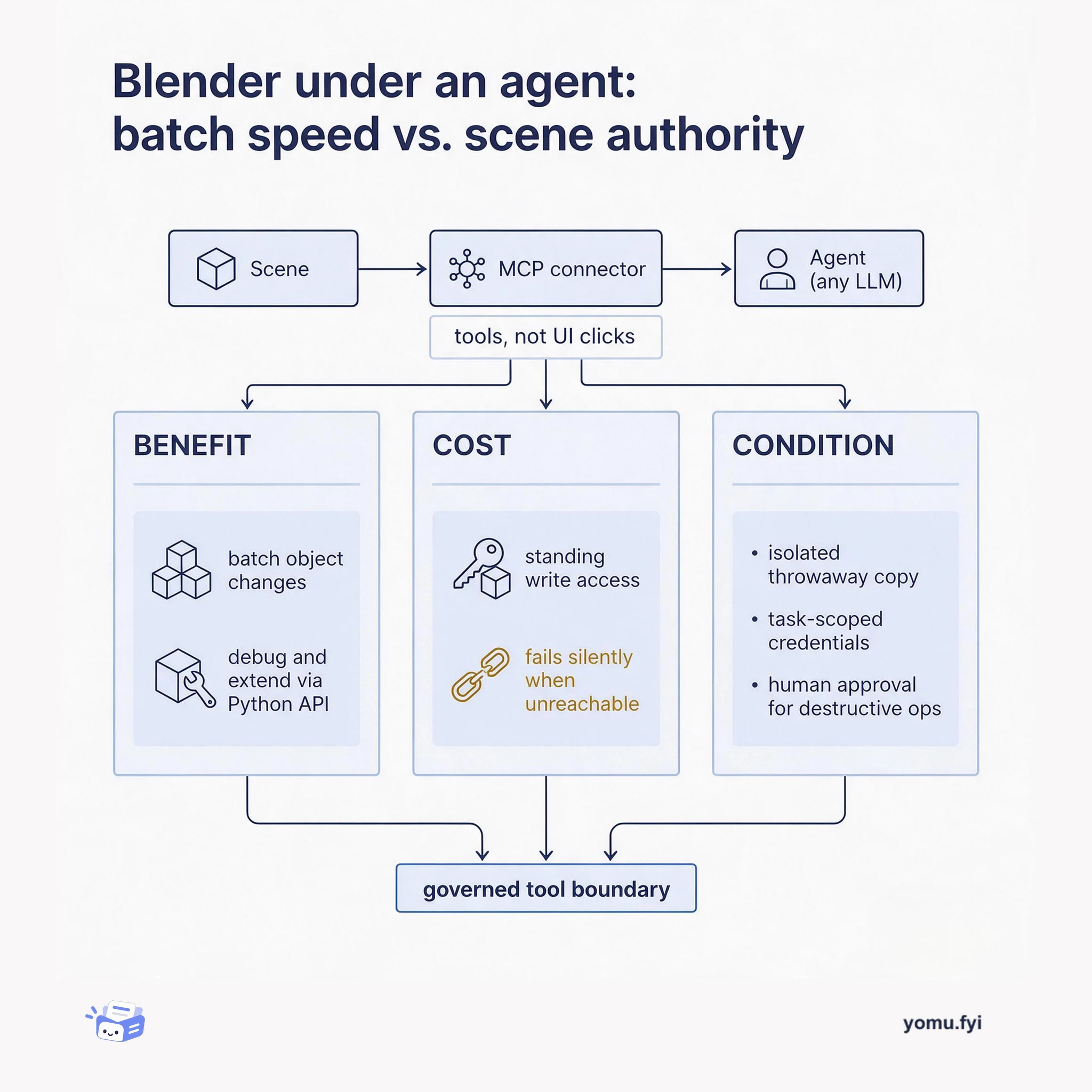
Blender's MCP Connector: Batch Speed vs. Authority Over the Scene
Blender's MCP connector lets an LLM analyze and batch-edit scenes through Blender's Python API. This trade-offs view weighs that speed against the authority and isolation it requires.
 DatabricksDatabricks StaffExplainer
Database branching creates isolated database environments from a known parent state using copy-on-write, where branches share unchanged data and only store modifications. For a large parent database like one that is 40 GB, two branches may require just 5.6 MB of additional storage instead of 80 GB with traditional full copies. Developers can test schema migrations like adding a NOT NULL column to a table with millions of rows against realistic data and constraints, CI pipelines provision per-pull-request branches for isolated tests, and AI agents experiment across short-lived environments without risking the parent database. Safe operation relies on protecting parent branches from writes and deletions, restricting sensitive data in disposable branches, automating creation and cleanup, and keeping environments reproducible through version-controlled configuration. Databricks Lakebase provides database branching, enabling teams to adopt Git-style workflows for development, CI/CD, and AI agent use cases.
Software teams use Git for isolated code development, but database environments typically require sharing a single database or creating full copies, causing delays and test conflicts.
Use copy-on-write to create database branches from a parent state, sharing unchanged data and storing only modifications. Branches initially share the parent’s data and only allocate storage for changed pages, making creation fast and inexpensive.
Database branching uses copy-on-write to share unchanged data with the parent, so branches require minimal additional storage until they diverge. A 40 GB parent with two branches may need only 5.6 MB extra instead of 80 GB with full copies.
Developers can test schema migrations against production-like data on a branch, catching failures like adding a NOT NULL column to a table with millions of rows before the migration reaches production.
Safe database branching requires protecting parent branches, restricting sensitive data in ephemeral branches, automating lifecycle, and treating branches as disposable environments that can be recreated from version-controlled configuration.
Database branching creates an isolated database environment from a parent database at a specific point in time. The branch starts with the parent's schema and data, but changes made to the branch remain isolated. With copy-on-write, branches share unchanged data with the parent, which makes them fast to create and inexpensive to discard.
Both create an isolated environment from a known state without affecting the original. Git branches isolate source code and are typically merged back, while database branches isolate schema and data and are not merged; instead, migration files remain the source of truth and are applied through deployment pipelines.
Database branching gives developers, CI jobs, and AI agents isolated environments for testing changes without affecting production or other workloads. It supports testing migrations against realistic data, creating per-PR environments, recovering from failed experiments, and running multiple database-backed workloads in parallel.
Summaries are generated from the original by a language model. Check the original before relying on it.
See the idea
Blender's MCP connector lets an LLM analyze and batch-edit scenes through Blender's Python API. This trade-offs view weighs that speed against the authority and isolation it requires.
Keep reading
The Good Stuff
Paid picks we use ourselves. Links carry a referral code — a subscription through one earns us a commission at no extra cost to you.
One useful email. Unsubscribe anytime.
