Choosing a time-series forecasting model is difficult because different architectures handle smooth industrial signals, noisy retail demand, and seasonal horizons differently. Granite Timeseries Ensemble addresses this by combining four pre-trained Granite models—PatchTST-FM-r1, PatchTST-FM-r2, FlowState-r1.1, and TTM-r3—into a single forecast without retraining or fitted weights. Two aggregation methods are provided: the Probabilistic Ensemble uses uniform probability pooling, while the IQR Ensemble adaptively weights members based on their forecast spread. On the GIFT-Eval benchmark, both ensembles outperform all individual members on aggregate MASE and MASE rank, with the Probabilistic Ensemble achieving the lowest MASE of 0.683. The ensemble offers a robust default, but users should backtest on their data and consider limitations like independent multivariate forecasting and increased inference time from loading four checkpoints.
Context
Time-series forecasting often requires choosing a single pre-trained model, but different architectures perform best on different data patterns. Granite Timeseries Ensemble combines four complementary Granite models to produce a single forecast without retraining, reducing the risk of picking the wrong model.
Approach / What changed
The Granite Timeseries Ensemble recipe stores the ensemble configuration rather than merged model weights. It downloads four member checkpoints at runtime. Two aggregation methods are provided: the Probabilistic Ensemble uses uniform probability pooling, and the IQR Ensemble adaptively weights members based on their forecast spread. The ensemble can be extended with compatible external forecasters.
Takeaways
1
The Granite Timeseries Ensemble combines four pre-trained models (PatchTST-FM-r1, PatchTST-FM-r2, FlowState-r1.1, TTM-r3) without retraining or fitted weights, using either uniform probability pooling or adaptive IQR weighting.
2
On the GIFT-Eval benchmark, both ensembles outperform all individual members on aggregate MASE and MASE rank, with the Probabilistic Ensemble achieving the lowest MASE of 0.683.
3
The ensemble does not guarantee calibration or robustness under distribution shift, and it forecasts multivariate channels independently, increasing inference time and memory relative to a single member.
FAQ
How does the Granite Timeseries Ensemble combine forecasts from different models?
The ensemble uses two methods: Probabilistic Ensemble pools quantile forecasts uniformly in probability space, while IQR Ensemble weights members by their forecast spread, giving narrower intervals greater influence. Both methods require no retraining or fitted weights.
Which ensemble method should I use?
Start with the Probabilistic Ensemble as a simple default. If forecast spread is informative for your application, compare the IQR Ensemble against it on representative data, as accuracy and calibration depend on the series and horizon.
Does the ensemble always outperform individual models?
On the GIFT-Eval benchmark, both ensembles outperform all four individual members on aggregate MASE and MASE rank, but the margin over the best single member (PatchTST-FM-r2) is small. The main benefit is robustness: comparable or better accuracy without needing to select the best architecture in advance.
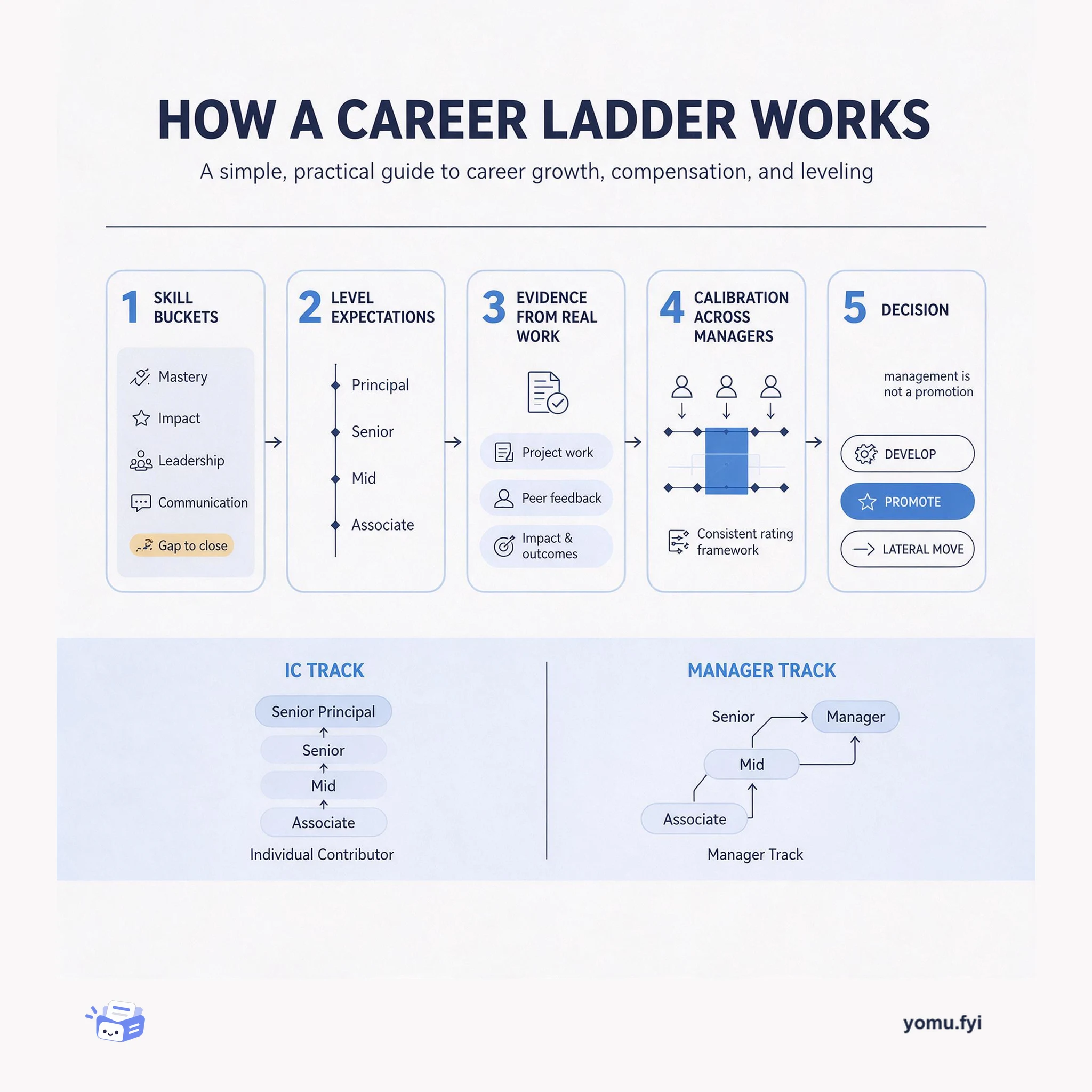
A career ladder turns vague seniority into a repeatable flow: define skill buckets, set level expectations, collect real evidence, calibrate across managers, then decide. Here is how each stage works.
Keep reading
Related reading
The Good Stuff
Paid picks we use ourselves. Links carry a referral code — a subscription through one earns us a commission at no extra cost to you.