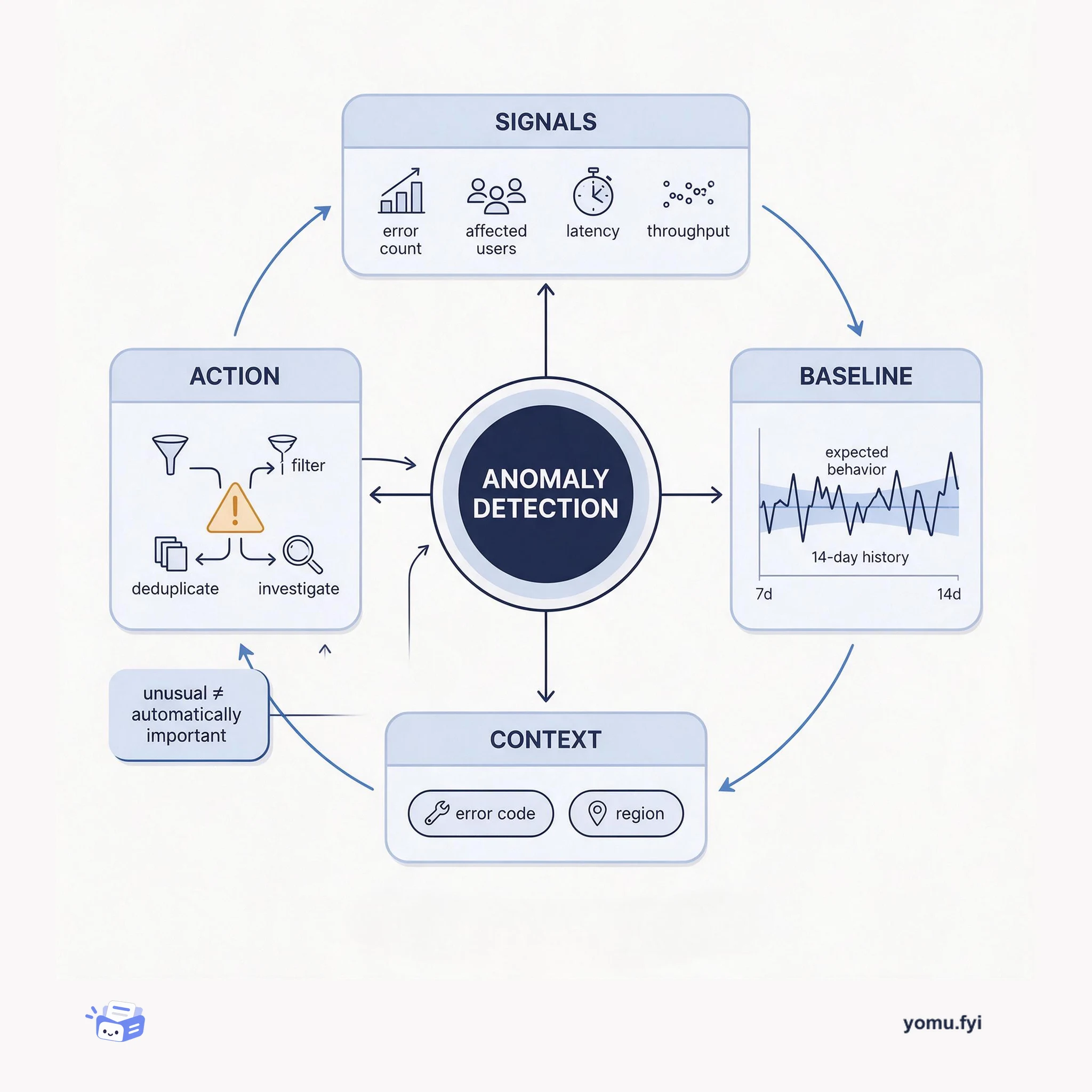
Anomaly Detection: From Baseline to Action
Anomaly detection identifies meaningful departures from expected behavior. This explainer shows how signals, baselines, context, and alert routing turn unusual measurements into engineer-ready findings.
Loading…
Topic
3 posts about Time Series. Every summary links to the original.
See the idea
Anomaly detection identifies meaningful departures from expected behavior. This explainer shows how signals, baselines, context, and alert routing turn unusual measurements into engineer-ready findings.
The Good Stuff
Paid picks we use ourselves. Links carry a referral code — a subscription through one earns us a commission at no extra cost to you.
Newest first
ClickHouse 26.9 ships with 56 new features, 135 performance optimizations, and 464 bug fixes. Among the highlights are conditional LIMIT boundaries that control output based on ordered stream values, incremental refreshes for append-only materialized views, and disk spilling for high-cardinality DISTINCT queries that automatically spills when memory usage reaches half the limit. The CREATE TOKEN feature issues time-limited credentials with a default lifetime of 30 minutes and restricted privileges, reducing the impact of leaked keys. Arithmetic operations between DateTime and Time types now support configurable overflow behaviors—throw, saturate, or ignore. PromQL support expands in a private preview on ClickHouse Cloud, bracket syntax simplifies JSON subcolumn access, and queries for min, max, and count receive performance improvements.
IBM has released Granite Time Series PatchTST-FM-r2, a roughly 385-million-parameter foundation model for zero-shot forecasting across demand, prices, energy loads, traffic, telemetry, and other time series. The model uses conformer blocks combining multi-head self-attention with temporal convolution, 50% overlapping patches with Hamming-window weighting, overlap-and-add forecasting, contexts up to 8,192 steps, and a 99-quantile prediction head for probabilistic outputs and imputation support. On GIFT-Eval, it ranks second for both CRPS and MASE among replicable zero-shot models as of September 8, 2026, and first in that category among permissively licensed models; including pretrained models, it ranks third for CRPS and fourth for MASE. IBM provides open weights, architecture, inference code, and reproducibility code under Apache 2.0 and OpenMDW 1.0. The release also describes Python use and streaming integration through Apache Flink on Confluent Cloud.
Uber upgraded M3DB from v1.1 to v1.5 after three years on its previous open-source deployment, seeking a repeatable rollout process for a roughly 100-cluster, 5,500-node environment. The effort addressed scale-specific validation: offline benchmarks measured correctness, latency, success rates, bootstrap and tick durations, and persistence across restarts and replacements, while online shadow testing compared sampled production traffic between old and new versions. Within each cluster, upgrades were limited to one node at a time because writes used a two-thirds majority quorum. A rollout-related read-quorum incident exposed missing replica data; the cause was bootstrap misconfiguration, corrected by using “exclude_commitlog,” since production workloads did not employ WAL. Production then showed significantly lower memory usage and improved node bootstrap times, supporting continued, data-driven upgrades and contributions to M3DB's benchmarking and documentation.
The best engineering reads, once a week.



