Pass@1 vs. pass@k: Two Ways to Read One Benchmark
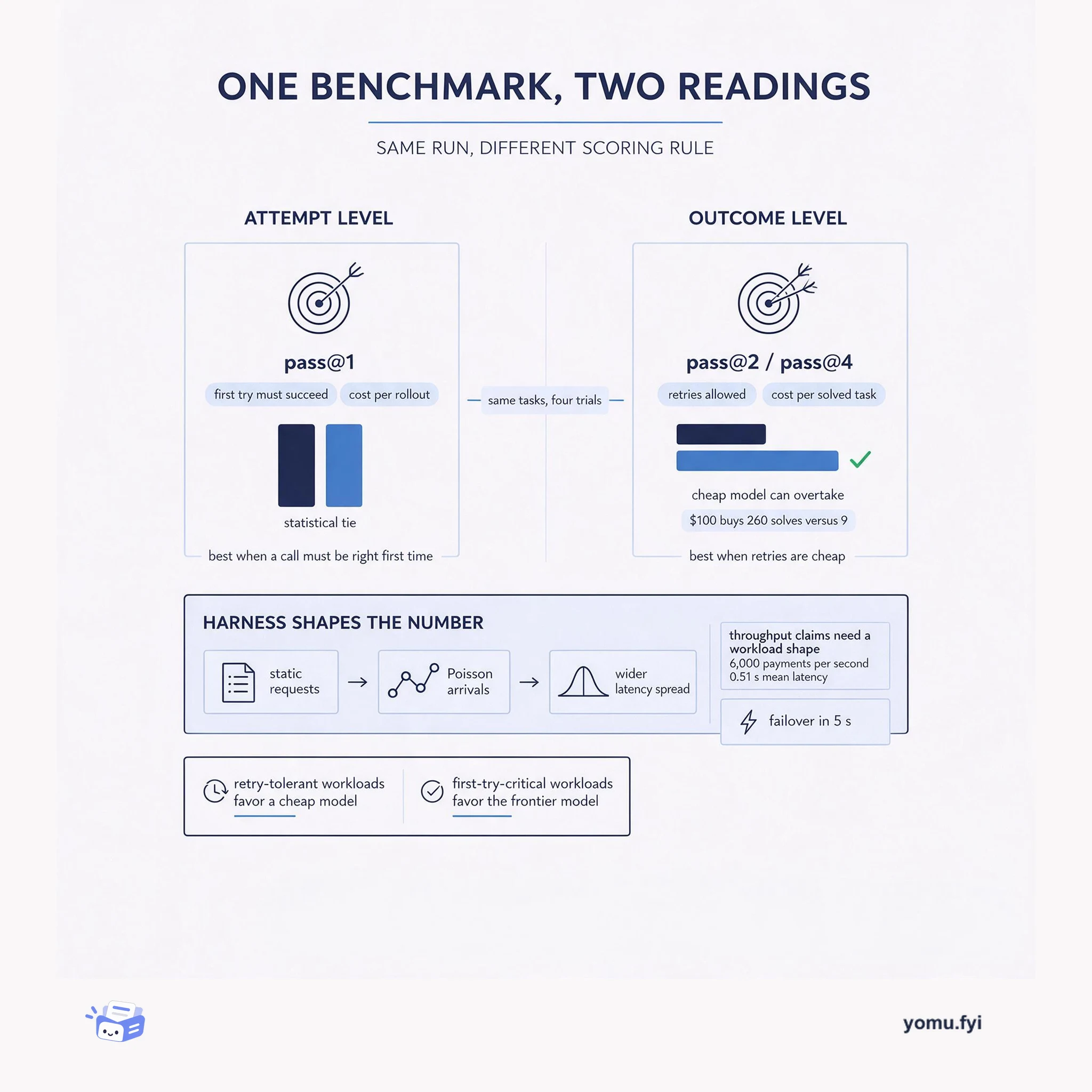
A benchmark can support two different verdicts: pass@1 on the first attempt, or pass@k with retries measured as cost per solved task. This comparison shows which reading matches your workload.
 Together AIBenchmark
GLM-5.3 and GPT-5.6 Sol were evaluated on 113 DeepSWE tasks with 904 rollouts, comparing accuracy, cost, and failure patterns. Sol edges ahead at pass@1 (72.7% vs 69.0%), but GLM-5.3 leads at pass@4 (87.6% vs 85.8%) at $3.99 per rollout, half Sol’s $8.37 cost and yielding 17 solves per $100 versus Sol’s 9. Their low per-task correlation of 0.43 makes a cascade effective: GLM-5.3 first, then Sol on test failure, achieving 85.9% solved at $6.61 per task. Sol runs faster (19 minutes, 61 steps vs 35 minutes, 124 steps) and achieves higher reliability (61 tasks solved all four tries vs 48), but it breaks passing tests in 20% of failures versus GLM-5.3’s 11%.
Run GLM-5.3 first and escalate to GPT-5.6 Sol only when the test suite rejects the answer. This cascade achieves 85.9% solved at $6.61 per task, which is cheaper than a single Sol rollout and beats a perfect one-shot oracle router.
GPT-5.6 Sol holds a narrow single-shot lead on DeepSWE (72.7% vs 69.0%), but GLM-5.3 performs better with multiple attempts, reaching 87.6% at four attempts (pass@4) at half the cost.
A cascade strategy that uses GLM-5.3 first and escalates to Sol only on test failure solves 85.9% of tasks for $6.61 per task, outperforming both the individual models and a perfect one-shot oracle router.
GLM-5.3 has a cleaner failure profile (11% regression rate vs Sol’s 20%) and excels at JavaScript and Rust, while Sol is faster, more reliable per attempt, and dominates protocol conformance and data modeling.
The cascade runs GLM-5.3 first and escalates to GPT-5.6 Sol only when the test suite rejects the answer. It achieves 85.9% solved tasks at $6.61 per task, cheaper than a single Sol rollout and beating a perfect one-shot oracle router.
Sol breaks the existing test suite in 20% of its failures, compared to 11% for GLM-5.3. GLM-5.3's failures are mostly near misses (61%) that leave the baseline intact, making it safer to accept without heavy regression gating.
Sol dominates protocol conformance (59%), data modeling and serialization (92%), build and ops tooling (73%), and concurrency (72%). GLM-5.3 excels at query and config languages (88%), language and runtime internals (83%), stateful reactivity (73%), program analysis, JavaScript (90%), and Rust (70%).
Summaries are generated from the original by a language model. Check the original before relying on it.
See the idea
A benchmark can support two different verdicts: pass@1 on the first attempt, or pass@k with retries measured as cost per solved task. This comparison shows which reading matches your workload.
Keep reading
The Good Stuff
Paid picks we use ourselves. Links carry a referral code — a subscription through one earns us a commission at no extra cost to you.
One useful email. Unsubscribe anytime.
