Change Management: Reversibility Sets the Gate
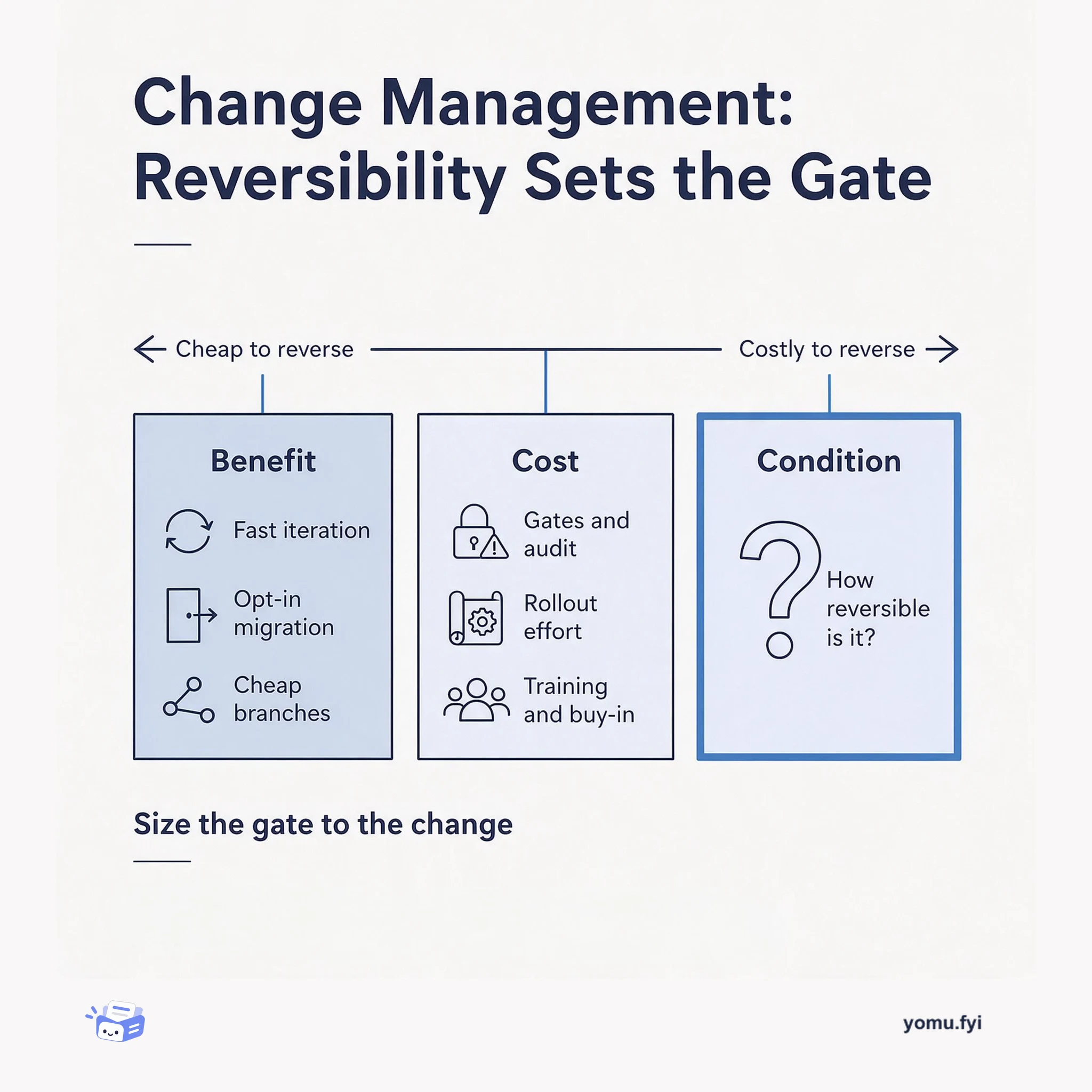
A trade-off map for change management: reversible changes can move fast with light gates, while irreversible ones need staged rollout, auditability, and adoption work.
 AWSTomislav LozančićProblem & solution
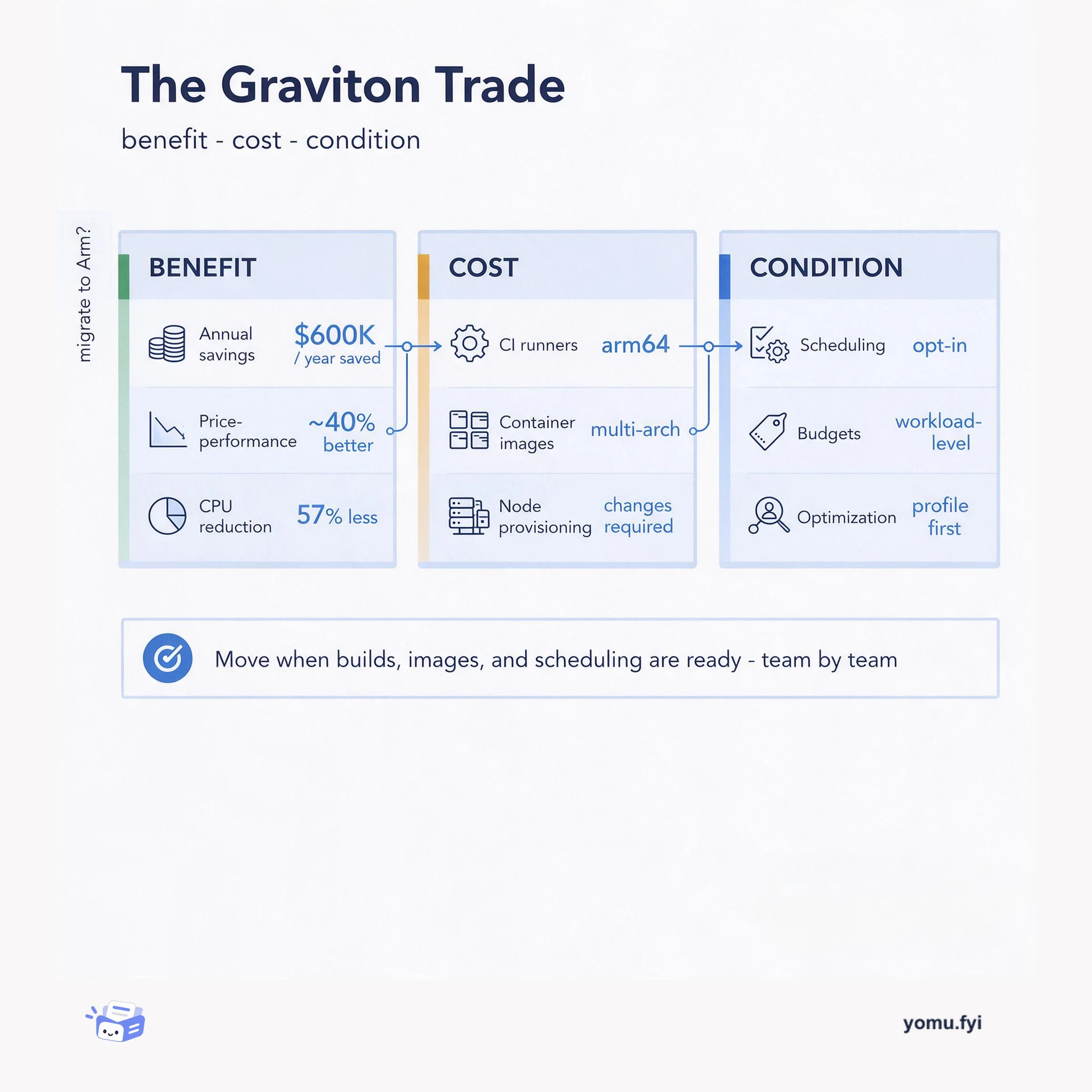
BMW Group’s Connected Vehicle platform, Orbit, powers digital services for more than 24.5 million vehicles worldwide. In 2024, the team began migrating from x86 to AWS Graviton Arm-based compute to advance economic and environmental goals. They adopted Karpenter for flexible node provisioning, extended GitHub Actions runners with Graviton for native arm64 builds, and used multi-architecture container images via manifest lists to support both architectures transparently. The migration achieved approximately $600,000 in annual infrastructure savings, a 40 percent price-performance improvement on the NGINX ingress controller, and a 57 percent reduction in CPU consumption while scaling efficiently during peak loads. Today, over 65 percent of the platform runs on Graviton, with an opt-in scheduling model using taints and tolerations that allows teams to migrate at their own pace without disruption.
BMW Connected Company migrated its Orbit connected vehicle platform from x86 to AWS Graviton Arm-based compute as part of a broader modernization strategy. The platform supports over 24.5 million vehicles, with more than 130,000 daily builds and deployments. The migration aimed to reduce costs, improve performance, and support sustainability goals.
The approach involved five stages: 1) Introducing Graviton-based CI/CD runners for native arm64 builds, 2) Implementing multi-architecture container images via Docker Buildx and OCI manifest lists, 3) Mirroring base images with Crane to preserve multi-arch support, 4) Creating dedicated Graviton node pools in Amazon EKS using Karpenter with taints and tolerations for opt-in scheduling, 5) Phased rollout starting with platform services (Karpenter, Prometheus) before application teams. Dual build pipelines and GitOps-based ArgoCD enabled quick rollback. Both native and emulated builds were supported.
Use taints, tolerations, and node selectors for opt-in scheduling so that only workloads explicitly ready for Arm migrate to Graviton nodes, preventing accidental disruption.
Build multi-architecture container images using OCI manifest lists so a single tag serves both arm64 and amd64 nodes transparently, simplifying deployment and instant rollback.
Validate the migration on platform services first (Karpenter, Prometheus, operational tooling) before enabling application teams; this identifies compatibility gaps and establishes rollback patterns.
The migration achieved approximately $600,000 in annualized infrastructure savings while maintaining the same workload profile.
They used dual build pipelines for multi-architecture images, taint-based opt-in scheduling with dedicated Graviton node pools, and GitOps-based ArgoCD for easy rollback. Workloads could fall back to x86 without image rebuilds.
Price-performance improved by roughly 40 percent, with CPU consumption decreasing by about 57 percent while maintaining the same ingress profile and scaling efficiently at peak loads.
Summaries are generated from the original by a language model. Check the original before relying on it.
See the idea
A trade-off map for change management: reversible changes can move fast with light gates, while irreversible ones need staged rollout, auditability, and adoption work.
AWS Graviton migration trades strong price-performance gains against real coordination costs. This map shows the benefit, the cost, and the conditions that decide when Arm adoption pays off.
Keep reading
The Good Stuff
Paid picks we use ourselves. Links carry a referral code — a subscription through one earns us a commission at no extra cost to you.
One useful email. Unsubscribe anytime.