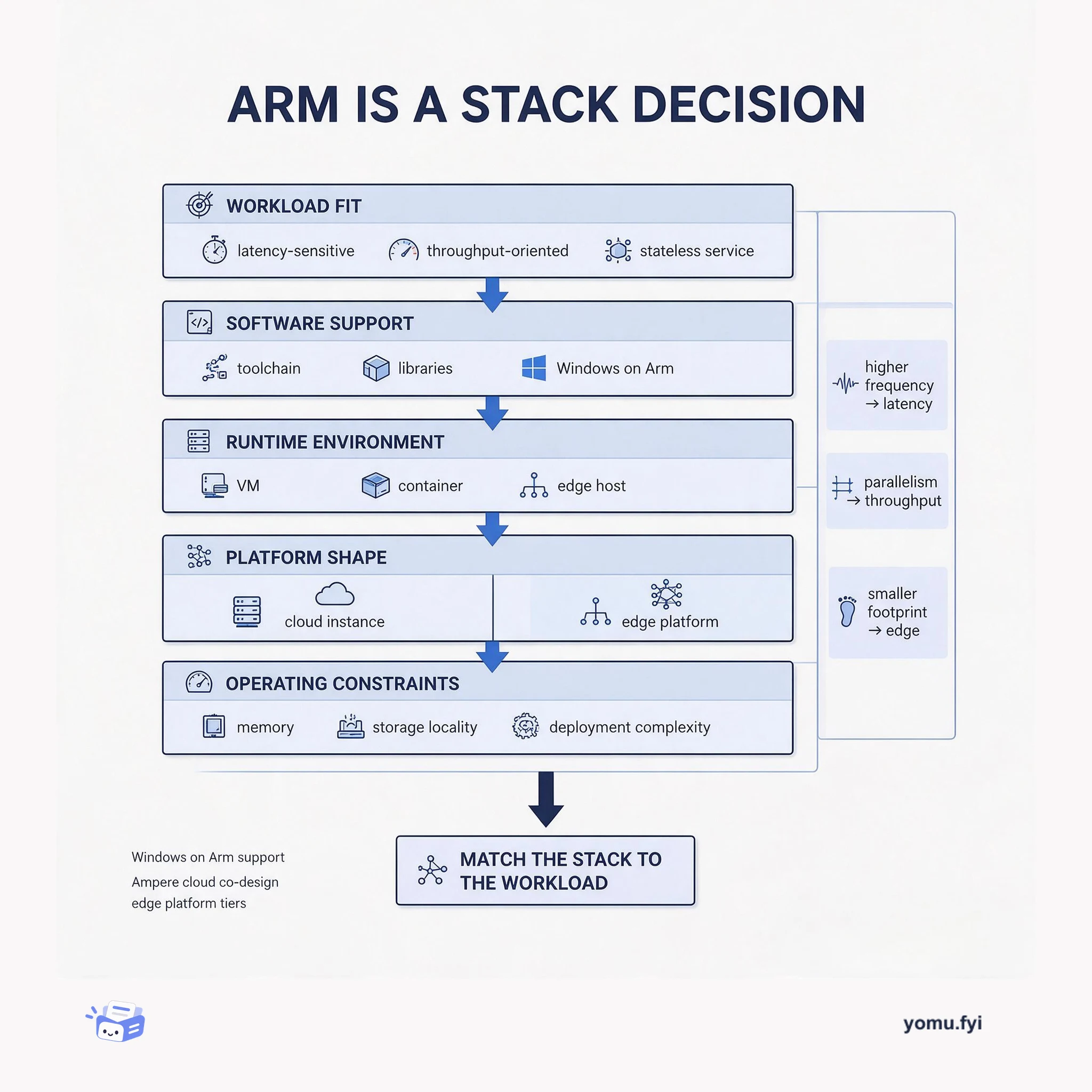
ARM Is a Stack Decision, Not a CPU Checkbox
An architecture view of ARM deployments, from workload fit and software support to platform choice, showing where performance, memory, storage, and operations shape the decision.
Loading…
Topic
2 posts about ARM. Every summary links to the original.
See the idea
An architecture view of ARM deployments, from workload fit and software support to platform choice, showing where performance, memory, storage, and operations shape the decision.
The Good Stuff
Paid picks we use ourselves. Links carry a referral code — a subscription through one earns us a commission at no extra cost to you.
Newest first
CUDA Toolkit 13.4 extends CUDA application support to Windows on Arm and provides preview support for NVIDIA Rubin (compute capability 107), alongside updates to GPU management, CUDA Python, CCCL, Nsight tools, and core math libraries. Multi-Process Service V3 adds a scriptable CLI, named server instances, namespaces, TOML configuration, streaming multiprocessor partition controls, and cgroup-integrated GPU memory limits for shared, containerized GPU workloads. CUDA Compute Fabric Transport lets communication-library developers address named NVLink endpoints and issue asynchronous put, get, and reduction operations without mapping every remote allocation into virtual address space; it is exposed only through the Driver API. The release also decouples driver installation from the toolkit, exposes locality and unified-memory residency queries, and changes coherent platforms to CDMM by default while retaining NUMA support.
Uber, Oracle Cloud Infrastructure, and Ampere co-optimized the OCI AmpereOne M A4 instance family after migrating large workloads from on-premises data centers to Arm-based cloud infrastructure. Early A1 and A2 deployments exposed dual-socket latency, Go performance degradation associated with smaller TLB and cache sizes, and insufficient single-thread performance for Gurobi services. Uber shared workload characteristics and targets that informed AmpereOne M silicon and an OCI FlexSKU, while the teams evaluated frequencies, core counts, deployment models, memory ratios, and storage. For latency-sensitive stateless services, the resulting guidance favors higher-frequency CPUs, about 8 GB per vCore, and virtual machines; throughput-oriented storage systems use parallelism, flexible memory-to-core ratios, and local NVMe or remote block storage according to locality. The collaboration is presented as improving price-performance and supporting energy-efficient, cost-optimized multi-architecture computing at scale.
The best engineering reads, once a week.


