Autonomous AI agents executing complex tasks over long time horizons introduce compounding risks as they access files, tools, and infrastructure. NVIDIA OpenShell is an open-source runtime that enforces deterministic governance outside the agent’s reach, treating workloads as untrusted and providing enforcement points for identity, authorization, and auditing. Its four components—Gateway, Supervisor, Sandbox, and Policy prover—manage sandbox lifecycles, check outbound requests, isolate workloads, and add formal verification. The reference architecture runs on NVIDIA Vera CPUs with 88 Olympus cores, Scalable Coherency Fabric, and LPDDR5X memory, delivering up to 2x performance on agentic workloads versus x86 and enabling over 11,000 concurrent sandboxes per rack. For additional protection, BlueField-4 DPUs and NVIDIA Sentry provide hardware-isolated monitoring and in-silicon policy enforcement within milliseconds.
Context
Autonomous AI agents executing complex tasks over long time horizons introduce compounding risks as they access files, tools, and infrastructure, requiring infrastructure-level security and governance.
Approach / What changed
The OpenShell Reference Architecture uses four components: Gateway, Supervisor, Sandbox, and Policy prover, running on NVIDIA Vera CPUs with optional hardware enforcement via BlueField-4 DPUs and NVIDIA Sentry.
Takeaways
1
OpenShell treats agent workloads as untrusted and enforces governance outside the agent’s reach through Gateway, Supervisor, Sandbox, and Policy prover components.
2
NVIDIA Vera CPUs deliver up to 2x performance on agentic workloads versus x86, with 88 Olympus cores, high-bandwidth fabric, and LPDDR5X memory, enabling over 11,000 concurrent sandboxes per rack.
3
For additional hardware-enforced protection, BlueField-4 DPUs and NVIDIA Sentry provide independent monitoring and in-silicon policy enforcement within milliseconds.
FAQ
How does OpenShell enforce governance without the agent's control?
OpenShell places authority outside the agent through four components: Gateway manages sandbox lifecycles, Supervisor checks outbound requests, Sandbox isolates workloads, and Policy prover adds formal verification. These run separately from the agent workload.
What hardware does the OpenShell reference architecture use?
It runs on NVIDIA Vera CPUs with 88 Olympus cores, Scalable Coherency Fabric, LPDDR5X memory, and PCIe Gen 6 I/O. For additional protection, it can use BlueField-4 DPUs and NVIDIA Sentry for hardware-isolated trust domains.
How much faster is Vera compared to x86 for agent workloads?
CoreWeave found Vera delivered 1.8x faster performance on Terminal Bench across real agentic loop tasks, and sandbox startup was more than 3x faster on Vera than on x86.
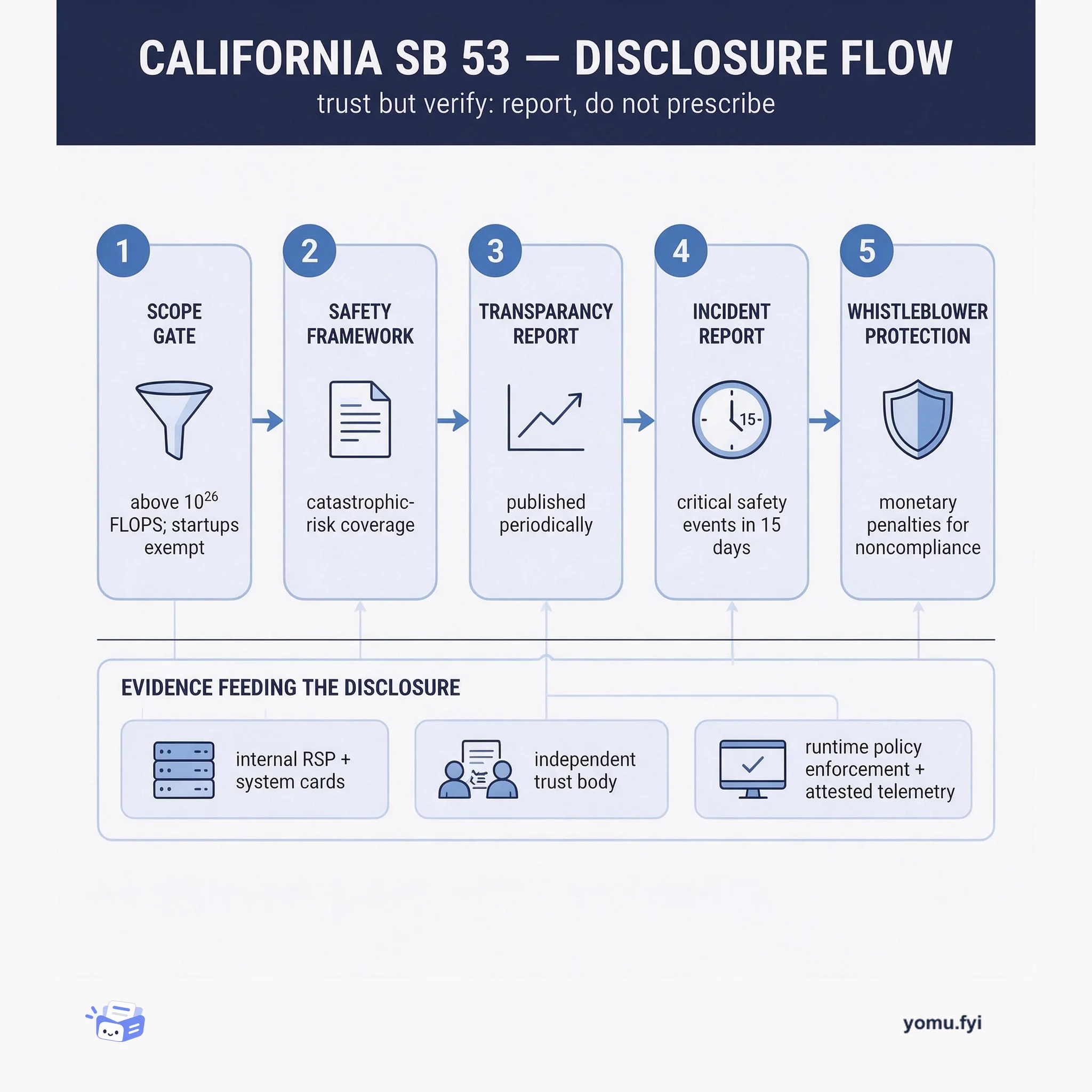
California's SB 53 is a trust-but-verify rule for frontier AI: large developers disclose rather than follow technical mandates. This flow maps the compute threshold, safety frameworks, transparency reports, and the 15-day incident clock.
Keep reading
Related reading
The Good Stuff
Paid picks we use ourselves. Links carry a referral code — a subscription through one earns us a commission at no extra cost to you.